Physics 5054/22 — May/June 2024
Cambridge O-Level · Theory · worked solutions for every part, with the mark scheme
Topics Kinematics · Current, Voltage and Resistance · Momentum · Mass, Weight and Density · Pressure · Thermal Properties of Matter · +11 more
Fig. 1.1 shows two trolleys. On the front of trolley A, there is a wooden rod. Trolley B is initially at rest.
As trolley A moves towards the right, the rod enters the modelling clay. Trolley A slows down and trolley B starts moving.
The trolleys then stick together and continue moving towards the right.
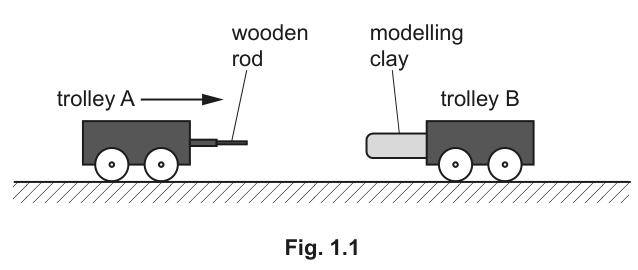
Fig. 1.2 shows the speed−time graph for the two trolleys.
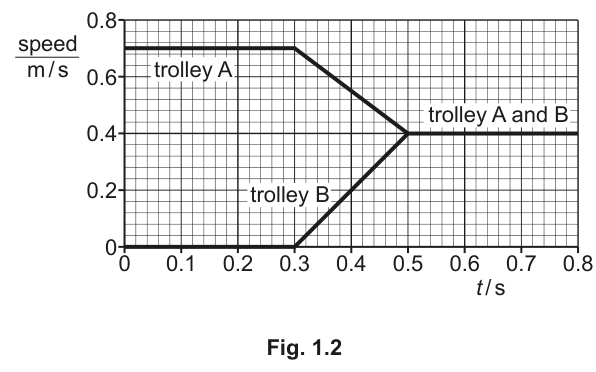
The trolleys start to collide at time . At , the trolleys are moving at the same speed.
State how Fig. 1.2 shows that, during the collision, trolley B has a uniform acceleration.
Answer
The line for trolley B is straight during the collision (from to ), which means its gradient (acceleration) is constant.
The line for trolley B is straight during the collision.
Walkthrough
A speed-time graph plots speed on the vertical axis and time on the horizontal axis. The gradient of this graph represents acceleration. If the line is straight, the gradient is constant, meaning the acceleration is uniform. In Fig. 1.2, the line for trolley B from to is a straight diagonal line, proving the acceleration is uniform.
Key Takeaways
- The gradient of a speed-time graph equals acceleration.
- A straight line on a speed-time graph indicates uniform (constant) acceleration.
Common Mistakes
- Saying 'the speed is constant' (that would be a horizontal line).
- Not referring specifically to the line being straight or the gradient being constant.
Things to Be Careful About
- Ensure you are looking at the correct trolley's line. Trolley A's line is also straight during the collision, but the question asks about trolley B.
Describe how the graph in Fig. 1.2 shows that the magnitude (size) of the acceleration of trolley B is larger than the magnitude of the deceleration of trolley A.
Answer
The line for trolley B is steeper than the line for trolley A, or trolley B has a larger change in speed in the same time interval.
The line for trolley B is steeper than the line for trolley A.
Walkthrough
The magnitude of acceleration is given by the steepness (gradient) of the line on a speed-time graph. Looking at Fig. 1.2 between and , the line for trolley B rises from to , while the line for trolley A falls from to . The line for trolley B is visually steeper, indicating a larger magnitude of acceleration.
Key Takeaways
- Steeper gradient on a speed-time graph means larger acceleration.
- You can compare accelerations by comparing the steepness of the lines or by comparing the change in speed over the same time interval.
Common Mistakes
- Saying 'trolley B has a larger speed' (speed and acceleration are different).
- Not mentioning 'steeper' or 'larger change in speed'.
Things to Be Careful About
- The question asks for the magnitude (size) of the acceleration, so direction does not matter. Just compare how steep the lines are.
Working
Acceleration is the gradient of the speed-time graph:
For trolley B, the speed changes from to between and :
Answer
acceleration = 2.0
Walkthrough
To find the acceleration at , we use the fact that the acceleration is uniform during the collision. We can calculate the gradient of the straight line for trolley B between and . The initial speed at , and the final speed at . The time interval . Substituting into gives .
Key Takeaways
- Acceleration can be calculated from the gradient of a speed-time graph: .
- For uniform acceleration, any two points on the straight line section can be used.
Common Mistakes
- Using the wrong time interval (e.g., instead of ).
- Forgetting to divide by the time interval.
Things to Be Careful About
- Ensure units are correct: speed in and time in , giving acceleration in . Give the answer to 2 significant figures as indicated by the graph readings.
The mass of trolley A = . The mass of trolley B = .
Show that momentum is conserved in the collision.
Working
Initial momentum (before collision):
Trolley A is moving at , trolley B is at rest ().
Final momentum (after collision):
Both trolleys move together at .
Answer
Initial momentum = and final momentum = . Since they are equal, momentum is conserved.
Walkthrough
The principle of conservation of momentum states that the total momentum before a collision equals the total momentum after, provided no external forces act. From Fig. 1.2, the initial speed of trolley A is and trolley B is . The final combined speed is . Calculate the total initial momentum: . Calculate the total final momentum: . The values match, showing conservation.
Key Takeaways
- Momentum .
- Total momentum before collision = total momentum after collision.
- When objects stick together, use the combined mass for the final momentum.
Common Mistakes
- Forgetting to add the masses of both trolleys for the final momentum.
- Using the wrong speed from the graph (e.g., using for the final speed).
Things to Be Careful About
- Units for momentum are . Ensure masses are in kg and speeds in m/s. The question asks to 'show that', so both calculations must be clearly presented.
In another collision between the same trolleys, the rod and modelling clay are not present. Trolley A hits trolley B with the same initial speed.
Explain why the force between the trolleys is larger in this collision.
Answer
- The collision is more rigid (or less pliable), which decreases the time of contact between the trolleys.
- Force is the rate of change of momentum (). For the same change in momentum (impulse), a shorter time of contact results in a larger force.
(Alternatively: The final velocity of B will be larger and A smaller, meaning a larger change in momentum, and the shorter contact time further increases the force.)
Walkthrough
In the first collision, the wooden rod enters the modelling clay, which deforms. This deformation acts as a crumple zone, increasing the time over which the collision occurs and reducing the peak force. If the rod and clay are removed, the trolleys collide more rigidly (like two hard blocks). This decreases the time of contact . Since force equals the rate of change of momentum ( or ), a shorter time for the same change in momentum results in a larger force. Additionally, without the clay to absorb energy, the collision is more elastic, meaning the change in velocity (and thus momentum) for each trolley is larger, which also increases the force.
Key Takeaways
- Deformable materials (like clay) increase the time of contact during a collision.
- Force is the rate of change of momentum: .
- Increasing the time of contact reduces the average force (this is the principle behind crumple zones in cars).
Common Mistakes
- Saying 'the mass is larger' (mass doesn't change).
- Not linking the rigid collision to a shorter time of contact.
- Saying 'there is more momentum' (momentum is conserved, the change in momentum or the time changes).
Things to Be Careful About
- The question asks to 'explain why', so a two-link chain is needed: rigid collision -> shorter time -> larger force. Or: rigid collision -> larger change in velocity -> larger change in momentum -> larger force. Any two of these logical links earn the marks.
Fig. 2.1 shows a small swimming pool containing water.
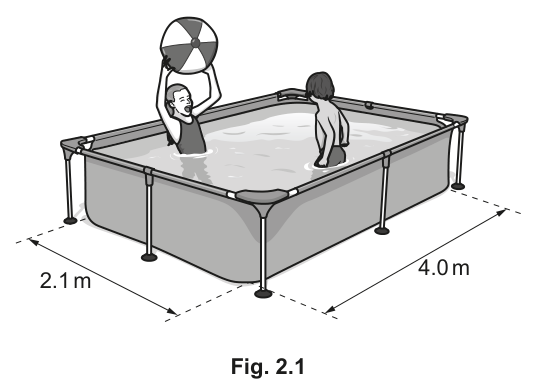
The depth of water in the pool is . The density of water is .
Working
Rounding to two significant figures gives approximately .
Answer
Mass =
6720 kg (approximately 6700 kg)
Walkthrough
First, calculate the volume of water in the pool. The pool is a rectangular prism, so its volume is length × width × depth:
Next, use the density formula , rearranged to , to find the mass:
The question asks to show the mass is approximately , which matches rounded to two significant figures.
Key Takeaways
- The volume of a rectangular container is found by multiplying its three dimensions.
- Mass can be calculated from density and volume using .
Common Mistakes
- Forgetting to include the depth () when calculating volume, using only length and width.
- Using the wrong units for density or dimensions.
Things to Be Careful About
- Ensure all dimensions are in metres before calculating volume, as density is given in .
- The question asks to show the mass is approximately , so rounding to two significant figures is expected.
Answer
Pressure is defined as the force acting per unit area of a surface.
Answer
force per unit area
force per unit area
Walkthrough
Pressure is a fundamental quantity in physics defined as the normal force applied per unit area over which that force is distributed. The mathematical definition is .
Key Takeaways
- Pressure is not just force; it depends on the area over which the force is spread.
- The standard SI unit for pressure is the pascal (Pa), which is equivalent to .
Common Mistakes
- Defining pressure as simply "force" without mentioning area.
- Confusing pressure with force or stress.
Things to Be Careful About
- Use the exact phrasing "force per unit area" as this is the standard definition credited in mark schemes.
Working
The pressure at the base of a liquid column is given by:
where:
- (density of water)
- (gravitational field strength)
- (depth of water)
(Rounded to two significant figures, this is .)
Answer
pressure =
7840 Pa
Walkthrough
The pressure exerted by a liquid at a given depth depends on the depth, the density of the liquid, and the gravitational field strength. The formula is .
Substitute the given values:
Alternatively, you could calculate the weight of the water () and divide by the area of the base ():
Both methods yield the same result. The mark scheme accepts (rounded to 2 s.f.) or .
Key Takeaways
- Liquid pressure depends only on depth, density, and , not on the shape or total volume of the container.
- is derived from where .
Common Mistakes
- Using the total mass of the water instead of density in the formula.
- Forgetting to convert units or using the wrong value for (e.g., using gives , which may not match the expected answer if is required).
Things to Be Careful About
- The mark scheme specifically lists as the accepted answer, implying and rounding to 2 significant figures. Always check which value of is expected in your exam series.
The water in the pool is initially at a temperature of .
The temperature rises when of energy is transferred to the water.
The specific heat capacity of water is .
Calculate the final temperature of the water.
temperature = ______
Working
The energy transferred to heat the water is given by:
Rearranging for the temperature change :
Substitute the values ( from part a(i)):
The final temperature is the initial temperature plus the temperature change:
Answer
temperature =
28 °C
Walkthrough
First, identify the known quantities:
- Energy transferred,
- Mass of water, (from part a(i))
- Specific heat capacity of water,
- Initial temperature,
Use the specific heat capacity equation to find the temperature rise :
Calculate the denominator:
Now divide:
Round to a sensible number of significant figures (2 s.f. based on the given data): .
Finally, add this temperature change to the initial temperature to find the final temperature:
Key Takeaways
- The specific heat capacity equation can be rearranged to find any one of the four variables.
- Always remember to add the temperature change to the initial temperature to get the final temperature; a common error is to stop at .
Common Mistakes
- Using instead of the more precise from part (a), leading to a slightly different .
- Forgetting to add the initial and answering instead of .
- Arithmetic errors when dividing large numbers like .
Things to Be Careful About
- Carry forward the unrounded mass value () from part (a) to avoid compounding rounding errors.
- Pay attention to significant figures; the energy is given to 2 s.f. (), so the final answer should logically be to 2 s.f. ().
Answer
Evaporation occurs when the fastest-moving (most energetic) particles at the surface of the liquid have enough kinetic energy to overcome the forces of attraction and escape into the air. This leaves behind the slower-moving (less energetic) particles, which lowers the average kinetic energy of the remaining liquid. Since temperature is a measure of average kinetic energy, the temperature of the liquid decreases, causing cooling.
Answer
The fastest/most energetic particles escape, leaving the slower/less energetic particles behind, which lowers the average kinetic energy.
The fastest/most energetic particles escape, leaving the slower/less energetic particles behind, which lowers the average kinetic energy.
Walkthrough
To explain evaporation and cooling in terms of the particle model, we need to describe what happens to the particles during the process:
- Particle energy distribution: In any liquid, the particles have a range of kinetic energies. Some are moving fast (high energy) and some are moving slow (low energy).
- Escape: Evaporation happens at the surface. Only the particles with the highest kinetic energy (the fastest-moving ones) have enough energy to break the intermolecular forces of attraction holding them in the liquid and escape into the air as gas.
- Cooling effect: When these high-energy particles leave, the average kinetic energy of the particles left behind in the liquid is lower. Since temperature is directly proportional to the average kinetic energy of the particles, the temperature of the liquid drops. This is why evaporation causes cooling.
Key Takeaways
- Evaporation is a surface phenomenon that depends on the energy distribution of particles.
- Cooling occurs because the highest-energy particles are removed, lowering the average energy of the remaining liquid.
Common Mistakes
- Saying "the particles lose energy" without specifying that it is the fastest or most energetic particles that escape.
- Using the word "heat" instead of "kinetic energy" or "thermal energy" when describing what is lost.
- Confusing evaporation with boiling (boiling happens throughout the liquid at a fixed temperature, evaporation happens at the surface at any temperature).
Things to Be Careful About
- The question specifically asks for the explanation "in terms of the movement of particles". You must mention particle speed or energy.
- Both marks are awarded for separate points: (1) fastest/most energetic particles escape, and (2) leaving slower/less energetic particles. Ensure both are stated clearly.
Changes to factors in the environment of the swimming pool can cause an increase or decrease in the amount of evaporation from the surface of the water.
State two changes to environmental factors that increase the amount of evaporation from the surface of the water.
- ______
- ______
Answer
Two changes to environmental factors that increase the amount of evaporation:
- Higher temperature
- Increased wind speed (or lower humidity / drier air)
Answer
- Higher temperature
- Increased wind speed
- Higher temperature, 2. Increased wind speed (or lower humidity)
Walkthrough
The rate of evaporation from a liquid surface depends on several environmental factors. To increase evaporation, you can:
- Increase the temperature: Higher temperatures mean the particles in the liquid have more average kinetic energy, so more particles will have the minimum energy required to escape.
- Increase wind speed: Wind blows away the water vapour molecules that have just evaporated from the surface. This keeps the concentration of water vapour near the surface low, allowing more particles to escape (the rate of condensation back into the liquid is reduced).
- Decrease humidity (lower water vapour concentration in the air): Similar to wind, drier air means a lower concentration of water vapour, increasing the net rate of evaporation.
- Increase the surface area: Though not strictly an "environmental factor" of the air, a larger surface area allows more particles to escape at once.
The mark scheme accepts any two from: higher temperature, wind, low humidity.
Key Takeaways
- Evaporation rate is influenced by temperature, air movement (wind), and humidity.
- All these factors affect the balance between the rate of evaporation and the rate of condensation at the surface.
Common Mistakes
- Giving factors that affect boiling (like atmospheric pressure) instead of evaporation.
- Saying "increase the pressure" which would actually decrease evaporation.
Things to Be Careful About
- The question asks for changes to environmental factors in the surroundings of the pool. Factors like "using a heater" are methods, not the environmental factor itself; the factor is "higher temperature".
- Only two factors are required; providing more will not gain extra marks but may introduce errors.
Fig. 3.1 shows a solar-powered charger connected to a cell phone (mobile phone).
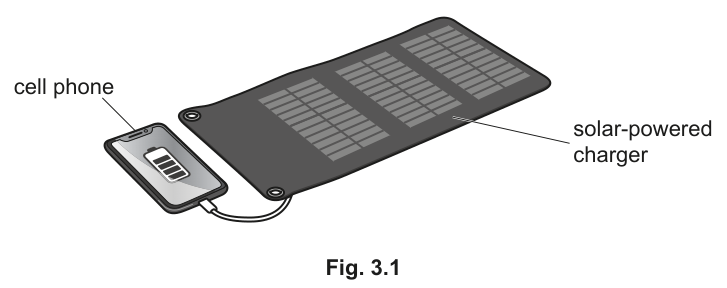
The battery inside the cell phone is charged by the solar-powered charger.
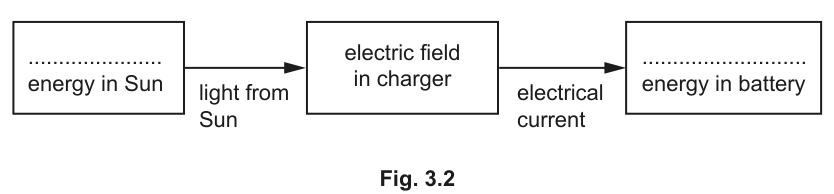
Answer
First box (energy in Sun): nuclear
Third box (energy in battery): chemical
nuclear; chemical
Walkthrough
The question asks to complete an energy transfer diagram showing the useful flow of energy from the Sun to the phone battery. Energy is stored in different ways depending on the object. The Sun produces energy through nuclear fusion in its core, so the energy store in the Sun is nuclear. The energy is transferred by light (electromagnetic radiation) to the solar panel, which converts it into electrical energy. This electrical energy is then transferred to the phone battery, where it is stored as chemical energy ready to be used later. We simply fill in these two missing store names in the diagram.
Key Takeaways
Energy is stored in specific ways: nuclear in stars, chemical in batteries. Energy transfers between stores via light, electrical currents, heating, or mechanical work. Always name the store, not the transfer mechanism.
Common Mistakes
- Writing 'solar' or 'light' for the energy store in the Sun. 'Solar' is not a standard energy store in the 5054 syllabus; the correct store is nuclear.
- Writing 'electricity' or 'electrical' for the energy store in the battery. The battery stores energy chemically; the electrical current is the transfer mechanism, not the store.
Things to Be Careful About
The diagram distinguishes between energy stores (inside the boxes) and energy transfers (on the arrows). 'Light from Sun' and 'electrical current' are transfers; 'nuclear' and 'chemical' are stores. Do not mix them up.
Answer
On a cloudy day, less light (energy) from the Sun reaches the solar panel. This means the solar panel produces less electrical current, so the battery charges more slowly.
Less light energy reaches the charger, producing less electrical current.
Walkthrough
The solar-powered charger converts light energy from the Sun into electrical energy. The rate at which it does this (its power output) depends on the intensity of the light hitting the panel. Clouds block and scatter sunlight, so less light energy reaches the solar panel. With less input energy, the charger produces a smaller electrical current. Since current is the rate of flow of charge (and thus the rate at which energy is transferred to the battery), a smaller current means the battery takes longer to charge.
Key Takeaways
The power output of a solar panel depends on the intensity of incident light. Reduced light input directly reduces the electrical current produced, slowing down the charging process.
Common Mistakes
- Saying 'there is no energy on a cloudy day'. There is still some energy, just less. Use 'less light' or 'reduced light', not 'no light'.
- Forgetting to link the reduced light to the reduced current. The mark scheme requires the chain: less light -> less current -> slower charging.
Things to Be Careful About
Be precise with wording. 'Less light energy' or 'less light reaching the panel' is acceptable. Simply saying 'it is cloudy' is not enough; you must explain the physical consequence (less energy/current).
After use, the outside surface of the cell phone is warm. When switched off, the cell phone cools down.
Name and describe the three processes by which thermal energy is transferred as the cell phone cools down.
- ______
- ______
- ______
Answer
- Conduction: Thermal energy is transferred through the solid phone case by vibrating particles passing energy to neighbouring particles.
- Convection: Thermal energy is transferred to the surrounding air, which becomes less dense and rises, carrying energy away.
- Radiation: Infrared radiation is emitted from the warm surface of the phone into the surroundings.
Conduction, convection, and radiation with descriptions of particle transfer, rising hot air, and infrared emission.
Walkthrough
When a warm object cools down in air, thermal energy is transferred to the surroundings by three mechanisms. The question asks to name and describe each.
- Conduction: The phone case is a solid. The warm particles in the solid vibrate and collide with neighbouring particles, passing kinetic energy along. At the surface, these particles also collide with air particles, transferring energy to them. This is conduction.
- Convection: The air particles in contact with the warm phone surface are heated. As they gain kinetic energy, they spread out and become less dense. This warm, less dense air rises, and cooler, denser air moves in to replace it. This creates a convection current that carries thermal energy away from the phone.
- Radiation: All objects emit infrared radiation. The warmer the object, the more it emits. The warm surface of the phone emits infrared waves that travel through space (and air) and are absorbed by cooler surrounding objects. This is thermal radiation.
Key Takeaways
Cooling by conduction requires direct contact (particle collisions in solids or at solid-gas boundaries). Cooling by convection requires a fluid (air or liquid) to move and carry energy away. Cooling by radiation requires no medium and involves infrared emission from all surfaces.
Common Mistakes
- Using the word 'heat' instead of 'thermal energy'. The 5054 syllabus prefers 'thermal energy' for the quantity being transferred.
- Describing convection as 'hot air rising' without mentioning the density change or the cycle of cooler air replacing it. A complete description needs 'hot air rises' and 'cooler air moves in'.
- Saying radiation is 'heat waves'. The correct term is 'infrared radiation' or 'infrared waves'.
Things to Be Careful About
The question asks to 'name and describe'. Simply naming the three processes (conduction, convection, radiation) is not enough; you must provide a one-sentence physical description for each to earn the marks. Ensure your descriptions are specific to the scenario (e.g., mention the solid phone case for conduction, and the surrounding air for convection).
It takes 4.5 hours to charge the battery with an average current of .
Calculate the quantity of charge that enters the battery. Give the unit of your answer.
charge = ______ unit ______
Working
Convert the given values to standard SI units:
Substitute into the equation:
(4900 C is also accepted if rounded to 2 significant figures).
Answer
charge = 4860 unit C (or coulomb)
4860 C
Walkthrough
The question asks for the quantity of charge that enters the battery. We are given the average current and the time . The relationship between charge, current, and time is:
Before substituting, we must convert the values to standard SI units (amperes for current, seconds for time) so the answer comes out in coulombs.
- Convert current: .
- Convert time: .
- Calculate charge: .
The mark scheme accepts 4900 C, which is 4860 rounded to 2 significant figures (matching the 2 s.f. in 4.5 hours). Both 4860 and 4900 are correct; 4860 is the exact calculated value.
Key Takeaways
Always convert units to SI before substituting into equations. and . The unit of charge is the coulomb (C).
Common Mistakes
- Forgetting to convert mA to A. Using instead of gives an answer times too large ().
- Forgetting to convert hours to seconds. Using directly gives , which is incorrect.
- Writing the unit as 'A' or 'A s' instead of 'C' or 'coulomb'. The question explicitly asks for the unit, and it must be stated.
Things to Be Careful About
The question has two blanks: 'charge = ______ unit ______'. You must provide both the numerical value and the unit. Missing the unit costs a mark. Pay attention to significant figures; 4860 has 3 or 4 s.f., while 4.5 has 2 s.f. Rounding to 2 s.f. gives 4900, which is acceptable, but the exact value 4860 is safer and fully correct.
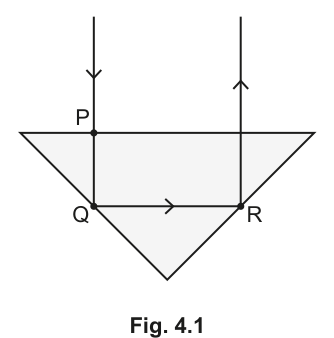
Fig. 4.1 shows light passing through a triangular glass prism.
Answer
0
0
Walkthrough
The light ray enters the glass at point P normally, meaning it is perpendicular to the top surface. The angle of incidence is defined as the angle between the incident ray and the normal to the surface at the point of incidence. Since the ray and the normal are the same line, the angle between them is 0 degrees.
Key Takeaways
The angle of incidence is always measured between the ray and the normal, never between the ray and the surface. When a ray enters a medium normally (perpendicularly), the angle of incidence is 0 and the ray does not bend.
Common Mistakes
Writing 90 degrees by measuring the angle between the ray and the surface instead of the normal. Remember: angle of incidence = angle with the normal.
Things to Be Careful About
Always draw the normal first as a dashed line perpendicular to the surface. Measure the angle from this normal.
Answer
Normal drawn perpendicular to the right-hand face at R; angle between normal and ray QR labelled as angle of incidence.
Walkthrough
At point R, the light ray QR is travelling horizontally and hits the right-hand sloped face of the prism. To find the angle of incidence, we must first draw the normal: a dashed line perpendicular to the surface at point R, pointing outwards. The angle of incidence is the angle between this normal and the incoming ray QR. This angle must be clearly marked with an arc and labelled 'angle of incidence' or ''.
Key Takeaways
The normal is always drawn perpendicular to the surface at the point where the ray hits. The angle of incidence is always between the normal and the incident ray.
Common Mistakes
Drawing the normal parallel to the face instead of perpendicular. Labeling the angle between the ray and the surface as the angle of incidence.
Things to Be Careful About
Use a ruler and set square to ensure the normal is exactly perpendicular to the sloped face. The angle of incidence at R is actually 45 degrees, but the question only asks you to draw and label it, not calculate the value.
State two conditions needed so that no light refracts from the glass into the air at point Q.
- ______
- ______
Answer
- Light is travelling from a more dense medium (higher refractive index) to a less dense medium (lower refractive index).
- The angle of incidence is greater than the critical angle.
Light must travel from a more dense to a less dense medium, and the angle of incidence must be greater than the critical angle.
Walkthrough
For total internal reflection to occur at point Q (or R), two conditions must be met simultaneously. First, the light must be travelling from a medium with a higher refractive index (more optically dense, like glass) into a medium with a lower refractive index (less optically dense, like air). Second, the angle at which the light hits the boundary (the angle of incidence) must be greater than the critical angle for that pair of media. If both conditions are met, all the light is reflected back into the denser medium and none is refracted out.
Key Takeaways
Total internal reflection requires: (1) travel from higher to lower refractive index, and (2) angle of incidence > critical angle. Both conditions are necessary.
Common Mistakes
Stating only one condition. Saying 'the angle is large' without referencing the critical angle. Saying 'from glass to air' is acceptable, but the general principle 'from more dense to less dense' is preferred.
Things to Be Careful About
Ensure you mention the direction of travel. If light travels from air into glass, total internal reflection cannot happen regardless of the angle.
Information is sent across the internet using pulses of visible light through long, thin glass fibres and electrical signals through copper wires.
State the name of one other type of electromagnetic radiation used to transmit information through long, thin glass fibres.
Answer
Infrared
Infrared
Walkthrough
Optical fibres can transmit information using pulses of visible light, but infrared radiation is also widely used because it experiences less attenuation (signal loss) in glass fibres over long distances.
Key Takeaways
Infrared radiation is commonly used in optical fibre communications alongside visible light.
Common Mistakes
Saying 'ultraviolet' or 'microwaves'. Microwaves are used in wireless communications (satellites, mobile phones), not typically in glass fibres.
Things to Be Careful About
The question asks for a type of electromagnetic radiation, so ensure you name a region of the spectrum (infrared), not a device or application.
Suggest two advantages of using glass fibres rather than copper wires to transmit information from the internet.
- ______
- ______
Answer
- Greater bandwidth (more calls/data per second) or faster speed.
- Less interference (or less noise, or less attenuation, or thinner/lighter, or more secure against hacking).
Greater bandwidth/faster speed and less interference/less attenuation.
Walkthrough
Glass fibres (optical fibres) offer several advantages over copper wires for transmitting internet data:
- Bandwidth/Speed: Light has a much higher frequency than electrical signals, allowing more data to be transmitted per second (greater bandwidth).
- Interference: Light signals are not affected by electromagnetic interference from nearby power cables or other signals, unlike electrical signals in copper wires.
- Attenuation: Light signals lose less energy over distance, so they can travel longer distances before needing to be boosted.
- Physical properties: Optical fibres are thinner, lighter, and use less raw material than thick copper cables.
- Security: It is harder to tap into an optical fibre without breaking the signal, making it more secure.
Any two of these points earn full marks.
Key Takeaways
Optical fibres provide higher bandwidth, less interference, less signal loss over distance, and are physically lighter and thinner than copper wires.
Common Mistakes
Saying 'light is faster than electricity' as a general statement without context; the speed in the medium is actually slower, but the data rate (bandwidth) is higher. Saying 'it is cheaper' is not always true and is not a standard mark scheme point.
Things to Be Careful About
Be specific. 'Less interference' is better than 'better quality'. 'Less attenuation' is better than 'goes further' (though 'longer transmission distances' is also accepted).
An initially uncharged rubber balloon is rubbed with a woollen cloth as shown in Fig. 5.1.
Rubbing the balloon causes the balloon to have a negative charge.
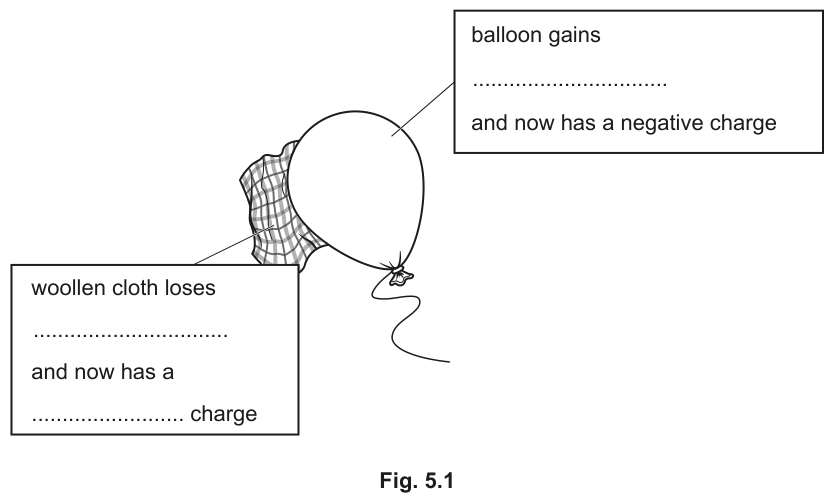
Answer
- woollen cloth loses electrons
- balloon gains electrons
- woollen cloth now has a positive charge
electrons; positive
Walkthrough
When two different materials are rubbed together, electrons can be transferred from one material to the other. The material that gains electrons becomes negatively charged, and the material that loses electrons becomes positively charged. Since the balloon is stated to have a negative charge, it must have gained electrons. Therefore, the woollen cloth must have lost electrons. Losing negatively charged electrons leaves the woollen cloth with a net positive charge.
Key Takeaways
Frictional charging involves the transfer of electrons, not protons. The object gaining electrons becomes negative; the object losing electrons becomes positive.
Common Mistakes
- Stating that 'protons' are transferred. Protons are bound in the nucleus and do not move during ordinary frictional charging.
- Saying the cloth becomes 'neutral' or 'uncharged'. Losing electrons creates a positive charge.
Things to Be Careful About
Ensure the blanks are filled in the correct boxes. The top blank in both boxes is 'electrons'. The bottom blank on the cloth box is 'positive'.
Answer
- Rubber (and the air inside) is an insulator.
- The electrons (or charge) are unable to move through the rubber or the air, so the charge stays on the balloon.
- (Little ionisation in the air caused by background radiation also means charge cannot easily leak away.)
Rubber and air are insulators, so electrons cannot move through them to leave the balloon.
Walkthrough
For a static charge to dissipate, the charged particles (electrons) must be able to move away from the object. In conductors (like metals), electrons are free to move throughout the material and can easily flow to the ground or through the air if ionised. Rubber is a classic insulator; its electrons are tightly bound to their atoms and cannot move freely through the material. Additionally, the air inside and around the balloon is also an insulator under normal conditions, meaning there are very few free ions to carry charge away. (Background radiation causes slight ionisation in air, but it is insufficient to discharge the balloon quickly.) Because neither the rubber nor the air allows charge to flow, the negative charge remains trapped on the balloon for a long time.
Key Takeaways
Insulators hold static charge because charge carriers cannot move through them. Conductors allow charge to flow and dissipate.
Common Mistakes
- Saying 'heat' or 'current' cannot flow. We are talking about static charge/electrons.
- Forgetting to mention that the material is an insulator. Just saying 'electrons can't move' is not enough; you must identify the material property.
Things to Be Careful About
The mark scheme accepts 'little ionisation in air' as an alternative or additional point. Ensure you mention that the charge/electrons cannot move through the material.
Rubbing the balloon causes the temperature of the air inside it to rise.
Explain, in terms of the particles of air, why the volume of the balloon increases when the temperature of the air rises.
Answer
- As the temperature rises, the air particles move faster (they have more kinetic energy).
- The faster particles hit the sides of the balloon more frequently and/or with greater force.
- This increases the pressure inside the balloon, causing the volume to increase (the balloon expands) until the internal pressure balances the external pressure and the tension of the rubber.
Particles move faster, hitting the sides more often and with greater force, increasing the pressure and expanding the balloon.
Walkthrough
Temperature is a measure of the average kinetic energy of the particles in a substance. When the air inside the balloon is heated (e.g., by the friction of rubbing), the temperature rises, meaning the air particles move faster.
As the particles move faster, two things happen when they collide with the inner walls of the balloon:
- They hit the walls more frequently because they are covering the distance between collisions more quickly.
- They hit the walls with greater force because they have more momentum and undergo a larger change in momentum upon collision.
Both of these effects increase the pressure exerted by the gas on the inside of the balloon. Since the balloon is flexible, this increased internal pressure pushes the walls outward, causing the volume of the balloon to increase (it expands) until the internal pressure is balanced by the external atmospheric pressure and the inward pull of the stretched rubber.
Key Takeaways
Increasing temperature increases particle speed. Faster particles collide with container walls more often and with greater force, increasing pressure. If the container is flexible, it will expand.
Common Mistakes
- Saying 'particles expand'. Particles themselves do not change size; the space between them or the container volume changes.
- Forgetting to link the increased collision force/frequency to an increase in pressure, and then to the expansion of the balloon.
- Stating that particles 'push harder' without mentioning frequency or force of collision.
Things to Be Careful About
The question specifically asks to explain 'in terms of the particles of air'. You must mention particle speed, collisions with the sides, and frequency/force of those collisions. The mark scheme awards marks for: particles move faster (B1), particles hit sides (C1), particles hit sides more often or with greater force (A1).
Fig. 6.1 shows a circuit diagram containing a battery, a light-dependent resistor (LDR) and a fixed resistor of resistance connected in series.
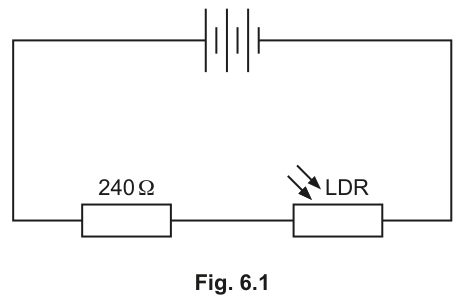
There is a lamp near the circuit. Light from the lamp is incident on the LDR when the lamp is switched on.
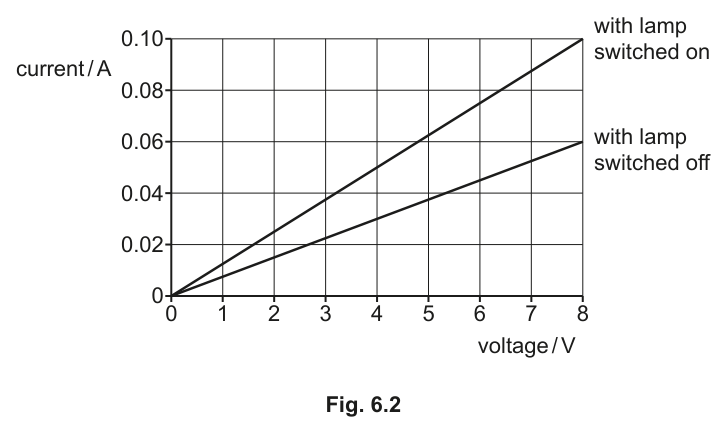
Fig. 6.2 shows the current−voltage graph for the LDR with the lamp switched on and with the lamp switched off.
Answer
Current is directly proportional to potential difference across it, at constant temperature.
Current is directly proportional to potential difference at constant temperature
Walkthrough
Ohm's law is a fundamental principle in electricity. To state it fully for 2 marks, two conditions must be given: the relationship between current and potential difference, and the constraint under which this relationship holds. The first mark is awarded for stating that current is directly proportional to potential difference (or voltage). The second mark is awarded for specifying that this is true at a constant temperature. Omitting the temperature condition is a common mistake, as resistance changes with temperature, breaking the linear relationship.
Key Takeaways
Ohm's law states that the current through a conductor is directly proportional to the potential difference across it, provided the temperature remains constant. Both the proportionality and the temperature condition are required for full marks.
Common Mistakes
- Stating only "current is proportional to voltage" without mentioning constant temperature. This loses a mark.
- Using the word "heat" instead of "temperature". The mark scheme specifically requires constant temperature.
- Saying "resistance is constant" instead of "at constant temperature". While related, these are not the same statement.
Things to Be Careful About
Always include the condition "at constant temperature" or "at constant physical conditions". In a series circuit with an LDR, the temperature of the LDR may change slightly with current, but for the purpose of stating the law, the constant temperature condition is the standard requirement.
Answer
The graph is a straight line passing through the origin, which shows that current is directly proportional to voltage.
The graph is a straight line through the origin
Walkthrough
Ohm's law predicts a linear relationship between current and voltage, passing through the origin (0,0). On a current-voltage graph, this appears as a straight line starting from the origin. The question asks how the graph lines in Fig. 6.2 demonstrate this. Both lines (with the lamp on and off) are straight and pass through (0,0), confirming that for any given illumination, the LDR obeys Ohm's law.
Key Takeaways
A current-voltage graph that is a straight line through the origin indicates an ohmic conductor, meaning it obeys Ohm's law. The gradient of the line is related to the resistance (gradient = 1/R).
Common Mistakes
- Only stating "the graph is a straight line" without mentioning it passes through the origin. Both features are required to show direct proportionality.
- Saying "the resistance is constant" without referencing the graph's shape. The question specifically asks how the graph lines show the law applies.
Things to Be Careful About
Ensure you mention both "straight line" and "through the origin". A straight line not through the origin would indicate a constant voltage offset, not direct proportionality.
Working
From Fig. 6.2, with the lamp switched on, at V = 8 V, I = 0.10 A.
With the lamp switched off, at V = 8 V, I = 0.06 A.
Answer
The resistance of the LDR decreases in brighter light (from 133 to 80 at 8 V).
The resistance decreases in brighter light (e.g. from 133 to 80 at 8 V)
Walkthrough
To explain the effect of light on resistance, we need to compare the resistance of the LDR under different illumination conditions. Resistance can be calculated using at any point on the graph.
- Select a voltage, for example V = 8 V.
- Read the current with the lamp switched on: I = 0.10 A. Calculate R = 8 / 0.10 = 80 .
- Read the current with the lamp switched off: I = 0.06 A. Calculate R = 8 / 0.06 = 133.3 .
- Compare the two resistances: 80 < 133 . Therefore, the resistance is lower when the light is on (brighter conditions).
Alternatively, one could argue that at the same voltage, the current is larger when the light is on, which means the resistance must be smaller (since R = V/I).
Key Takeaways
Light-dependent resistors (LDRs) have a resistance that decreases as light intensity increases. This can be demonstrated by calculating R = V/I at the same voltage for both graph lines and showing the resistance is lower for the 'lamp on' line.
Common Mistakes
- Calculating resistance incorrectly (e.g., multiplying V and I instead of dividing).
- Stating "resistance increases in light" without showing the calculation to support it.
- Not using values from Fig. 6.2. The mark scheme requires evidence from the graph.
Things to Be Careful About
When calculating resistance from the graph, ensure you read the correct current for the correct line ('lamp on' vs 'lamp off'). Rounding 133.3 to 130 or 133 is acceptable, but be consistent with significant figures.
With the lamp switched on, the current in the LDR is .
Answer
0.050 A
In a series circuit, the current is the same at all points. Since the fixed resistor and the LDR are in series, the current through the fixed resistor is also 0.050 A.
0.050
Walkthrough
Fig. 6.1 shows a simple series circuit containing a battery, a fixed resistor, and an LDR. In a series circuit, there is only one path for the current to flow. Therefore, the current is identical through every component in the loop. The question states the current in the LDR is 0.050 A, so the current in the fixed resistor must also be 0.050 A.
Key Takeaways
In a series circuit, the current is the same through all components. This is a fundamental rule of series circuits and is often used to find currents in parts of the circuit where direct measurement isn't given.
Common Mistakes
- Trying to calculate the current using Ohm's law without first knowing the voltage across the fixed resistor. While possible later, the series rule is the direct and intended method.
- Assuming the current splits or changes between components. Current does not 'get used up' in a circuit.
Things to Be Careful About
The question asks for the current in Amperes, and the blank is followed by the unit A. Simply provide the numerical value 0.050. Do not add extra units or change the number of significant figures unnecessarily.
Working
Voltage across the fixed resistor:
From Fig. 6.2 (lamp switched on), at I = 0.050 A, the voltage across the LDR is 4 V.
Total e.m.f. of the cell (sum of voltages in series):
Answer
16 V
16
Walkthrough
To find the e.m.f. of the cell, we need to find the total voltage supplied to the series circuit. In a series circuit, the total e.m.f. is equal to the sum of the potential differences across each component.
- Voltage across the fixed resistor: We know the current I = 0.050 A and the resistance R = 240 . Using :
- Voltage across the LDR: We are given the current I = 0.050 A. We use Fig. 6.2 (the line for 'lamp switched on') to find the corresponding voltage. Locate 0.050 A on the vertical axis, move across to the 'lamp on' line, and read down to the horizontal axis. The voltage is 4 V.
- Total e.m.f.: Add the two voltages:
Alternative method: Calculate the total resistance. . Total . Then .
Key Takeaways
In a series circuit, the total e.m.f. equals the sum of the p.d. across each component. You can find individual p.d.s using for known resistors and reading values from characteristic graphs (like the LDR's I-V graph) for unknown resistors.
Common Mistakes
- Forgetting to add the two voltages together and only calculating the p.d. across the fixed resistor (12 V).
- Reading the wrong line from Fig. 6.2 (using the 'lamp off' line instead of 'lamp on').
- Using the wrong current value. The current is 0.050 A for the entire series circuit.
Things to Be Careful About
- Ensure you read the graph correctly. At 0.050 A on the 'lamp on' line, the voltage is exactly 4 V (midway between 0.04 and 0.06 on the y-axis corresponds to 4 V on the x-axis).
- The e.m.f. is the total voltage, so it must be the sum of the p.d.s across all components in the series loop.
A plotting compass contains a needle. The needle is a small magnet that can rotate about its centre.
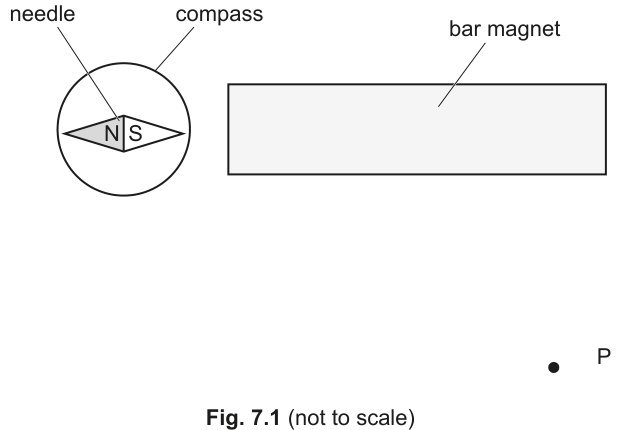
Fig. 7.1 shows the plotting compass placed close to a bar magnet.
Answer
Mark the left end of the bar magnet as N and the right end as S.
Left end: N, Right end: S
Walkthrough
The needle of a plotting compass is a small magnet. Its N pole points in the direction of the magnetic field at that point. In Fig. 7.1, the compass is placed to the left of the bar magnet, and its N pole is pointing to the left (away from the bar magnet). This means the magnetic field lines at the compass are pointing away from the bar magnet. Since magnetic field lines emerge from the N pole of a magnet and enter the S pole, the left end of the bar magnet must be the N pole, and the right end must be the S pole.
Key Takeaways
A plotting compass N pole always points along the magnetic field line in the direction from N to S outside the magnet.
Common Mistakes
Students often assume the compass N pole is attracted to the magnet's N pole. Remember that like poles repel; the compass N pole is repelled by the magnet's N pole (or attracted to its S pole).
Things to Be Careful About
Always label the poles directly on the diagram where the question asks. Do not just write 'N' and 'S' in your working; the mark is awarded for the correct placement on the figure.
There is a piece of paper underneath the magnet.
Describe how the compass is used to plot the magnetic field line that passes from one pole to the other and through P.
Answer
- Place one end of the compass needle on point P and mark the position of the other end of the needle on the paper.
- Move the compass so that the end you just marked is now at the position of the other end of the needle, then mark the new position of the first end.
- Continue this process, stepping around the field line, and finally join all the marks with a smooth curve.
Place compass on P, mark the other end; move compass so the other end is on the mark, mark the new position; repeat and join marks.
Walkthrough
To plot a magnetic field line, you trace the direction of the field step by step. Starting at point P, you place the compass down. The needle aligns with the local magnetic field. You mark the tip of the N pole (or one end). Then you move the compass so that the opposite end is now at the mark you just made. The needle will point in a new direction; you mark this new tip. Repeating this process traces out the path of the field line. Finally, you connect the dots with a smooth curve to represent the continuous field line.
Key Takeaways
Plotting a field line is a sequential process: place, mark, move, mark, join. Each step relies on the previous mark to determine the new position.
Common Mistakes
- Forgetting to move the compass to the mark made by the previous step.
- Drawing straight lines between marks instead of smooth curves.
- Not joining the marks at the end to form a continuous line.
Things to Be Careful About
Ensure you mark the paper clearly. The marks must be joined with a smooth curve, not a jagged line, to represent the continuous nature of a magnetic field line.
Describe how to use the compass in Fig. 7.1 to determine the direction of the magnetic field at P.
Answer
Place the plotting compass on point P. The direction of the magnetic field at P is the direction in which the N pole (or the shaded end) of the compass needle points.
Place compass on P; the N pole points in the direction of the field.
Walkthrough
The magnetic field direction at any point is defined as the direction that the N pole of a small compass would point when placed at that point. Therefore, simply placing the compass on P and reading the orientation of the N pole gives the field direction.
Key Takeaways
The N pole of a plotting compass always indicates the direction of the magnetic field line at that location.
Common Mistakes
- Saying the S pole points in the direction of the field.
- Forgetting to state that the compass must be placed on P first.
Things to Be Careful About
Be precise with wording: it is the 'N pole' or 'shaded end' that points in the direction of the field, not the 'S pole' or 'white end'.
Fig. 7.2 shows the apparatus a student uses to produce an alternating current (a.c.).
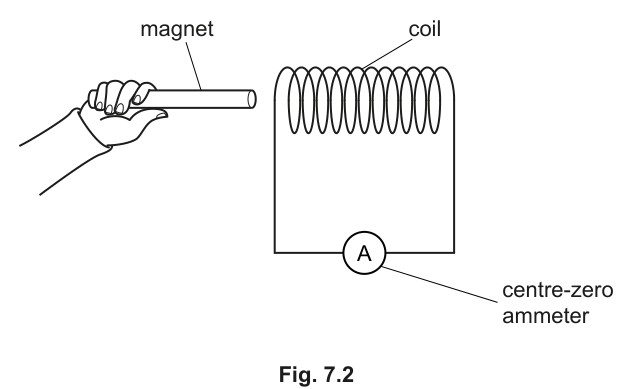
The magnet is moved into and out of the coil.
Answer
When the magnet moves, its magnetic field cuts through the coil (or the magnetic flux through the coil changes). This change in magnetic flux induces an e.m.f. in the coil by electromagnetic induction, which drives a current around the closed circuit.
The changing magnetic field cuts the coil, inducing an e.m.f. by electromagnetic induction.
Walkthrough
Current is only produced when there is a change in the magnetic environment of the coil. Moving the magnet changes the magnetic field passing through the coil (magnetic flux). According to the principle of electromagnetic induction, a changing magnetic flux through a conductor induces an e.m.f. Since the coil is connected in a closed circuit, this induced e.m.f. causes a current to flow.
Key Takeaways
Relative motion between a magnet and a coil changes the magnetic flux, inducing an e.m.f. and current.
Common Mistakes
- Saying 'the magnet creates a current' without mentioning induction or e.m.f.
- Stating that the magnetic field 'is' in the coil rather than 'changes' or 'cuts' the coil.
Things to Be Careful About
Use precise terminology: 'cuts the coil' or 'changes the magnetic flux' are both acceptable, but 'induces an e.m.f.' is the key principle that must be stated for the second mark.
Answer
Move the magnet in and out of the coil once every 2 seconds.
Move the magnet in and out once every 2 s.
Walkthrough
Frequency () is the number of complete cycles per second. A frequency of means 0.5 cycles per second. The period () is the time for one complete cycle, given by . Therefore, one complete in-and-out movement must take 2 seconds.
Key Takeaways
Frequency and period are reciprocals: .
Common Mistakes
- Confusing frequency with period (saying 'once every 0.5 s').
- Not specifying that the movement is 'in and out' (a full cycle).
Things to Be Careful About
Ensure the units are correct. is half a cycle per second, so one cycle takes 2 seconds.
Describe how the centre-zero ammeter shows the current is a.c. rather than d.c. (direct current).
Answer
The ammeter reading swings to both positive and negative values (both sides of zero), showing that the current changes direction.
The ammeter shows readings on both sides of zero (positive and negative).
Walkthrough
An alternating current (a.c.) constantly reverses direction. A centre-zero ammeter is designed to show positive current in one direction and negative current in the opposite direction. If the current were direct current (d.c.), the needle would deflect to only one side of zero and stay there. The fact that the reading is on both sides of zero proves the current is alternating.
Key Takeaways
A centre-zero ammeter deflects in opposite directions for current flowing in opposite directions, making it ideal for detecting a.c.
Common Mistakes
- Saying the ammeter 'moves back and forth' without specifying it goes to both sides of zero.
- Not mentioning that d.c. would only show one side.
Things to Be Careful About
Be precise: the reading must be on 'both sides of zero' or 'positive and negative'.
Explain why increasing the frequency of the a.c. produced also increases the magnitude (size) of the a.c produced.
Answer
Increasing the frequency increases the rate at which the magnetic field lines are cut (or the rate of change of magnetic flux through the coil). This induces a larger e.m.f., and therefore a larger current.
Higher frequency means a larger rate of change of magnetic flux, inducing a larger e.m.f.
Walkthrough
The magnitude of the induced e.m.f. depends on the rate of change of magnetic flux (or the rate at which field lines are cut). If the frequency of the magnet's movement is increased, the magnet moves faster through the coil. This means the magnetic flux changes more rapidly, cutting the coil's field lines at a higher rate. A faster rate of change of flux induces a larger e.m.f. according to Faraday's law (qualitatively), resulting in a larger current.
Key Takeaways
The size of the induced e.m.f. is proportional to the rate of change of magnetic flux.
Common Mistakes
- Saying 'more field lines are cut' instead of 'cut faster' or 'rate of cutting is higher'.
- Not linking the larger e.m.f. to a larger current (though the question only asks for the magnitude of the a.c., which implies current or e.m.f.).
Things to Be Careful About
Use the phrase 'rate of change' or 'rate of cutting'. Simply saying 'the field changes more' is not precise enough; it must be the rate of change that increases.
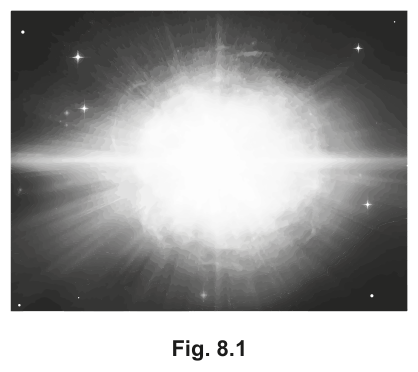
Fig. 8.1 is a picture of a nebula formed from a supernova.
Answer
A supernova is an explosion of a red giant or massive star at the end of its life cycle.
an explosion of a red giant or massive star at the end of its life cycle
Walkthrough
A supernova is a violent explosion that marks the end of the life cycle of a massive star or a red giant. The candidate simply needs to recall this definition and state that it is an explosion involving a massive star or red giant.
Key Takeaways
Students should be familiar with the key stages in the life cycle of a star, particularly the final explosive stages for massive stars.
Common Mistakes
Students may simply write "explosion" without specifying the type of star (red giant or massive star) or the stage in its life cycle, which would not earn the second mark. "Gravity" on its own is not a sufficient explanation for a supernova.
Things to Be Careful About
Ensure the answer specifies that the explosion involves a massive star or red giant, as this is the key distinguishing feature credited by the mark scheme.
Answer
Clouds of dust and gas in the nebula come together and collapse due to gravitational attraction, resulting in an increase in temperature.
Clouds of dust and gas collapse due to gravitational attraction, increasing the temperature
Walkthrough
A protostar forms inside a nebula when clouds of dust and gas are pulled together by their own gravitational attraction. As the material collapses inward, the gravitational potential energy is converted into kinetic energy, causing the temperature of the cloud to rise. Once the temperature and pressure become high enough, nuclear fusion may begin, and a star is born.
Key Takeaways
The formation of a star from a nebula is driven by gravity. The collapse of the gas and dust cloud increases both the density and the temperature of the protostar.
Common Mistakes
Students might say the cloud is pulled together by "magnetism" or "light pressure". The correct force is gravitational attraction. Students may also forget to mention the resulting increase in temperature, which is a key part of the protostar's formation.
Things to Be Careful About
The answer requires two distinct points: the mechanism of collapse (gravity) and the consequence (temperature increase). Both are needed for full marks.
Our Sun is in a circular orbit around a black hole at the centre of our galaxy.
Answer
The Milky Way.
The Milky Way
Walkthrough
Our solar system, including the Sun, is located in a spiral galaxy called the Milky Way. This is a standard astronomical fact covered in the Earth and the Solar System and Stars and the Universe topics.
Key Takeaways
Students should know the name of our home galaxy and that it contains hundreds of billions of stars.
Common Mistakes
Students may confuse the Milky Way with the Andromeda galaxy or other nearby galaxies. The answer must be specifically "the Milky Way".
Things to Be Careful About
Ensure the name is spelled correctly and capitalised as "The Milky Way" or "Milky Way".
Answer
A light-year is the distance travelled by light in one year.
the distance travelled by light in one year
Walkthrough
A light-year is a unit of distance, not time. It is defined as the distance that light travels in a vacuum in one Julian year (365.25 days). Since the speed of light is constant, this provides a convenient way to express vast astronomical distances.
Key Takeaways
Students must distinguish between a light-year (distance) and a year (time). The definition is straightforward: distance = speed of light × time (one year).
Common Mistakes
A very common mistake is to say a light-year is a unit of time. Students must explicitly state it is a distance.
Things to Be Careful About
Ensure the answer specifies "distance" and not "time". The mark scheme accepts "distance travelled by light in one year".
The time taken for one complete orbit of our Sun around the black hole is .
The distance from our Sun to the black hole is .
Calculate the speed of our Sun as it orbits the black hole.
Show your working and give your answer in .
speed = ______
Working
First, convert the orbital radius from light-years to metres:
The distance of one complete orbit (circumference) is:
The speed is:
Rounding to two significant figures:
Answer
speed = 210 000 m / s
210 000
Walkthrough
To find the speed of the Sun, we need the total distance it travels in one orbit and the time it takes. The orbit is circular, so the distance is the circumference . The radius is given in light-years, so we must convert it to metres using the speed of light and the number of seconds in a year.
- Calculate the length of one light-year in metres: .
- Calculate the orbital radius : .
- Calculate the orbital circumference: .
- Calculate the speed: .
- Round to an appropriate number of significant figures (two, based on the given data): or .
Key Takeaways
When dealing with astronomical scales, unit conversion is essential. Always convert given units (like light-years) into standard SI units (metres) before applying kinematic equations. The circular orbit means the distance is .
Common Mistakes
- Forgetting to convert light-years to metres and using directly as the radius in metres.
- Using the diameter instead of the radius when calculating the circumference (, not ).
- Dividing the radius by the time instead of the circumference by the time.
- Significant figures: the final answer should be given to 2 or 3 significant figures. or is acceptable.
Things to Be Careful About
- Ensure all powers of ten are handled correctly during multiplication and division.
- The mark scheme accepts the unrounded value or similar, but is the expected 2-sig-fig answer. Writing is also correct and often clearer for large numbers.
- Do not confuse the time for one orbit (period ) with the time it takes light to travel one light-year.
Alpha particles are sometimes emitted from the nuclei of radioactive elements.
This emission is both random and spontaneous.
Answer
It happens by itself, without any cause or external condition such as temperature, pressure or another emission.
It happens by itself and is not affected by external conditions
Walkthrough
Spontaneous means the emission happens on its own. There is no external trigger such as temperature, pressure or another nuclear event that causes it. It also does not depend on how long the nucleus has already existed.
Key Takeaways
- Spontaneous emission is an unforced, natural process.
- It is not affected by outside conditions or by the age of the nucleus.
Common Mistakes
- Saying it happens 'quickly' is not enough; the key idea is 'by itself'.
- Do not say it is caused by temperature or pressure.
Things to Be Careful About
Use the word 'spontaneous' carefully: it means the event is self-caused, not merely random.
Answer
An alpha particle is made of two protons and two neutrons. It is the same as a helium nucleus.
two protons and two neutrons (a helium nucleus)
Walkthrough
An alpha particle contains two protons and two neutrons. Because it has two protons, it is the nucleus of a helium atom. This is why alpha particles are often written as .
Key Takeaways
- Alpha particle = 2 protons + 2 neutrons.
- It is identical to a helium nucleus.
Common Mistakes
- Confusing an alpha particle with an electron or a single proton.
- Saying 'two protons and two electrons' is wrong.
Things to Be Careful About
The two marks are for the protons and the neutrons separately. Saying only 'a helium nucleus' is not enough on its own.
Alpha particles are detected using the tracks shown in a cloud chamber or by the sparks produced in a spark counter.
Describe the structure of either a cloud chamber or a spark counter. Include a labelled drawing of the apparatus.
Answer
A cloud chamber is a sealed glass container with a transparent window. Inside, the air is saturated with alcohol vapour. A piston or dry ice cools the chamber so the vapour is supersaturated. When an alpha particle passes through, it ionises the air and a visible line of condensation droplets forms along its path.
Labelled cloud chamber diagram: transparent window, alcohol vapour, cooling, alpha source, and alpha-particle track
Walkthrough
A cloud chamber works because a charged particle such as an alpha particle ionises the air as it passes through. If the chamber is filled with alcohol vapour and then cooled, the vapour becomes supersaturated. The ions produced by the alpha particle act as nuclei for condensation, so a visible line of droplets forms along the track.
The labelled drawing should show:
- a transparent window or side for viewing,
- a small radioactive source inside,
- a layer of alcohol,
- a cooling method, such as dry ice or a piston,
- a dashed track of condensation droplets.
Key Takeaways
- Cloud chambers detect alpha particles by the tracks of condensation they produce.
- The apparatus needs a vapour source, a way of cooling, and a transparent window.
Common Mistakes
- Missing the labels on the drawing; each label is part of the mark.
- Forgetting to show the source of alcohol vapour or the cooling method.
- Not showing a transparent window for viewing.
Things to Be Careful About
If you choose a spark counter instead, you would need to show a fine wire, a plate or grille, and a high-voltage supply. The drawing must be clear and fully labelled to score all three marks.
Describe how the emission of alpha particles is shown as random in the apparatus you described in (c)(i).
Answer
The randomness is shown because the tracks do not appear at regular intervals: sometimes several tracks appear close together, and sometimes there is a long gap with no tracks.
The time between tracks varies, so the emission is random
Walkthrough
In a cloud chamber, the tracks appear at unpredictable times. If the emission were regular, the tracks would be equally spaced. The fact that the intervals between tracks vary is direct evidence that the emission is random.
Key Takeaways
- Random means the time between emissions is not fixed.
- The variation in track spacing is the observable evidence.
Common Mistakes
- Saying 'the tracks go in different directions' is acceptable, but the clearest answer is that the time between tracks varies.
- Do not say that the tracks appear at regular intervals.
Things to Be Careful About
If you described a spark counter, say that the time between sparks varies. The same idea applies.
A radioactive source produces 120 tracks in one minute in a cloud chamber.
6.0 hours later, the same source produces 15 tracks in one minute.
Without the source present, no tracks are produced.
Calculate the half-life of the radioactive isotope in the source.
half-life = ______ hours
Working
The count halves as:
120 → 60 → 30 → 15
So 3 half-lives have passed in 6.0 hours.
Answer
2.0 hours
2.0 hours
Walkthrough
The count falls from 120 tracks per minute to 15 tracks per minute. Each half-life halves the count:
120 → 60 → 30 → 15
That is three halvings, so 3 half-lives have passed in 6.0 hours.
Therefore one half-life is 6.0 ÷ 3 = 2.0 hours.
No correction for background is needed because the question says no tracks are produced without the source.
Key Takeaways
- Half-life is the time for the number of radioactive nuclei to halve.
- Work out the number of half-lives by successive halving.
Common Mistakes
- Dividing 6.0 by 120 and then by 15, which gives the wrong answer.
- Forgetting the unit 'hours' in the final answer.
Things to Be Careful About
Count the number of halvings carefully. Here 120 to 15 is 3 halvings, not 2. The answer must be 2.0 hours, with the unit included.