Physics 5054/42 — October/November 2023
Cambridge O-Level · Alternative to Practical · worked solutions for every part, with the mark scheme
Topics Experimental Contexts · Observations and Measurements · Use of Techniques, Apparatus and Materials · Analysis, Conclusions and Evaluation · Planning Experiments and Investigations
A student measures the spring constant of a spring using two different methods.
The spring constant of a spring is a measure of the stiffness of the spring. The larger the spring constant , the more difficult the spring is to stretch.
Method 1
The student:
- measures the unstretched length of the spring to the nearest 0.1 cm.
A full-size diagram of the spring is shown in Fig. 1.1.
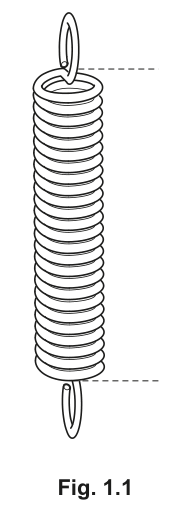
Measure the unstretched length of the spring to the nearest 0.1 cm.
Do not include the loops at the end of the spring in your measurement.
= ______
The student:
- attaches the spring to a clamp on a stand
- suspends a 300 g mass from the spring.
The arrangement of apparatus is shown in Fig. 1.2.
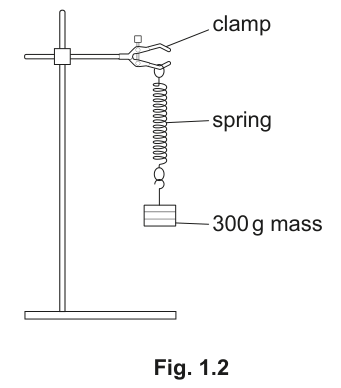
- The student measures the new length of the spring.
Calculate the extension of the spring produced by the mass.
Use the equation:
= ______
Calculate the spring constant of the spring.
Use the equation:
= ______
It is important to avoid line-of-sight (parallax) errors when determining the extension of the spring.
Explain what is meant by parallax errors and how to avoid parallax errors.
explanation ______
how to avoid parallax errors ______
Method 2
The student:
- pulls the 300 g mass down by a small distance and releases it so that the mass oscillates up and down
- measures the time taken for 20 oscillations.
The reading on the stop-watch is shown in Fig. 1.3.
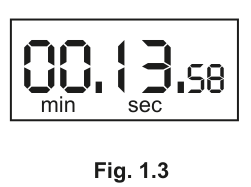
Record this time in Table 1.1 to one decimal place.
Table 1.1
| mass | time for 20 oscillations / | time for 20 oscillations / | mean time for 20 oscillations / | period | |
|---|---|---|---|---|---|
| 300 | 13.8 |
- The student measures the time for 20 oscillations once more and records the time in Table 1.1.
Calculate the mean time for 20 oscillations and record your answer in Table 1.1.
The mean period of the oscillation is the mean time taken for one oscillation.
Calculate the mean period .
Calculate the value of .
Record all your values in Table 1.1.
Use your value of from Table 1.1 to calculate the spring constant of the spring.
Use the equation:
= ______
Explain why the value for the mean period obtained by measuring 20 oscillations twice is more accurate than the value obtained by measuring 1 oscillation twice.
The rest of this paper
3 more questions- Q2Observations and Measurements · Experimental Contexts · Analysis, Conclusions and Evaluation · Use of Techniques, Apparatus and Materials · Planning Experiments and Investigations10M
- Q3Observations and Measurements · Experimental Contexts · Analysis, Conclusions and Evaluation · Use of Techniques, Apparatus and Materials14M
- Q4Planning Experiments and Investigations · Experimental Contexts6M