Physics 5054/31 — October/November 2023
Cambridge O-Level · Practical Test · worked solutions for every part, with the mark scheme
Topics Experimental Contexts · Observations and Measurements · Analysis, Conclusions and Evaluation · Use of Techniques, Apparatus and Materials · Planning Experiments and Investigations
In this experiment you will determine the speed of a wave on the surface of water.
You are provided with:
- a plate filled with water
- a dropping pipette
- a stop-watch
- a 30 cm ruler
- a small beaker of water
- paper towels to mop up any spillages.
Fig. 1.1 shows a scale marked on the side of the dropping pipette.
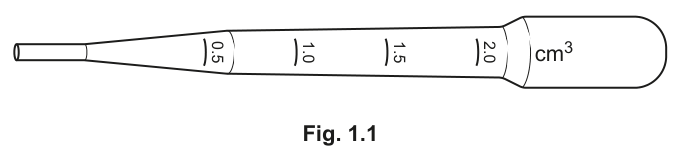
Describe the technique you use to put of water into the dropping pipette.
Fig. 1.2 shows a wavefront moving outwards from the centre of the plate. The wavefront is produced by one drop of water from the dropping pipette.
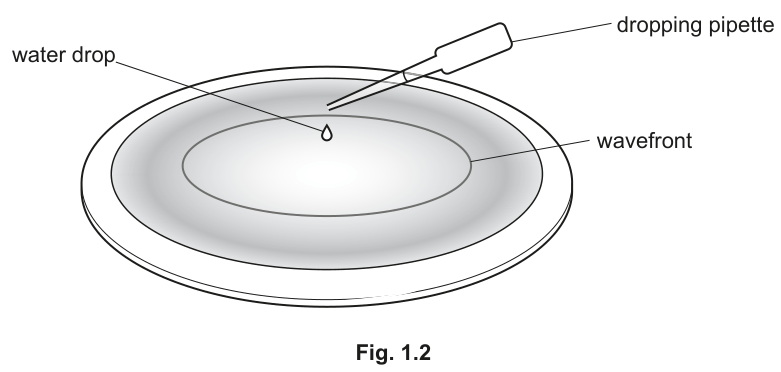
Using the dropping pipette, let one drop of water fall into the centre of the plate.
Observe a wavefront travel to the edge of the plate, reflect back to the centre and then travel back out again. The wavefront will move in and out several times.
Take measurements to determine an accurate time for the wavefront to travel once from the centre of the plate and back to the centre.
= ______
Using your answer to (b)(i) calculate the speed of the wavefront.
You will need to make and record an additional measurement.
Use the equation:
speed = ______
Identify two causes of uncertainty in this experiment.
- ______
- ______
Suggest one improvement that could be made to this experiment.
The rest of this paper
3 more questions- Q2Observations and Measurements · Experimental Contexts · Analysis, Conclusions and Evaluation10M
- Q3Use of Techniques, Apparatus and Materials · Experimental Contexts · Observations and Measurements · Analysis, Conclusions and Evaluation · Planning Experiments and Investigations14M
- Q4Planning Experiments and Investigations · Observations and Measurements · Experimental Contexts6M