Physics 5054/42 — May/June 2023
Cambridge O-Level · Alternative to Practical · worked solutions for every part, with the mark scheme
Topics Observations and Measurements · Analysis, Conclusions and Evaluation · Experimental Contexts · Use of Techniques, Apparatus and Materials · Planning Experiments and Investigations
A student measures the capacity of a drinks cup by three different methods.
The capacity of a cup is the maximum volume of liquid that it can hold.
method 1
The student measures:
- the height of the cup
- the diameter of the top of the cup
- the diameter of the bottom of the cup.
Fig. 1.1 shows a full-size diagram of the cup.
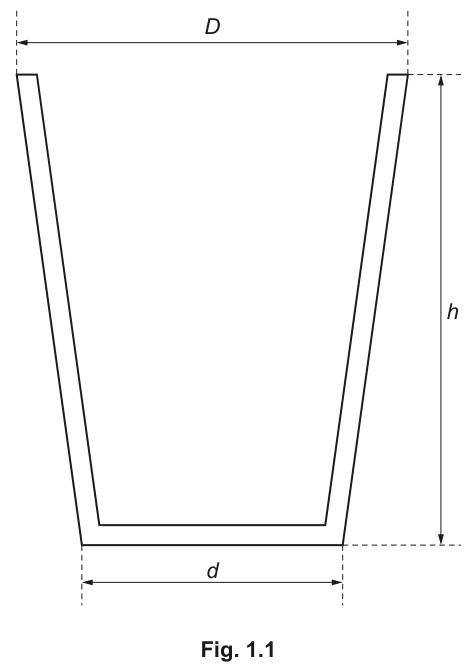
Measure the height , the diameter and the diameter of the cup in the diagram.
= ______
= ______
= ______
Calculate the average diameter of the cup using your readings from (a)(i) and the equation:
= ______
Calculate a value for the capacity of the cup using the equation:
= ______
method 2
The student uses a length of string and a metre rule to determine the average circumference of the cup.
The student:
- wraps some of the string 5 times around the cup
- measures the length of string used.
Calculate the average circumference of the cup.
= ______
Use your values of from (a)(i) and from (b)(i) to calculate a value for the capacity of the cup using the equation:
= ______
method 3
The student:
- fills a measuring cylinder with water, up to the 220 mark
- pours water from the measuring cylinder into the cup until the cup is full
- records the new reading on the measuring cylinder.
Fig. 1.2 shows the new reading .
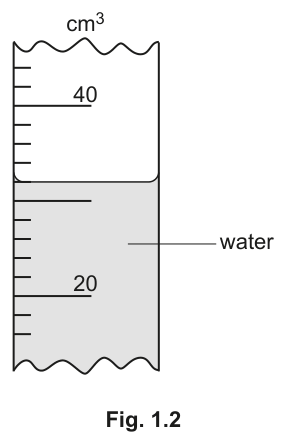
Write down the new reading .
= ______
Determine the volume of water in the cup.
Show your working.
= ______
All three methods of determining the capacity of the drinks cup give values which are approximate.
State one reason why the volume calculated in method 2 and one reason why the volume calculated in method 3 are not accurate.
method 2 ______
method 3 ______
The rest of this paper
3 more questions- Q2Observations and Measurements · Experimental Contexts · Analysis, Conclusions and Evaluation · Use of Techniques, Apparatus and Materials10M
- Q3Experimental Contexts · Observations and Measurements · Analysis, Conclusions and Evaluation14M
- Q4Planning Experiments and Investigations · Experimental Contexts6M