Physics 5054/32 — October/November 2022
Cambridge O-Level · Practical Test · worked solutions for every part, with the mark scheme
Topics Observations and Measurements · Experimental Contexts · Analysis, Conclusions and Evaluation · Use of Techniques, Apparatus and Materials · Planning Experiments and Investigations
In this experiment you will investigate factors affecting friction.
You are provided with:
- a block of wood with a small nail at one end
- a spring attached to a loop of thread
- a ruler kept in place on the bench with a small amount of adhesive putty
- masses on the block of wood and two other masses.
The supervisor has arranged the apparatus as shown in Fig. 1.1.
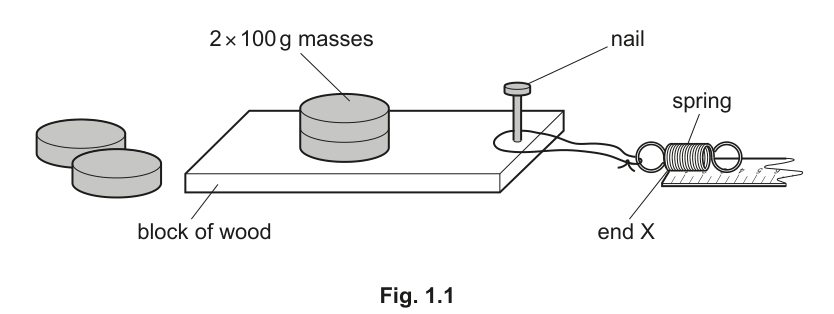
Rearrange the apparatus so that the end X of the spring is lined up with the zero end of the scale on the ruler as shown in Fig. 1.2. The string loop between the nail and the spring should be as straight as possible.
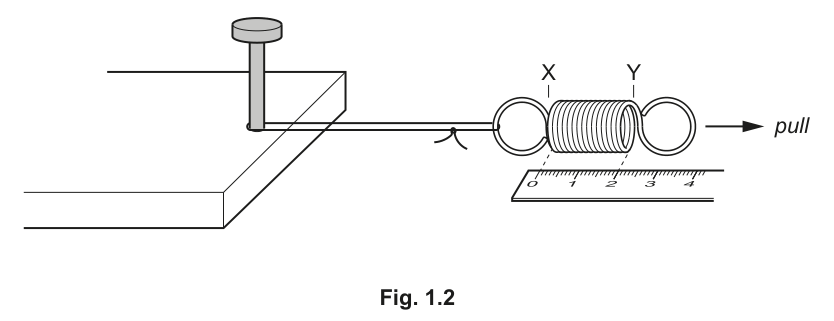
Slowly pull end Y of the spring in the direction shown in Fig. 1.2.
Observe that the spring extends until the pulling force overcomes the friction between the block and the bench.
At this point the block will slide a small distance in the direction of the pulling force. Stop pulling the spring, holding end Y at its new position on the scale.
End X of the spring is now also at a new position on the scale.
Record the readings and where:
- is the new position on the scale of end X of the spring
- is the new position on the scale of end Y of the spring.
= ______
= ______
Answer
Candidate must perform the experiment and record their own readings to the nearest mm, ensuring .
Example values:
Candidate-dependent readings to nearest mm, with x < y. Example: x = 15 mm, y = 45 mm
Walkthrough
The candidate is expected to physically perform the experiment described. They pull the spring until the block just begins to slide, then record the new positions of end X () and end Y () on the ruler. The reading must be taken to the nearest millimetre. Because end X has moved from zero but end Y has moved further to stretch the spring, must be less than . Since this is a practical paper, the exact numerical values will vary from candidate to candidate depending on their apparatus and technique.
Key Takeaways
- Practical readings must be taken to the precision the instrument allows (nearest mm for a standard ruler).
- In this setup, the extension of the spring is proportional to the pulling force, and the reading is always greater than because the spring itself is stretched.
Common Mistakes
- Reading to the wrong precision (e.g., to the nearest 0.5 mm or 1 cm when the scale only allows mm).
- Forgetting to state that .
- Inventing fixed numerical values instead of recognising this as a candidate-dependent practical task.
Things to Be Careful About
- Ensure readings are taken at eye level to avoid parallax error against the ruler.
- The string loop must be as straight as possible so the pull is horizontal and along the ruler.
- Stop pulling exactly when the block first slides; any further pulling will increase without changing the friction force.
A student claims that is directly proportional to .
Plan an experiment to find out if the student's claim is correct.
In your plan you should:
- state two quantities that you will keep constant
- describe how you will obtain different values of and
- describe how the results will show if the student's claim is correct.
You do not have to do this experiment.
Answer
Control variables (state any two):
- Same type of surface (the bench top)
- Same block of wood (same size, mass, and surface material)
- Same spring (same spring constant)
Method (manipulation):
- Vary the mass added to the block by using the spare masses (add them one by one or in different combinations). This changes the normal contact force and therefore the friction, giving different values of and .
How the results show if the claim is correct:
- Plot a graph of against . If the student's claim is correct (that is directly proportional to ), the graph will be a straight line passing through the origin. Alternatively, calculate the ratio for each set of readings; if it is constant, the claim is correct.
Control: same surface, same block, same spring. Method: vary mass added to block. Conclusion: plot x vs y; straight line through origin or constant x/y ratio proves direct proportionality.
Walkthrough
To test whether is directly proportional to , the student must obtain multiple pairs of values. Since the apparatus is fixed, the only way to change the friction force (and thus the spring extensions and ) is to change the normal force between the block and the bench. This is done by adding the spare masses to the block.
To ensure a fair test, all other factors that could affect friction or the spring extension must be kept constant. These include the surface material, the block itself, and the spring used.
Once multiple pairs of readings are collected, direct proportionality is tested by plotting a graph of (dependent variable) against (independent variable). A directly proportional relationship produces a straight-line graph that passes through the origin . Another valid check is to calculate the ratio for each trial; if it is constant, the variables are directly proportional.
Key Takeaways
- In friction experiments, the normal force is varied by changing the mass on the surface.
- Control variables must isolate the relationship being tested; here, surface, block, and spring must remain unchanged.
- Direct proportionality is confirmed by a straight-line graph through the origin or a constant ratio between the two variables.
Common Mistakes
- Suggesting to change the surface or the spring to get different values (this changes the constants, not just the friction).
- Failing to explain how the results will be analysed (e.g., just saying "look at the numbers" instead of specifying a graph or ratio).
- Confusing direct proportionality with a linear relationship that has a non-zero y-intercept.
Things to Be Careful About
- The plan must explicitly state how to obtain different values (vary the mass), not just list the control variables.
- When describing the graph, specify which variable is on which axis ( on the y-axis, on the x-axis, or vice versa, but be consistent), and mention the origin.
- Ensure the control variables are genuinely constant across all trials (e.g., use the same side of the block against the bench).
The rest of this paper
3 more questions- Q2Experimental Contexts · Observations and Measurements · Analysis, Conclusions and Evaluation5M
- Q3Observations and Measurements · Experimental Contexts · Analysis, Conclusions and Evaluation · Use of Techniques, Apparatus and Materials5M
- Q4Experimental Contexts · Observations and Measurements · Analysis, Conclusions and Evaluation · Use of Techniques, Apparatus and Materials15M