Physics 5054/42 — May/June 2022
Cambridge O-Level · Alternative to Practical · worked solutions for every part, with the mark scheme
Topics Use of Techniques, Apparatus and Materials · Analysis, Conclusions and Evaluation · Experimental Contexts · Observations and Measurements · Planning Experiments and Investigations
A student determines the thickness of the glass in a test-tube.
The student uses a ruler and two rectangular wooden blocks to help him measure the external diameter of the test-tube.
Describe, with the aid of a diagram, how the student determines an accurate value for .
The student:
- clamps the test-tube in a stand
- fills a measuring cylinder to the 100 mark with water
- pours some water from the measuring cylinder into the test-tube.
The arrangement of apparatus is shown in Fig. 1.1. The test-tube containing water is also shown full size in Fig. 1.1.
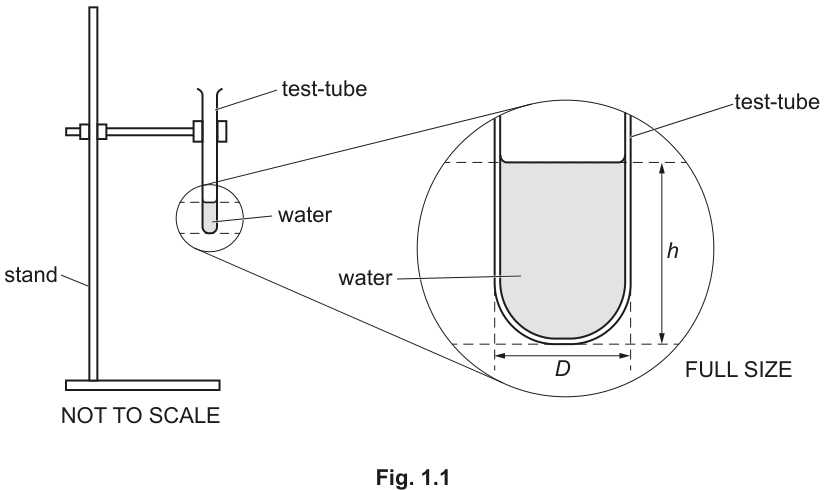
Measure the height of the water in the full size test-tube in Fig. 1.1.
Record in centimetres to the nearest millimetre in the second row in Table 1.1.
Fig. 1.2 shows the volume of water remaining in the measuring cylinder.
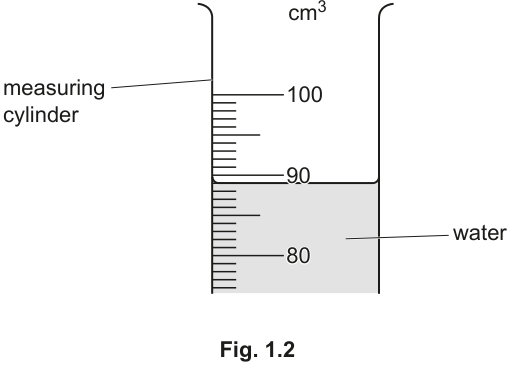
Record in Table 1.1.
Calculate the volume of water in the test-tube.
Record your answer in Table 1.1.
The student:
- adds more water from the measuring cylinder into the test-tube
- measures and records the new values of and in Table 1.1
- repeats the procedure for three more values of and .
The student's results are shown in Table 1.1.
Table 1.1
| 5.6 | 79 | 21 |
| 8.9 | 66 | 34 |
| 12.5 | 54 | 46 |
| 14.2 | 47 | 53 |
On the grid provided, plot a graph of on the y-axis against on the x-axis.
Start both axes from the origin (0, 0).
Draw the best-fit straight line.
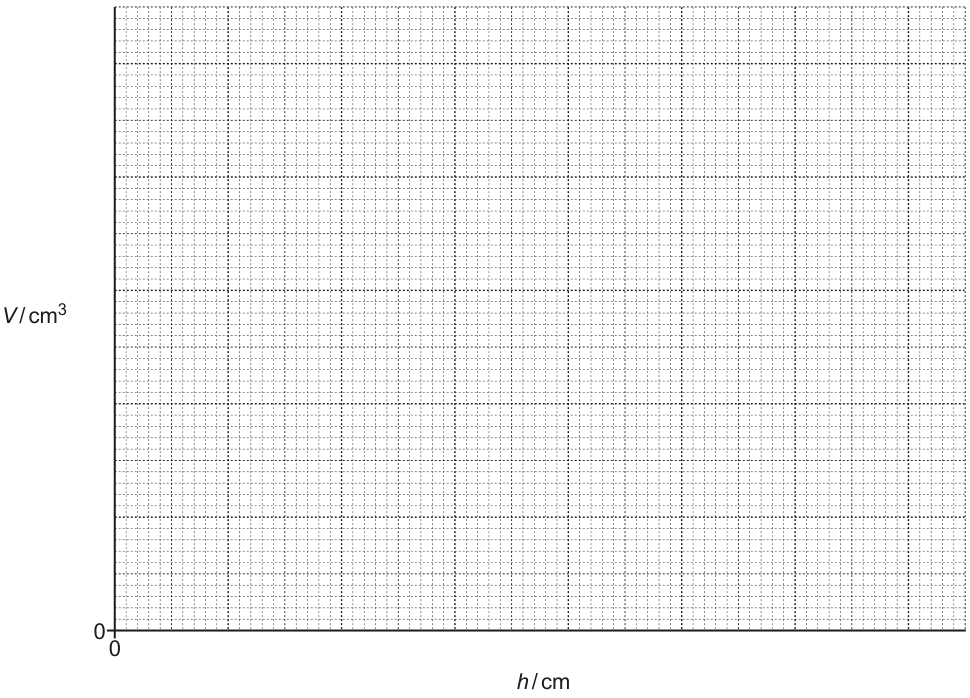
Calculate the gradient of your line. Show all working and indicate on the graph the values you use.
= ______
If the test-tube is a perfect cylinder, then the internal diameter is given by the equation:
Use your value of from (e)(i) and the equation to calculate .
= ______
Your value for is approximate.
State one difficulty in measuring the height of the water in the test-tube and suggest how this difficulty can be overcome.
difficulty ______
suggestion ______
Suggest another reason why your calculated value for is only approximate.
Measure the external diameter of the full size test-tube in Fig. 1.1.
Record in centimetres to the nearest millimetre.
= ______
Use your answers for (e)(ii) and (g)(i) to calculate the thickness of the glass in the test-tube.
thickness of the glass = ______
The rest of this paper
3 more questions- Q2Experimental Contexts · Use of Techniques, Apparatus and Materials · Analysis, Conclusions and Evaluation · Planning Experiments and Investigations6M
- Q3Analysis, Conclusions and Evaluation · Use of Techniques, Apparatus and Materials · Experimental Contexts5M
- Q4Experimental Contexts4M