Physics 5054/31 — October/November 2021
Cambridge O-Level · Practical Test · worked solutions for every part, with the mark scheme
Topics Observations and Measurements · Experimental Contexts · Analysis, Conclusions and Evaluation · Use of Techniques, Apparatus and Materials · Planning Experiments and Investigations
In this experiment you will investigate angles of reflection.
You are provided with:
- an illuminated slit
- a pair of mirrors joined together
- a small amount of adhesive putty
- a protractor.
Fig. 1.1 is on page 3 of your question paper.
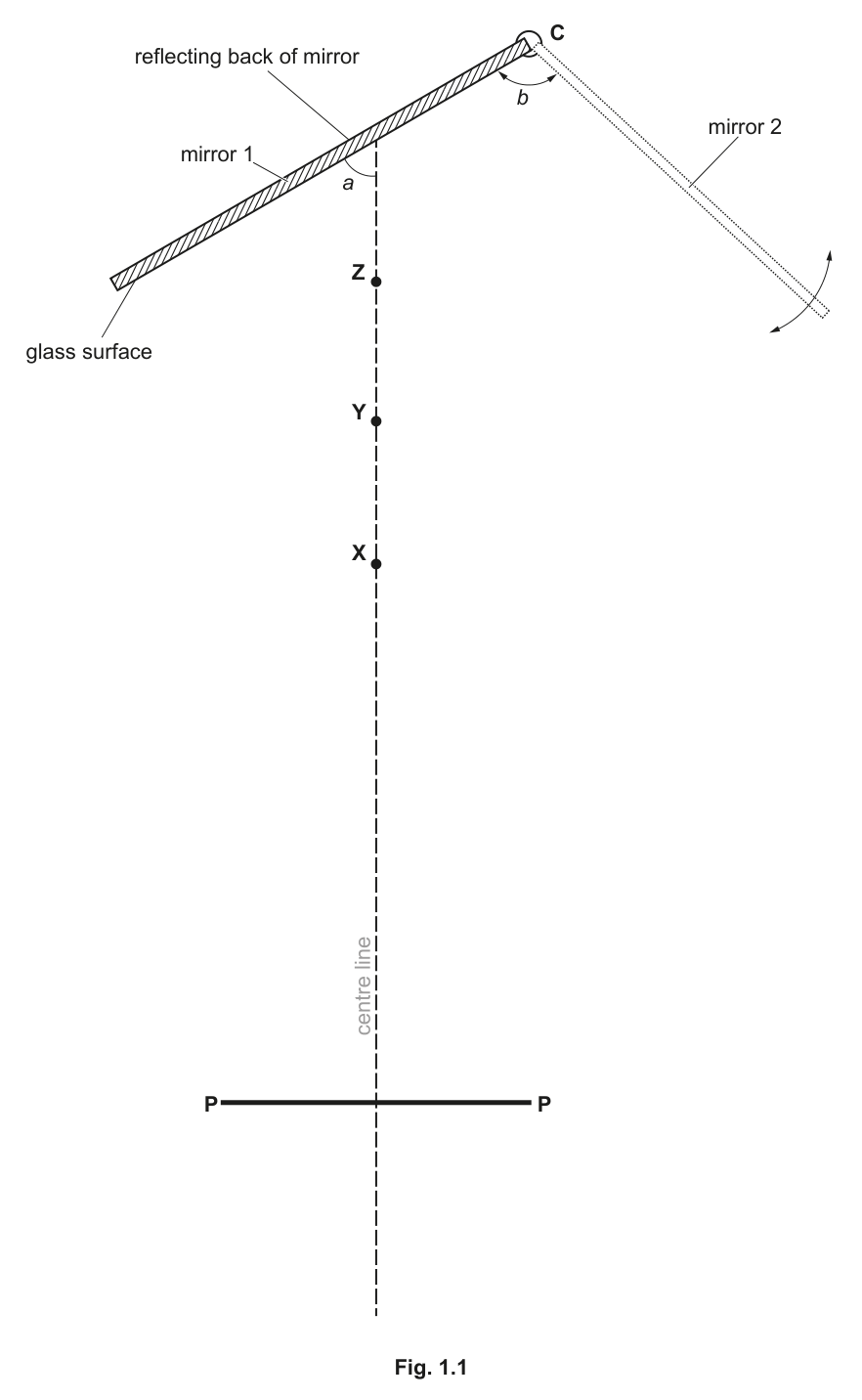
Measure and record angle on Fig. 1.1.
angle = ______
Answer
angle = 60°
60
Walkthrough
The candidate is asked to measure angle on Fig. 1.1. Angle is the angle between mirror 1 and the dashed centre line. Using a protractor on the printed question paper, place the centre of the protractor at point C where mirror 1 meets the centre line, align the 0° line with the centre line, and read off where the back of mirror 1 crosses the scale. The printed figure is drawn so that this angle is 60°. Record the value with the unit °.
Key Takeaways
- Practical papers require candidates to take readings from printed figures using the correct instrument (a protractor here).
- Readings must be given to the precision the scale allows, including a trailing zero if appropriate.
Common Mistakes
- Forgetting to write the unit ° — the unit is required for this mark.
- Reading the angle between mirror 1 and the horizontal instead of between mirror 1 and the centre line.
- Not placing the protractor centre exactly at point C.
Things to Be Careful About
- The protractor must be placed with its centre at point C and its baseline along the centre line.
- Read to the nearest degree as the protractor on the question paper allows.
- Do not confuse angle with angle ; angle is between mirror 1 and the centre line, angle is between the two mirrors.
On Fig. 1.1:
- place the illuminated slit plate or the slit plate of the ray box on the line PP. If you are using the small lamp with the slit plate, you will need to turn the lamp upside down so that the glass is touching the paper next to the slit. Adjust the position of the slit plate so that, when the lamp or ray box is switched on, a single ray of light emerging from the slit lines up with the centre line marked on Fig. 1.1
- place the pair of mirrors so that the corner where they are joined together is at point C and one mirror lines up with the marked area, as shown on Fig. 1.1. A small amount of adhesive putty may be used to fix this mirror into place. This mirror is mirror 1.
The angle between the two mirrors is angle .
- Switch on the lamp.
Observe the ray reflected from mirror 1. Without moving mirror 1, adjust the position of mirror 2 so that the ray also reflects from this mirror.
Without moving mirror 1, rotate mirror 2 so that the reflected ray from this mirror passes through point X.
Draw a line along the face of mirror 2. Label this line X.
Measure and record angle between this line and mirror 1.
angle = ______
Answer
angle = 80°
80
Walkthrough
The ray travels up the centre line from P-P and strikes mirror 1 at point C. Angle between mirror 1 and the centre line is 60°, so the angle of incidence on mirror 1 (measured from the normal, which is perpendicular to mirror 1) is 90° − 60° = 30°. By the law of reflection, the ray reflects from mirror 1 at 30° on the other side of the normal, i.e. 60° from mirror 1, heading to the right and downward.
Mirror 2 must redirect this ray so it passes through point X on the centre line. Draw a straight line from the reflected ray's path on mirror 1 to point X. The line of mirror 2 must bisect the angle between the incoming ray (from mirror 1) and the outgoing ray (to point X), because the angle of incidence equals the angle of reflection at mirror 2. Draw this line along the face of mirror 2 and label it X.
Measure angle , the angle between the face of mirror 2 (line X) and mirror 1. Using a protractor at point C, this angle is approximately 80°. The mark scheme requires .
Key Takeaways
- The law of reflection states that the angle of incidence equals the angle of reflection, both measured from the normal.
- To position a second mirror so that a ray reflects to a specific point, the mirror face must bisect the angle between the incident and reflected rays at that mirror.
- Construction lines must be drawn accurately; the measured angle must be less than 90°.
Common Mistakes
- Forgetting that angles in reflection are measured from the normal, not from the mirror surface.
- Drawing mirror 2 along the bisector of the wrong angle.
- Measuring angle from the wrong reference (must be between mirror 2 and mirror 1, not between mirror 2 and the centre line).
Things to Be Careful About
- The angle must be less than 90°; if your construction gives a value greater than 90°, recheck the ray path.
- Draw the line along the face (glass surface) of mirror 2, not the back.
- Measure to the nearest degree with the protractor.
Repeat the procedure in (b)(i) for points Y and Z labelling the lines Y and Z respectively.
angle = ______
angle = ______
Switch off the lamp.
Answer
angle = 65°
angle = 55°
b_Y = 65°, b_Z = 55°
Walkthrough
Repeat the procedure from part (b)(i) for points Y and Z on the centre line.
For point Y: The reflected ray from mirror 1 hits mirror 2 and must be redirected to point Y, which is higher up on the centre line than X (closer to C). Draw a line from the reflected ray path on mirror 1 to point Y. Mirror 2 is repositioned so its face bisects the angle between the incoming ray and the outgoing ray to Y. Label this line Y. Measure angle between mirror 1 and line Y. This angle is approximately 65°.
For point Z: Point Z is even closer to C on the centre line. Repeat the construction for Z. Label the mirror position line Z. Measure angle between mirror 1 and line Z. This angle is approximately 55°.
The mark scheme requires and , with a minimum accepted value of . The values 65° and 55° satisfy these constraints.
Switch off the lamp when finished.
Key Takeaways
- As the target point moves closer to C along the centre line (from X to Y to Z), the required angle between the two mirrors decreases.
- Each measurement requires a fresh construction based on the law of reflection.
- The trend must be consistently decreasing.
Common Mistakes
- Not redrawing mirror 2 for each new point; using the same mirror 2 position for all three points.
- Measuring angle from the wrong reference line.
- Recording values that do not show the required decreasing trend.
- Forgetting to switch off the lamp at the end.
Things to Be Careful About
- Ensure mirror 1 is not moved between measurements; only mirror 2 is adjusted.
- The angle must be at least 50°; values below this are outside the accepted range.
- All angles must be measured to the same precision (nearest degree).
- Record values in the order asked: , then , then .
Describe the trend in angle as the reflected ray moves from point X to point Z.
Answer
The angle decreases as the reflected ray moves from point X to point Y to point Z.
The angle decreases
Walkthrough
Look at the three measured values: , , . As the target point on the centre line moves from X (furthest from C) to Y to Z (closest to C), the angle between the two mirrors gets smaller. State this trend clearly, referencing the direction of movement from X to Z.
Key Takeaways
- A trend is a consistent pattern in the data as one variable changes.
- State the trend in terms of the quantities named in the question.
Common Mistakes
- Saying the angle increases (the opposite of the correct trend).
- Not referencing the movement from X to Z; just saying "the angle changes".
- Confusing angle with angle ; angle is fixed and does not change.
Things to Be Careful About
- The question asks for the trend as the ray moves from X to Z, so state the direction clearly.
- Do not explain why the trend occurs in this part; that would be going beyond what is asked.
Suggest one practical reason why it is difficult to obtain accurate results with this experiment.
Answer
The thickness of the mirrors and the reflecting surface at the back of the glass makes it difficult to determine exactly where the reflection occurs, so angles cannot be measured precisely.
Alternatively:
- The ray spreads out too much, making it difficult to align accurately.
- Background light makes the ray hard to see.
- Angles can only be measured to within about ±2° using a protractor.
Thickness of mirrors and reflecting surface at back
Walkthrough
The question asks for one practical reason why accurate results are difficult to obtain. Think about what could go wrong in this experiment:
-
Mirror thickness: Mirrors have a glass front and a reflecting coating at the back. The ray enters the glass, reflects off the back surface, and exits. The exact point of reflection is at the back surface, not the front face. When measuring angles from the front face of the mirror, there is a systematic error due to the glass thickness.
-
Ray spread: A slit produces a ray that spreads out over distance. At the mirrors, the ray may be several millimetres wide, making it hard to determine the exact centre line of the ray.
-
Background light: If the room is too bright, the ray is hard to see, making alignment and angle measurement less accurate.
-
Protractor precision: The protractor on the question paper may only allow readings to the nearest degree or two, limiting precision to about ±2°.
Any one of these (or a similar valid point) earns the mark.
Key Takeaways
- Practical experiments always have limitations; candidates must identify them.
- A good suggestion names the quantity affected and explains why it causes inaccuracy.
- Vague answers like "human error" or "be more careful" do not score.
Common Mistakes
- Saying "human error" — this is not a specific practical reason.
- Saying "be more careful" — this is not a valid suggestion.
- Suggesting a reason that does not apply to this particular apparatus.
Things to Be Careful About
- The suggestion must be specific and relate to the apparatus or method used.
- The mark scheme accepts multiple valid points; any one is sufficient.
- Avoid answers that are too vague or generic.
The rest of this paper
3 more questions- Q2Experimental Contexts · Use of Techniques, Apparatus and Materials · Observations and Measurements · Analysis, Conclusions and Evaluation5M
- Q3Experimental Contexts · Observations and Measurements · Analysis, Conclusions and Evaluation · Planning Experiments and Investigations5M
- Q4Use of Techniques, Apparatus and Materials · Experimental Contexts · Observations and Measurements · Planning Experiments and Investigations · Analysis, Conclusions and Evaluation15M