Physics 5054/12 — October/November 2021
Cambridge O-Level · Multiple Choice · answer key with instant marking and worked solutions
Topics Thermal Properties of Matter · Forces · Energy, Work and Power · Lenses and Dispersion · Current, Voltage and Resistance · Physical Quantities and Measurement · +18 more
Tap an option under each question to check it — your score builds as you go.
A boy starts at P and walks due north from P to Q and then due east from Q to R.
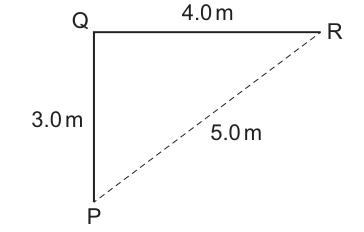
What is the shortest distance that he must now walk to have an overall displacement of zero?
Options
A
B
C
D
Working
To have an overall displacement of zero, the boy must return to his starting point P. The shortest distance from his current position R back to P is the straight line PR.
The path from P to Q (3.0 m due north) and Q to R (4.0 m due east) are at right angles, forming a right-angled triangle PQR. Using Pythagoras' theorem:
Answer
C
C
Walkthrough
Displacement is a vector quantity that measures the straight-line distance from the starting point to the final position, along with the direction. For the overall displacement to be zero, the boy's final position must be exactly the same as his starting point P. Therefore, he must walk from R back to P.
The shortest distance between any two points is a straight line, so we need to find the length of the straight line PR. The boy's path from P to Q to R forms two legs of a right-angled triangle: 3.0 m due north and 4.0 m due east. Since north and east are perpendicular, we can apply Pythagoras' theorem to find the hypotenuse PR:
This matches option C.
Key Takeaways
- Displacement is a vector; zero overall displacement means returning to the starting point.
- The shortest distance between two points is a straight line.
- Pythagoras' theorem () is used to find the resultant of two perpendicular vectors.
Common Mistakes
- Adding the distances: Choosing 7.0 m (option D) by simply adding 3.0 m and 4.0 m. This calculates the total distance walked, not the displacement.
- Confusing distance and displacement: Forgetting that displacement is a vector quantity that depends only on the start and end points.
Things to Be Careful About
- Always distinguish between distance (a scalar, total path length) and displacement (a vector, straight-line change in position).
- When combining perpendicular vectors, use Pythagoras' theorem for the magnitude and trigonometry for the direction. Here, only the magnitude (distance to walk) is required.
The rest of this paper
39 more questions- Q2Physical Quantities and Measurement1M
- Q3Kinematics1M
- Q4Forces1M
- Q5Forces1M
- Q6Mass, Weight and Density1M
- Q7Mass, Weight and Density1M
- Q8Turning Effect of Forces1M
- Q9Forces1M
- Q10Pressure1M
- Q11Kinetic Particle Model of Matter1M
- Q12Energy, Work and Power1M
- Q13Energy, Work and Power1M
- Q14Kinetic Particle Model of Matter1M
- Q15Transfer of Thermal Energy1M
- Q16[Legacy] Temperature and Thermometry1M
- Q17Thermal Properties of Matter · [Legacy] Temperature and Thermometry1M
- Q18Thermal Properties of Matter · Energy, Work and Power1M
- Q19Thermal Properties of Matter1M
- Q20Thermal Properties of Matter1M
- Q21General Properties of Waves1M
- Q22General Properties of Waves1M
- Q23Reflection and Refraction of Light1M
- Q24Lenses and Dispersion1M
- Q25Lenses and Dispersion1M
- Q26Lenses and Dispersion · Reflection and Refraction of Light1M
- Q27Electromagnetic Spectrum1M
- Q28Sound1M
- Q29Sound1M
- Q30Simple Magnetism and Magnetic Fields1M
- Q31Static Electricity1M
- Q32Current, Voltage and Resistance1M
- Q33Current, Voltage and Resistance1M
- Q34Electromagnetic Induction and Transformers · Practical Electricity1M
- Q35Magnetic Effect of a Current and the d.c. Motor1M
- Q36Current, Voltage and Resistance · Electromagnetic Spectrum1M
- Q37Radioactivity1M
- Q38Radioactivity1M
- Q39The Nuclear Atom1M
- Q40The Nuclear Atom1M