Physics 5054/42 — May/June 2021
Cambridge O-Level · Alternative to Practical · worked solutions for every part, with the mark scheme
Topics Experimental Contexts · Analysis, Conclusions and Evaluation · Use of Techniques, Apparatus and Materials · Observations and Measurements
A student investigates how the potential difference (p.d.) across a fixed resistor R changes as extra resistance is added to the circuit.
- She sets up the circuit shown in Fig. 1.1.
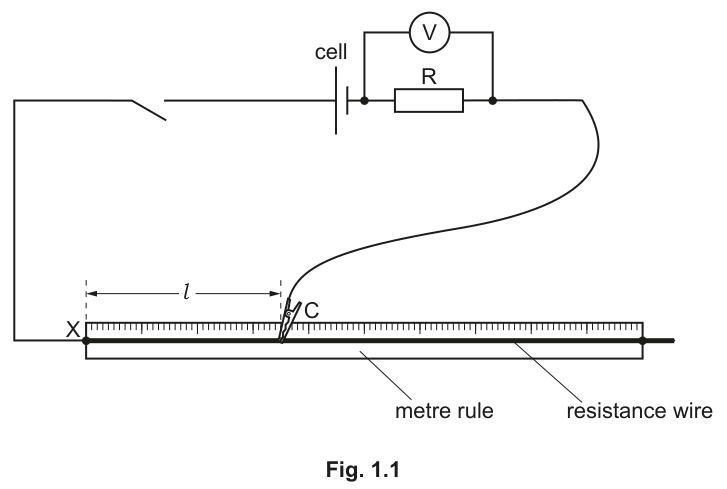
- She connects the crocodile clip C to a point on the resistance wire at a length from end X.
- She closes the switch.
- She reads the voltmeter and records the reading.
- She opens the switch.
Fig. 1.2 shows the voltmeter reading.
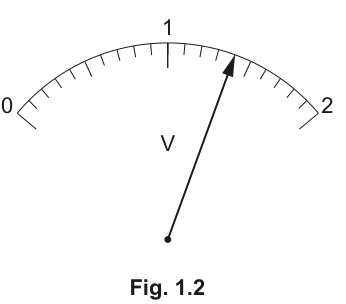
Read the voltmeter scale and in Table 1.1 on page 4, record the p.d. .
Calculate and record its value in Table 1.1 on page 4 to the appropriate number of significant figures.
She repeats the procedure in (a) using values of , , and . Her results are shown in Table 1.1.
Table 1.1
| length / | potential difference / | / |
|---|---|---|
| 20.0 | ||
| 30.0 | 1.3 | 0.77 |
| 40.0 | 1.1 | 0.91 |
| 60.0 | 0.90 | 1.1 |
| 80.0 | 0.80 | 1.3 |
Suggest why the student opens the switch between readings.
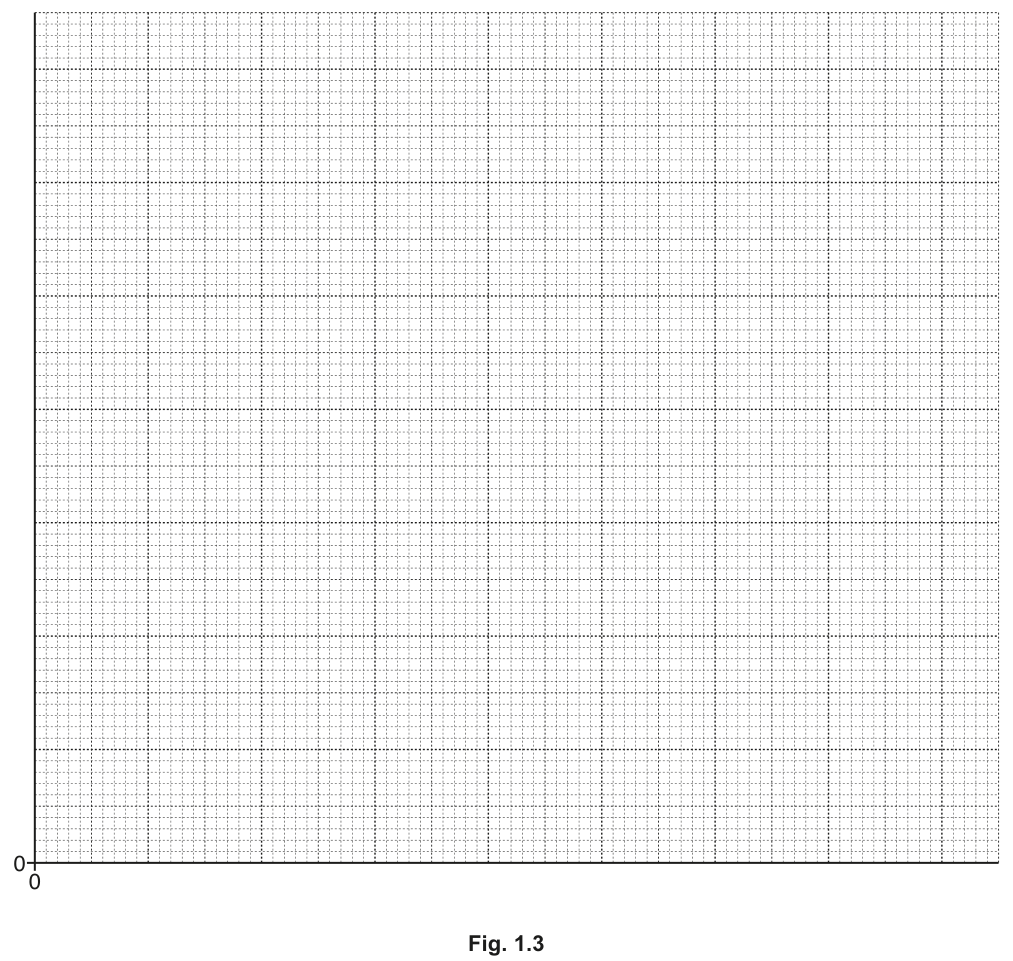
On the grid provided in Fig. 1.3 on page 5, plot a graph of on the y-axis against on the x-axis.
Start both axes from the origin (0, 0).
Draw the best-fit straight line.
Calculate the gradient of your line. Show all working and indicate on the graph the values you use.
= ______
Extend your line until it crosses the y-axis.
Measure the intercept that your line makes with the y-axis.
= ______
Calculate the electromotive force (e.m.f.) of the cell using the equation:
where .
= ______
Suggest one practical reason why, despite carrying out the experiment with care, the student's value for may not be the true value.
The results in Table 1.1 show that as the length of resistance wire increases, the potential difference decreases.
State how the results show that is not inversely proportional to .
The rest of this paper
3 more questions- Q2Use of Techniques, Apparatus and Materials · Analysis, Conclusions and Evaluation8M
- Q3Experimental Contexts4M
- Q4Experimental Contexts · Analysis, Conclusions and Evaluation4M