Physics 5054/41 — May/June 2021
Cambridge O-Level · Alternative to Practical · worked solutions for every part, with the mark scheme
Topics Experimental Contexts · Use of Techniques, Apparatus and Materials · Observations and Measurements · Analysis, Conclusions and Evaluation · Planning Experiments and Investigations
A student investigates the relationship between the resistance of different lengths of wire and their length . Resistance can be found using the equation:
where is the voltage and is the current.
The student is provided with different lengths of wire of the same material.
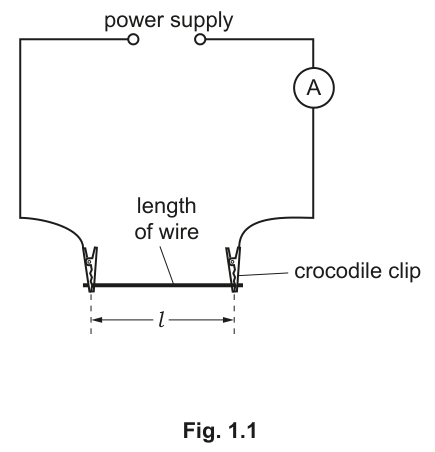
He uses the circuit shown in Fig. 1.1.
State one property of the wire that must be the same for the student to make a fair comparison.
______
On Fig. 1.1, draw a voltmeter symbol connected to measure the voltage across the length of wire.
- The student places a 40.0 cm length of wire between the crocodile clips shown in Fig. 1.1.
- He switches on the power supply.
Name the piece of apparatus he uses to measure the length of the wire between the crocodile clips.
______
Fig. 1.2 shows the ammeter and the voltmeter readings when length .
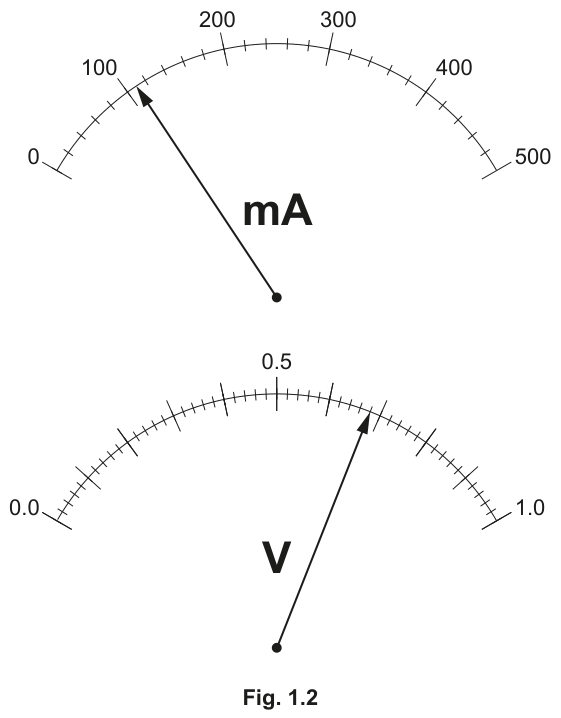
Record the readings of current and voltage for this length of wire.
current = ______
voltage = ______
- The student switches off the power supply.
- He removes the wire and replaces it with a different length of wire.
- He repeats the procedure for wires of length , , and .
- The values of , and that he obtains are shown in Table 1.1.
Table 1.1
| 20.0 | 0.58 | 0.180 | 3.2 |
| 40.0 | |||
| 60.0 | 0.75 | 0.076 | 9.9 |
| 80.0 | 0.82 | 0.066 | 12.4 |
| 100.0 | 0.86 | 0.056 | 15.4 |
Complete Table 1.1, using your recorded readings in (c)(ii).
On Fig. 1.3, plot the graph of on the y-axis against on the x-axis. Start both axes from the origin (0,0).
Draw the straight line of best fit.
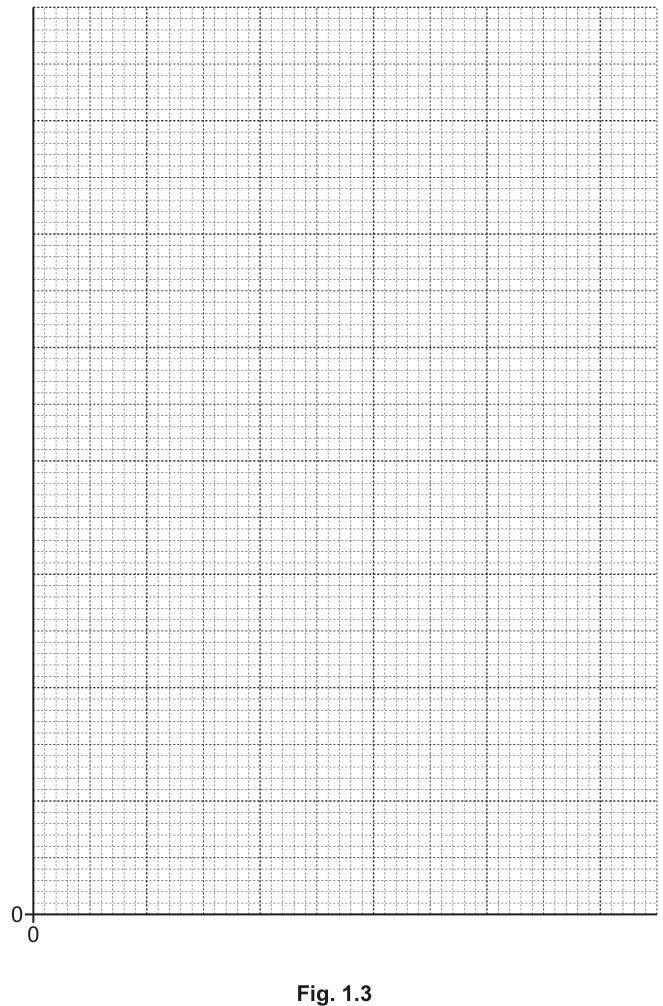
State the relationship between and shown by your graph.
______
Use your graph to determine the length of wire that has a resistance of .
Show how you determine this value on your graph.
length of wire needed = ______
A second student carries out the same experiment.
- He uses one single length of wire.
- He connects two crocodile clips at different points along the wire so that the required length of wire for each measurement is between them for each reading.
He switches off the power supply after each reading and waits a short time before taking the next reading.
Suggest a reason for waiting a short time.
______
The rest of this paper
3 more questions- Q2Experimental Contexts · Observations and Measurements · Analysis, Conclusions and Evaluation5M
- Q3Experimental Contexts · Use of Techniques, Apparatus and Materials · Observations and Measurements · Analysis, Conclusions and Evaluation7M
- Q4Use of Techniques, Apparatus and Materials · Experimental Contexts5M