Physics 5054/21 — May/June 2021
Cambridge O-Level · Theory · worked solutions for every part, with the mark scheme
Topics Forces · Electric Circuits · Current, Voltage and Resistance · Physical Quantities and Measurement · Kinematics · Transfer of Thermal Energy · +12 more
An aircraft flies at a constant height.
Air drag and the force from the aircraft's engines together produce a force on the aircraft of due north, as shown in Fig. 1.1.
The wind produces a force of towards the east.
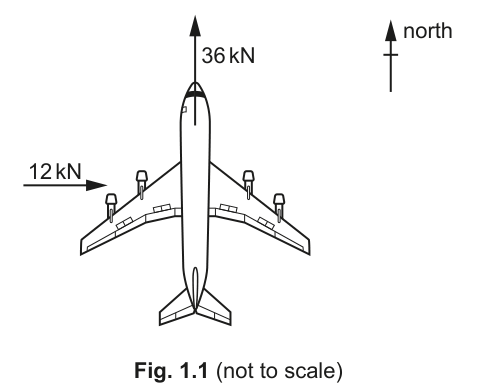
Draw a scale drawing to show the resultant force acting on the aircraft.
Use your drawing to determine the size of the resultant force and the angle between the resultant force and north.
size of resultant force = ______
angle = ______
Answer
Scale vector diagram: using a scale of 1 cm = 10 kN, draw a vertical arrow 3.6 cm long pointing north, labelled 36 kN. From its tip, draw a horizontal arrow 1.2 cm long pointing east, labelled 12 kN. Join the start to the end to show the resultant force.
size of resultant force = 38 kN
angle = 18°
38 kN, 18°
Walkthrough
To find the resultant of two perpendicular forces, a scale vector diagram is constructed. A convenient scale is 1 cm = 10 kN, so the northward force is drawn as a 3.6 cm arrow and the eastward force as a 1.2 cm arrow starting from the tip of the first. The resultant is the vector joining the tail of the first to the tip of the second. Measuring this resultant gives a length of about 3.8 cm, which corresponds to 38 kN. The angle measured from the north direction is about 18°.
Key Takeaways
Vector addition of perpendicular forces can be done graphically using a scale diagram. The magnitude and direction are read directly from the drawing.
Common Mistakes
Forgetting to use a consistent scale, drawing the vectors in the wrong order (though for perpendicular vectors the resultant is the same), or measuring the angle from the east axis instead of north.
Things to Be Careful About
Allow a range for the measured values (37-39 kN and 15-21°). Ensure the scale is stated and the diagram is drawn to scale. The angle must be measured from the north direction as requested.
The acceleration of the aircraft is uniform.
Describe how a uniform acceleration differs from a non-uniform acceleration.
Answer
In uniform acceleration, the velocity increases by the same amount in equal time intervals (or the rate of change of velocity is constant). In non-uniform acceleration, the velocity does not increase by the same amount in equal time intervals (or the acceleration changes).
Uniform acceleration is a constant rate of change of velocity, whereas non-uniform acceleration is a changing rate of change of velocity.
Walkthrough
Acceleration is defined as the rate of change of velocity. Uniform acceleration means this rate of change is constant, so the velocity changes by the same amount in any equal time period. Non-uniform acceleration means the rate of change of velocity is not constant; it varies with time.
Key Takeaways
Uniform acceleration implies a constant rate of change of velocity, which would appear as a straight line on a speed-time graph. Non-uniform acceleration implies a changing rate of change, appearing as a curved line on a speed-time graph.
Common Mistakes
Saying 'constant speed' instead of 'constant rate of change of velocity'. Acceleration is about how velocity changes, not about the velocity itself being zero or constant.
Things to Be Careful About
Use the word 'velocity' or 'speed' correctly. The mark scheme accepts 'same increase in speed/velocity in same time' or 'constant acceleration'. Be precise about what is constant (the rate of change, not the velocity).
The mass of the aircraft is .
Calculate the acceleration of the aircraft.
acceleration = ______
Working
Answer
0.63 m/s²
0.63 m/s²
Walkthrough
Newton's second law states that the resultant force on an object is equal to its mass multiplied by its acceleration (). Rearranging for acceleration gives . The resultant force from part (a) is 38 kN, which is 38,000 N. The mass is 60,000 kg. Substituting these values gives m/s², which rounds to 0.63 m/s².
Key Takeaways
Always convert forces from kN to N before substituting into . The equation can be rearranged to solve for any of the three variables.
Common Mistakes
Forgetting to convert 38 kN to 38,000 N, which gives an answer of 0.63 instead of 630 or 0.00063. Using the wrong mass or force value.
Things to Be Careful About
The mark scheme accepts a range of 0.63-0.66 m/s², which accounts for the slight variation in the resultant force read from the scale diagram (37-39 kN). Ensure units are consistent: force in newtons, mass in kilograms, acceleration in m/s².
The rest of this paper
9 more questions- Q2Transfer of Thermal Energy5M
- Q3Thermal Properties of Matter6M
- Q4General Properties of Waves · Electromagnetic Spectrum · Sound6M
- Q5Lenses and Dispersion · Reflection and Refraction of Light6M
- Q6Electromagnetic Induction and Transformers7M
- Q7Electric Circuits · Current, Voltage and Resistance · Practical Electricity8M
- Q8Forces · Turning Effect of Forces · Energy, Work and Power15M
- Q9Electric Circuits · Current, Voltage and Resistance15M
- Q10Radioactivity · The Nuclear Atom15M