Physics 5054/42 — October/November 2020
Cambridge O-Level · Alternative to Practical · worked solutions for every part, with the mark scheme
Topics Experimental Contexts · Analysis, Conclusions and Evaluation · Observations and Measurements · Use of Techniques, Apparatus and Materials · Planning Experiments and Investigations
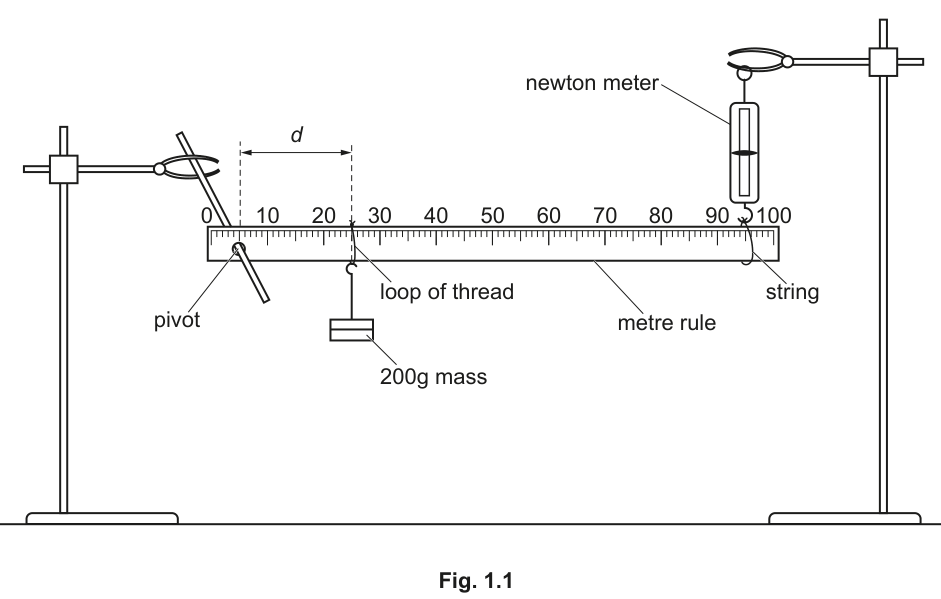
A student investigates the balancing of a metre rule.
She uses a metre rule that has a small hole drilled through it at the mark.
- She pivots the rule at the mark.
- She supports the other end of the rule using a newton meter attached to a loop of string placed at the mark.
- She suspends a mass from the rule using a loop of thread.
- The student moves the loop of thread supporting the mass until it is at the mark on the metre rule.
Fig. 1.1 shows the apparatus set up by the student.
- She calculates the distance of the mass from the pivot and records her value in the first row of Table 1.1.
- She adjusts the height of the clamp supporting the newton meter until the rule is horizontal.
- She records the reading on the newton meter in the first row of Table 1.1.
- The student repeats this procedure with the loop of thread supporting the mass at the , , and marks on the metre rule.
Table 1.1
| reading on rule / | distance from pivot / | newton meter reading / |
|---|---|---|
| 25.0 | 20.0 | 1.1 |
| 40.0 | 35.0 | 1.4 |
| 55.0 | ||
| 65.0 | 60.0 | 2.0 |
| 80.0 | 75.0 | 2.3 |
Fig. 1.2 shows the newton meter reading when the mass is placed at the mark on the metre rule.
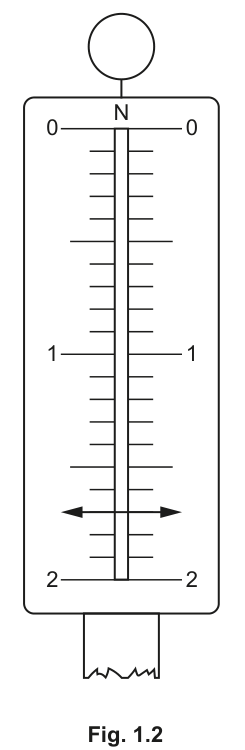
In Table 1.1, record the distance of the mass from the pivot.
In Table 1.1, record the reading on the newton meter.
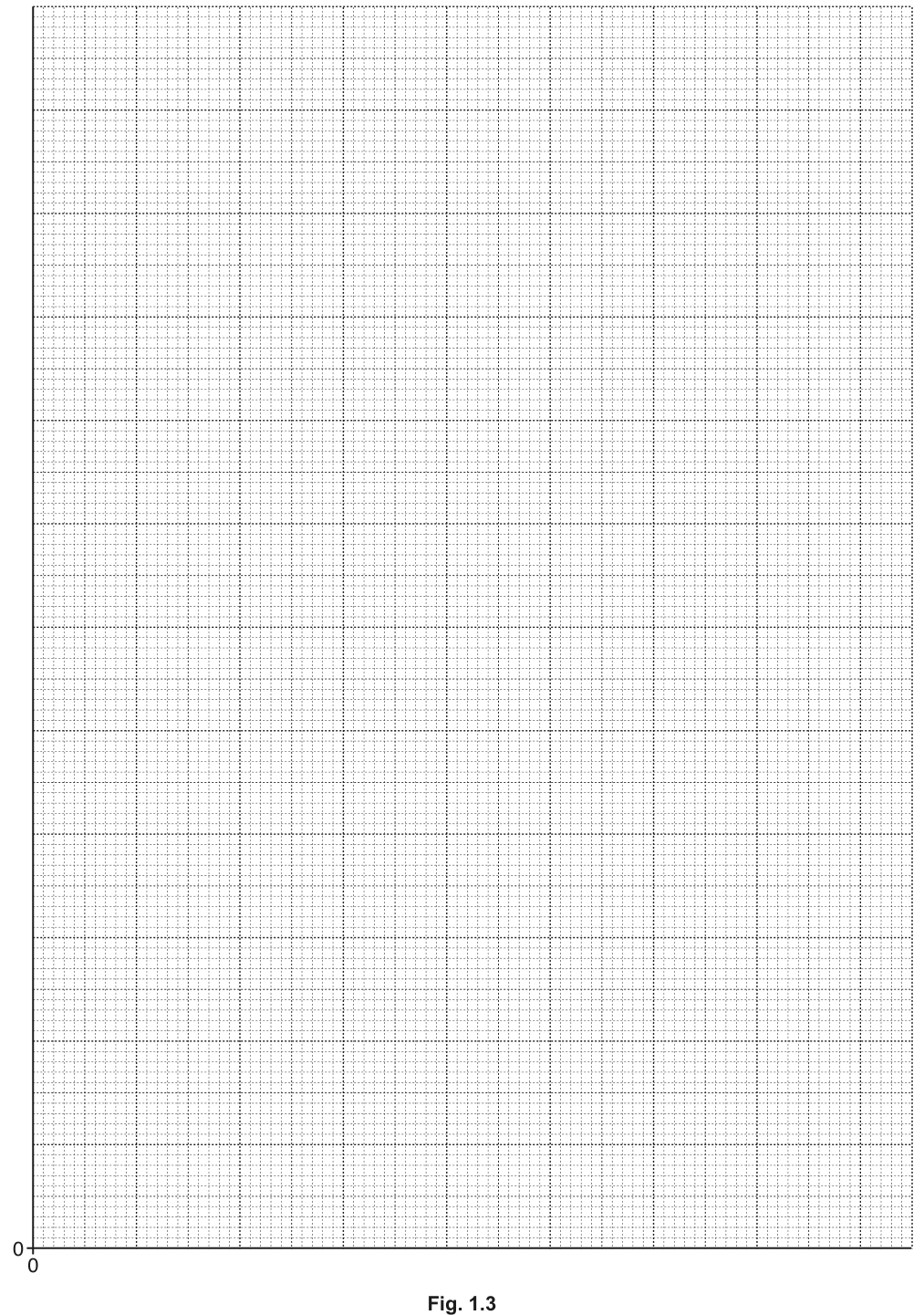
On Fig. 1.3, plot a graph of on the -axis against on the -axis. Start both axes from the origin. Draw the straight line of best fit.
Calculate the gradient of your line.
Show all working and indicate on the graph the values you choose.
= ______
Extend your line so that it cuts the -axis. Write down the intercept that your line makes with the -axis.
= ______
Calculate , where
= ______
The weight of the metre rule is given by the equation shown
where .
Calculate . Give your answer to an appropriate number of significant figures.
= ______
When performing the investigation, the student rests a spirit level on the rule to check that the rule is horizontal before taking each newton meter reading.
Suggest why using a spirit level in this way is not suitable for carrying out the check in this instance.
Describe a method, other than using a spirit level, of checking that the rule is horizontal.
The rest of this paper
3 more questions- Q2Experimental Contexts · Observations and Measurements · Analysis, Conclusions and Evaluation6M
- Q3Use of Techniques, Apparatus and Materials · Experimental Contexts · Analysis, Conclusions and Evaluation6M
- Q4Observations and Measurements · Experimental Contexts · Use of Techniques, Apparatus and Materials · Analysis, Conclusions and Evaluation · Planning Experiments and Investigations4M