Physics 5054/41 — October/November 2020
Cambridge O-Level · Alternative to Practical · worked solutions for every part, with the mark scheme
Topics Experimental Contexts · Observations and Measurements · Analysis, Conclusions and Evaluation · Use of Techniques, Apparatus and Materials · Planning Experiments and Investigations
A student investigates how the strength of a bridge varies with its width. Fig. 1.1 shows the apparatus that the student uses.
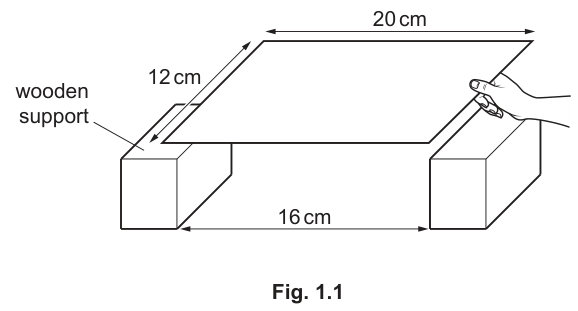
The student is given a rectangular piece of card which is 20 cm long and 12 cm wide. The card represents the bridge. The length of the card does not change but the width is reduced during the experiment.
She also has two identical wooden supports which are placed so that the gap between them is 16 cm.
- She places the card on the supports to make a bridge.
- She loads the bridge by placing identical coins, one at a time, onto it.
- She places the coins on top of each other on the middle of the card.
Suggest why she places the coins in the middle of the card.
She needs to know the mass of each coin. The balance available measures mass to the nearest gram.
Describe how the student uses this balance to find the mass of a coin to the nearest 0.1 g.
Each coin has a mass of 3.4 g.
- She adds coins carefully, one at a time, onto her bridge until the bridge collapses.
- She records the number of coins that the bridge holds just before it collapses.
- She repeats this four more times.
The number of coins needed is:
Find the average mass in grams that the card can support. Give your answer to 2 significant figures.
= ______
- She cuts a 2 cm wide strip from the long side of her card.
- The width of the card remaining is 10 cm.
- She repeats the experiment.
- She compares the results for the two widths of card.
Suggest one way in which her method allows a fair comparison to be made.
- She repeats this procedure until there is only a 2 cm wide piece of card left.
Her results are recorded in Table 1.1.
Table 1.1
| width | mass |
|---|---|
| 12 | |
| 10 | 37 |
| 8 | 26 |
| 6 | 18 |
| 4 | 11 |
| 2 | 5 |
Add your value for from 1(b)(ii) to Table 1.1.
On Fig. 1.2, plot a graph of on the y-axis against on the x-axis. Start both axes from the origin. Draw the smooth curve of best fit.
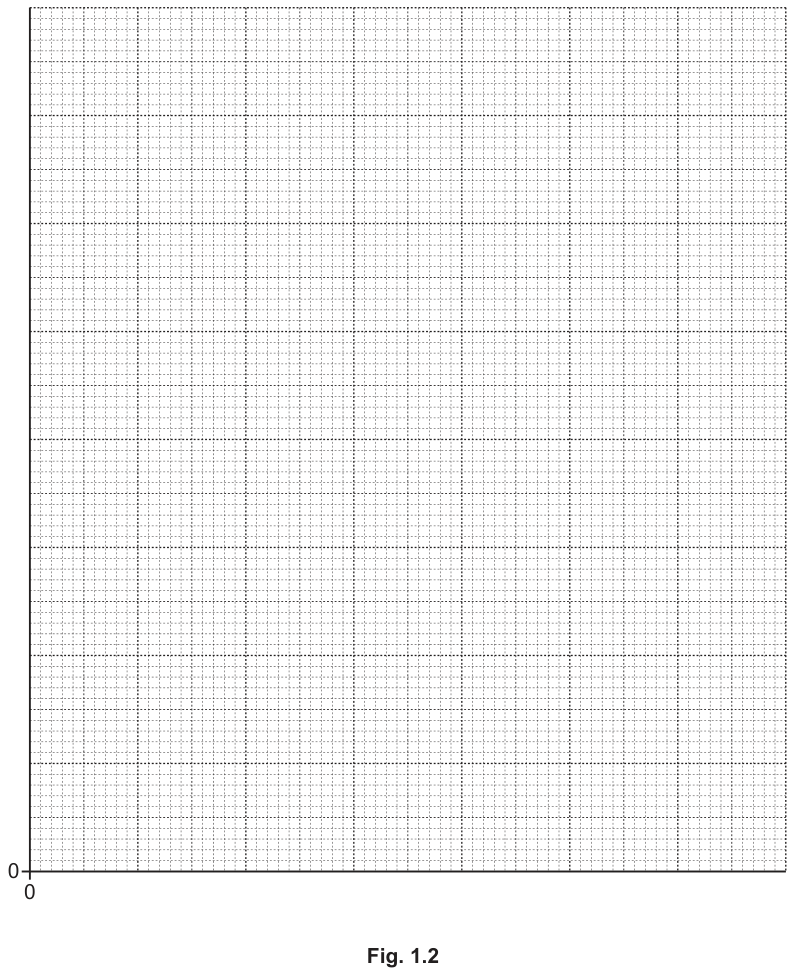
Extend your curve to estimate the mass of coins that collapse the bridge for a card that is 13 cm wide.
Show your working on the grid in Fig. 1.2.
mass of coins = ______
Suggest how the student can alter the apparatus so that the bridge holds more mass for all widths of card.
Each student in the class has only one piece of card at the start of the experiment. A second student decides to carry out the experiment starting with a 2 cm wide piece of card and then increasing the width.
Suggest why this causes a problem.
The rest of this paper
3 more questions- Q2Use of Techniques, Apparatus and Materials · Observations and Measurements · Experimental Contexts · Analysis, Conclusions and Evaluation9M
- Q3Experimental Contexts · Observations and Measurements3M
- Q4Use of Techniques, Apparatus and Materials · Experimental Contexts5M