Physics 5054/22 — October/November 2020
Cambridge O-Level · Theory · worked solutions for every part, with the mark scheme
Topics Mass, Weight and Density · Turning Effect of Forces · Energy, Work and Power · Transfer of Thermal Energy · Kinetic Particle Model of Matter · Thermal Properties of Matter · +11 more
A glass beaker has a mass of . A liquid of density is poured into the beaker until it reaches the mark.
Calculate the total mass of the beaker and its contents.
Working
Answer
410 g (or 0.41 kg)
410 g
Walkthrough
The question asks for the total mass of the beaker and the liquid inside it. We are given the mass of the empty beaker (), the density of the liquid (), and the volume of the liquid ().
First, we calculate the mass of the liquid using the density formula . Substituting the given values: .
Next, we add the mass of the liquid to the mass of the beaker to find the total mass: . This can also be expressed in kilograms as .
Key Takeaways
- The relationship between mass, density, and volume is .
- Total mass is the sum of the masses of all components (container + contents).
- Always check if the final answer requires a specific unit; and are both acceptable here.
Common Mistakes
- Forgetting to add the mass of the beaker () and only calculating the mass of the liquid.
- Using the wrong formula, such as dividing density by volume or multiplying mass and volume incorrectly.
Things to Be Careful About
- Ensure units are consistent. Here, density is in and volume is in , so the mass will naturally be in grams. Convert to kg only if required or for convenience in later parts.
The centre of mass of a metre rule is at the mark.
State what is meant by centre of mass.
Answer
The point at which the entire mass of an object appears to be concentrated, or the point at which the object balances.
The point at which the entire mass of an object appears to be concentrated, or the point at which the object balances
Walkthrough
This part asks for the definition of the centre of mass. The centre of mass is a specific point in an object where all its mass can be considered to be concentrated for the purpose of calculating moments and gravitational forces. Practically, it is the point through which the object's weight acts, and if supported at this point, the object will balance perfectly in any orientation.
Key Takeaways
- The centre of mass is the average position of all the parts of the system, weighted according to their masses.
- For a uniform object like a metre rule, the centre of mass is at its geometric centre (the mark).
Common Mistakes
- Saying 'the point where gravity acts' is not precise enough; it is where the weight appears to act or where the mass is concentrated.
- Confusing centre of mass with centre of gravity (though they are effectively the same in a uniform gravitational field, the O Level mark scheme specifically looks for 'mass' or 'balances').
Things to Be Careful About
- Use the exact wording expected by the mark scheme: 'where the mass appears to be concentrated' or 'where the object balances'.
The metre rule is placed on a pivot. The tip of the pivot is under the mark on the rule.
The beaker with its contents is then placed at different positions along the rule until the rule is balanced.
Fig. 1.1 shows the arrangement with the rule balanced.
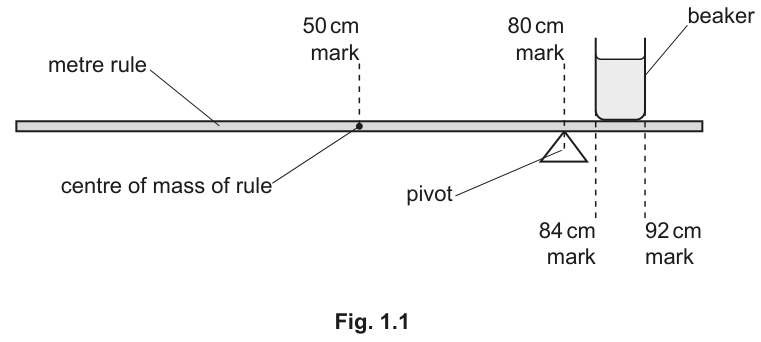
One side of the beaker is at the mark and the other side is at the mark.
Calculate the mass of the rule.
Working
The beaker spans from the mark to the mark. Its centre of mass is at the midpoint:
The pivot is at the mark. The perpendicular distance from the pivot to the beaker's centre of mass is:
The centre of mass of the metre rule is at the mark. The perpendicular distance from the pivot to the rule's centre of mass is:
By the principle of moments, the clockwise moment equals the anticlockwise moment for the rule to be balanced:
The cancels out:
Rounding to 2 significant figures:
Answer
110 g (or 0.11 kg)
110 g
Walkthrough
To find the mass of the metre rule, we apply the principle of moments about the pivot. The rule is balanced, meaning the total clockwise moment equals the total anticlockwise moment.
First, we identify the forces and their positions. The weight of the beaker and its contents () acts downwards at the centre of the beaker. Since the beaker extends from to , its centre is at . The pivot is at , so the perpendicular distance (moment arm) for the beaker is . This creates a clockwise moment.
Second, the weight of the metre rule acts downwards at its centre of mass, which is given as the mark. The distance from the pivot () to the rule's centre of mass is . This creates an anticlockwise moment.
Setting the moments equal: . Solving for gives , which rounds to to 2 significant figures.
Key Takeaways
- When an object is placed on a rule, its effective weight acts at its own centre of mass (midpoint if uniform).
- The principle of moments requires using perpendicular distances from the pivot to the line of action of each force.
- Gravitational field strength cancels out when balancing masses on the same side of the equation.
Common Mistakes
- Using the edge of the beaker ( or ) instead of its centre () for the moment calculation.
- Forgetting that the rule's own weight acts at its centre of mass ( mark), not at the end.
- Calculating the distance incorrectly (e.g., using instead of ).
Things to Be Careful About
- Always find the centre of mass of the beaker itself before calculating its moment arm.
- Ensure distances are measured from the pivot, not from the mark.
- Round the final answer to an appropriate number of significant figures (2 s.f. is standard here, giving ).
The rest of this paper
8 more questions- Q2Energy, Work and Power7M
- Q3Transfer of Thermal Energy7M
- Q4Kinetic Particle Model of Matter · Thermal Properties of Matter8M
- Q5Practical Electricity7M
- Q6The Nuclear Atom · Radioactivity9M
- Q7Kinematics · Physical Quantities and Measurement · Forces15M
- Q8Reflection and Refraction of Light · Lenses and Dispersion15M
- Q9Simple Magnetism and Magnetic Fields · Current, Voltage and Resistance · Magnetic Effect of a Current and the d.c. Motor15M