Physics 5054/21 — October/November 2020
Cambridge O-Level · Theory · worked solutions for every part, with the mark scheme
Topics Forces · Energy, Work and Power · Kinematics · Kinetic Particle Model of Matter · Physical Quantities and Measurement · Mass, Weight and Density · +10 more
Fig. 1.1 is the distance–time graph for a skydiver who jumps from a balloon at time .
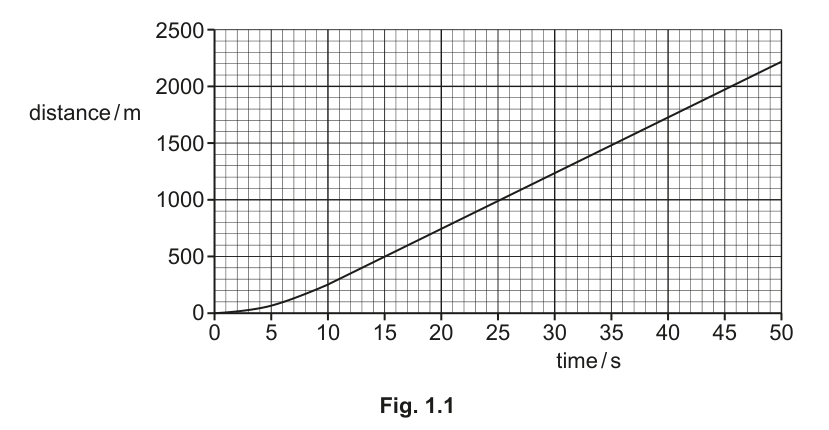
The first part of the graph shows the motion of the skydiver from when he jumps until he reaches terminal velocity.
Describe the motion of the skydiver between and .
Answer
The skydiver is accelerating (speed is increasing). The acceleration is decreasing (speed is increasing at a decreasing rate).
Accelerating with decreasing acceleration
Walkthrough
A distance-time graph shows how far an object has travelled over time. The gradient of the graph at any point gives the speed. Between and , the curve is rising, which means the distance is increasing and the skydiver is moving. The gradient is getting steeper, so the speed is increasing — the skydiver is accelerating. However, the curve is bending over (concave down), meaning the gradient is increasing at a slower and slower rate. This tells us the acceleration is decreasing, even though the speed is still going up.
Key Takeaways
- The gradient of a distance-time graph represents speed.
- A straight line means constant speed (zero acceleration).
- A curve with an increasing gradient means increasing speed (acceleration).
- A curve that bends over (increasing gradient but at a decreasing rate) means decreasing acceleration.
Common Mistakes
- Saying "the skydiver is decelerating" just because the curve bends over. Deceleration means the speed is actually falling, which would show as a curve with a decreasing gradient (bending the other way).
- Forgetting to mention that the acceleration is decreasing; just saying "accelerating" only scores one mark.
Things to Be Careful About
- Use precise language: "speed is increasing" is better than "going faster". "Acceleration is decreasing" is a distinct mark from "speed is increasing".
Explain the motion of the skydiver between and in terms of the forces acting on him.
Answer
Initially, the only force acting is the weight (force of gravity), so there is a large resultant force downwards causing acceleration. As the speed increases, the air resistance (drag) increases. The resultant force therefore decreases. When the air resistance equals the weight, the forces balance and the resultant force is zero, so the skydiver stops accelerating and falls at a constant terminal velocity.
Weight causes acceleration; air resistance increases with speed until it equals weight, making the resultant force zero
Walkthrough
To explain the motion, we apply Newton's second law () and consider the forces acting on the skydiver. There are two main forces: the downward weight () and the upward air resistance ().
- At the moment of the jump (), the speed is zero, so air resistance is zero. The only force is weight, giving a large resultant force downwards and therefore a large downward acceleration.
- As the skydiver falls and gains speed, air resistance increases. Air resistance depends on speed, so it grows as the skydiver falls faster.
- Because the upward air resistance is growing, the resultant force () gets smaller. A smaller resultant force means a smaller acceleration, even though the speed is still increasing.
- Eventually, the speed becomes high enough that the air resistance equals the weight. At this point, the forces are balanced, the resultant force is zero, and by Newton's first law, the skydiver continues at a constant speed — the terminal velocity.
Key Takeaways
- Terminal velocity is reached when drag equals weight, making the resultant force zero.
- Air resistance increases with speed.
- A decreasing resultant force means decreasing acceleration, not necessarily decreasing speed.
Common Mistakes
- Saying "gravity decreases" or "weight decreases" as the skydiver falls. Weight is constant (approximately) near Earth's surface.
- Stopping the explanation at "forces balance" without explaining why they balance (air resistance increases with speed).
- Using the word "heat" instead of "thermal energy" if discussing energy, though not relevant here.
Things to Be Careful About
- The mark scheme specifically looks for the link between speed and air resistance. Just saying "air resistance increases" without linking it to increasing speed may not score.
- "Resultant force" is the preferred term over just "force" when discussing acceleration.
Using Fig. 1.1, determine the terminal velocity of the skydiver.
On Fig. 1.1, indicate any values used for your calculation.
terminal velocity = ______
Working
The terminal velocity is the constant speed reached when the graph becomes a straight line. We find this by calculating the gradient of the straight-line section (from about to ).
Reading two coordinates from the straight-line section of the graph:
Point 1:
Point 2:
(Any two clear points on the straight line giving a gradient between 48 and 52 m/s are accepted. For example, using and gives .)
Answer
50 m/s
50 m/s
Walkthrough
Terminal velocity is the constant maximum speed reached when the resultant force on a falling object becomes zero. On a distance-time graph, constant speed is represented by a straight line with a constant gradient. Therefore, the terminal velocity is simply the gradient of the straight-line portion of the graph.
- Identify the straight-line section: The curve flattens out and becomes a straight line from approximately onwards.
- Choose two points on this straight line that are far apart to minimize reading errors. Good choices are and , or and .
- Calculate the gradient: .
- Substitute the values: .
The mark scheme accepts any answer between 48 and 52 m/s, acknowledging slight variations in reading the graph.
Key Takeaways
- Terminal velocity corresponds to the straight-line section of a distance-time graph.
- Speed is the gradient of a distance-time graph.
- Always use two points on the line to calculate a gradient; do not just read a single coordinate.
Common Mistakes
- Calculating the gradient from the curved section (e.g., using the origin and a point on the curve). This gives an average speed, not the terminal velocity.
- Forgetting the units. The vertical axis is in metres and the horizontal axis is in seconds, so the gradient is in m/s.
- Reading a single coordinate and dividing by the time (e.g., ). This is incorrect unless the line passes through the origin, which the straight-line section does not.
Things to Be Careful About
- When reading coordinates from the graph, ensure you are reading from the straight-line section only.
- The mark scheme explicitly requires "two different pairs of co-ordinates" to be shown or used, so write them down in your working to secure the method marks (C1).
- A triangle drawn on the graph showing the and values is good practice and helps avoid errors.
The rest of this paper
9 more questions- Q2Physical Quantities and Measurement · Forces · Kinematics · Mass, Weight and Density5M
- Q3Turning Effect of Forces · Energy, Work and Power6M
- Q4Reflection and Refraction of Light6M
- Q5[Legacy] Temperature and Thermometry6M
- Q6Electromagnetic Induction and Transformers7M
- Q7Stars and the Universe · Energy, Work and Power7M
- Q8Pressure · Forces · Kinetic Particle Model of Matter15M
- Q9Thermal Properties of Matter · Kinetic Particle Model of Matter · Energy, Work and Power15M
- Q10Current, Voltage and Resistance · Electric Circuits · Uses of an Oscilloscope15M