Physics 5054/12 — October/November 2020
Cambridge O-Level · Multiple Choice · answer key with instant marking and worked solutions
Topics Forces · Energy, Work and Power · Kinetic Particle Model of Matter · Electric Circuits · Mass, Weight and Density · Sound · +15 more
Tap an option under each question to check it — your score builds as you go.
A heavy nail is fixed firmly to a wall. It is pulled by a string at to the vertical. The nail does not move.
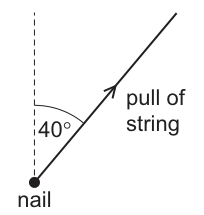
Three forces act on the nail:
its weight ,
the tension in the string,
the force exerted by the wall.
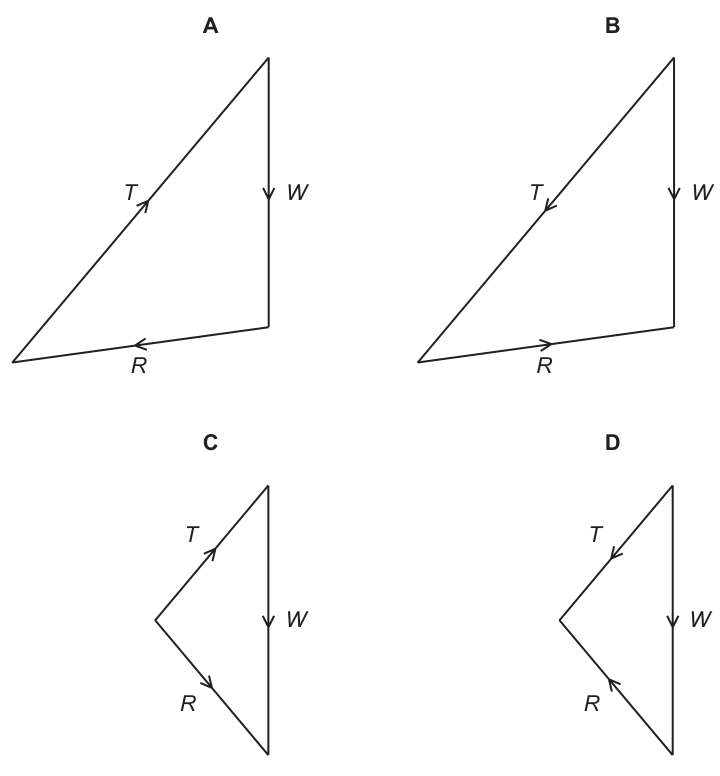
Which diagram, drawn to scale, represents the three forces?
Options
Working
The nail is in equilibrium, so the resultant force on it is zero. The three forces — weight , tension , and wall reaction — must therefore form a closed triangle when drawn head-to-tail.
- Weight acts vertically downwards.
- Tension acts along the string, pulling the nail. Since the string is directed upwards and to the right at to the vertical, points upwards and to the right.
- For the horizontal components to balance, the wall must exert a force to the left (since has a rightward component).
Diagram A shows downwards, upwards and to the right, and to the left. Tracing these head-to-tail (down , left , up-right ) forms a closed triangle, satisfying .
Diagram B has pointing the wrong way. Diagram C has pointing right, which cannot balance 's rightward component. Diagram D has pointing the wrong way.
Answer
A
A
Walkthrough
- State the equilibrium condition: The nail is fixed and does not move, meaning it is in static equilibrium. By Newton's first law, the resultant force acting on it is zero.
- Determine the direction of each force:
- Weight : Always acts vertically downwards towards the centre of the Earth.
- Tension : Acts along the string, pulling the nail away from it. The string goes upwards and to the right at to the vertical, so must point upwards and to the right.
- Reaction force : Must balance the other two forces. Since has a horizontal component to the right, must have a horizontal component to the left to ensure the net horizontal force is zero.
- Apply the triangle of forces: When three forces are in equilibrium, they can be drawn as a closed triangle if placed head-to-tail. The vector sum means that following the arrows in sequence must return you to the starting point.
- Evaluate the options:
- A: is down, is left, is up-right. Tracing head-to-tail (down left up-right) closes the triangle perfectly. All directions match our analysis.
- B: is drawn pointing down-left, which contradicts the string pulling the nail up and right.
- C: is drawn pointing down-right. This would add to the rightward pull of instead of balancing it, so the horizontal resultant cannot be zero.
- D: is drawn pointing down-left, again contradicting the physical setup.
- Conclusion: Diagram A is the only correct representation.
Key Takeaways
- An object in equilibrium has a resultant force of zero.
- Three concurrent forces in equilibrium can be represented as a closed triangle of forces when drawn head-to-tail.
- Tension in a string always acts along the string, pulling away from the object it is attached to.
- The reaction force from a wall must have a component normal to the surface to balance any lateral pull.
Common Mistakes
- Drawing tension in the wrong direction: Tension pulls away from the object along the string. Candidates sometimes draw it pointing down the string towards the anchor point.
- Forgetting the horizontal balance: Some candidates only check vertical components and miss that must point leftwards to balance the rightward horizontal component of .
- Misinterpreting the triangle: Forgetting that the arrows must be placed head-to-tail to form a closed loop; checking only the directions without verifying the head-to-tail closure leads to selecting diagrams like C where the vectors do not form a closed polygon.
Things to Be Careful About
- Vector direction vs. line of action: The line of action of is along the string, but the arrow must point away from the nail (up and right). The angle to the vertical confirms it is not purely horizontal or vertical.
- Closed triangle rule: The triangle of forces requires head-to-tail placement. Just having the correct directions is not enough; the vectors must connect tip-to-tail to sum to zero.
- Wall reaction direction: The force from the wall is not necessarily purely horizontal. Because the nail is "fixed firmly", the wall can exert both a normal reaction and a frictional force, so can point at any angle necessary to maintain equilibrium (here, left and slightly down or up depending on magnitudes, but definitely leftwards).
The rest of this paper
39 more questions- Q2Kinematics1M
- Q3Kinematics1M
- Q4Forces1M
- Q5Forces1M
- Q6Forces1M
- Q7Mass, Weight and Density · Physical Quantities and Measurement1M
- Q8Mass, Weight and Density1M
- Q9Static Electricity · Mass, Weight and Density1M
- Q10Forces1M
- Q11Forces1M
- Q12Kinetic Particle Model of Matter1M
- Q13Energy, Work and Power1M
- Q14Energy, Work and Power1M
- Q15Energy, Work and Power1M
- Q16Energy, Work and Power1M
- Q17Transfer of Thermal Energy1M
- Q18[Legacy] Temperature and Thermometry1M
- Q19Thermal Properties of Matter1M
- Q20Kinetic Particle Model of Matter1M
- Q21Kinetic Particle Model of Matter1M
- Q22Kinetic Particle Model of Matter1M
- Q23Reflection and Refraction of Light1M
- Q24Reflection and Refraction of Light · General Properties of Waves1M
- Q25Electromagnetic Spectrum1M
- Q26Sound1M
- Q27Sound1M
- Q28Sound1M
- Q29Energy, Work and Power1M
- Q30Current, Voltage and Resistance · Electric Circuits1M
- Q31Electric Circuits1M
- Q32Electric Circuits1M
- Q33Practical Electricity1M
- Q34Electromagnetic Induction and Transformers1M
- Q35Energy, Work and Power1M
- Q36Electromagnetic Induction and Transformers1M
- Q37Uses of an Oscilloscope · Current, Voltage and Resistance1M
- Q38Electric Circuits1M
- Q39Radioactivity1M
- Q40The Nuclear Atom1M