Physics 5054/32 — October/November 2019
Cambridge O-Level · Practical Test · worked solutions for every part, with the mark scheme
Topics Experimental Contexts · Observations and Measurements · Analysis, Conclusions and Evaluation · Use of Techniques, Apparatus and Materials · Planning Experiments and Investigations
In this experiment, you will investigate the oscillation of a mass on a spring.
You are provided with:
- 2 springs joined together end to end, attached to a piece of marked card
- a stopwatch
- 3 pieces of Blu Tack of equal mass
- a stand, boss and clamp
- a set square
- a metre rule.
Take one piece of Blu Tack and press it onto position on the card. Press the second piece onto position as shown in Fig. 1.1.
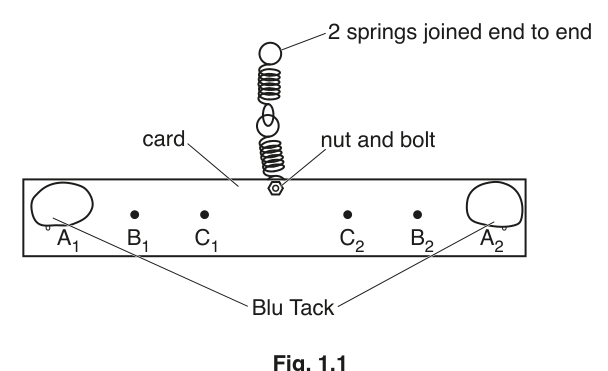
Pass the loop of the top spring on to the clamp, and secure this loop to the clamp with the third piece of Blu Tack. Make small adjustments to the position of the Blu Tack, if necessary, to ensure that the card is horizontal as shown in Fig. 1.2.
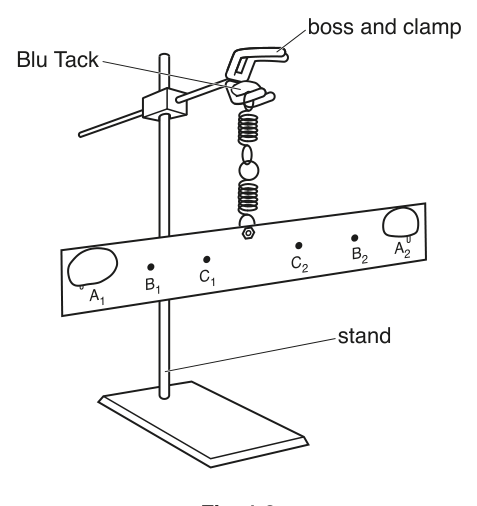
Describe how you ensure that the card is horizontal.
Answer
Use a metre rule to check that both ends of the card are at the same height above the bench. Alternatively, check that the card is parallel to a distant horizontal object such as a window sill or door frame.
Use a metre rule to check that both ends of the card are at the same height above the bench.
Walkthrough
The question asks how to ensure the card is horizontal before starting the oscillation. There are two accepted methods:
- Using a ruler: Place the metre rule on the bench and measure the vertical distance from the bench to each end of the card (e.g., at A1 and A2). If the two measurements are equal, the card is horizontal.
- Using a reference object: Look at a distant horizontal object in the room, such as a window sill, a door frame, or a shelf. Adjust the card until it appears parallel to this distant object.
Both methods are valid as long as the candidate explains how they are checking, not just that they are checking.
Key Takeaways
Basic laboratory technique for ensuring apparatus is correctly aligned. In practical papers, you must always describe the method, not just state the goal.
Common Mistakes
- Saying "look at it" or "use eye level" without a specific reference.
- Saying "make sure it is level" without explaining how the levelness is verified.
- The mark scheme explicitly rejects vague answers; it requires a ruler or a distant horizontal object.
Things to Be Careful About
- The mark scheme accepts either method. Choose the one you are most comfortable describing.
- Ensure you mention checking both ends or the whole card, not just one side.
Rotate the card by moving end away from you and end towards you. Continue to rotate until the card has moved through one complete turn and and are in their original positions.
Release the card. It will rotate in the opposite direction, stop briefly, reverse direction and stop again briefly. This is one oscillation.
Determine an accurate value of , the time for one oscillation.
= ______
Working
To get an accurate value for the time of one oscillation, , you must reduce the effect of reaction time by timing multiple oscillations.
- Time the number of complete oscillations (e.g., 10 oscillations) using the stopwatch.
- Divide the total time by the number of oscillations to find the time for one oscillation.
- Repeat this measurement at least once more and calculate the average of your results.
Answer
t_A = 7.0 s
(value in range 5.5 - 8.5 s, to at least 1 d.p.)
7.0 s (accept 5.5 - 8.5 s)
Walkthrough
Timing a single oscillation has a large percentage error due to human reaction time when starting and stopping the stopwatch. The standard technique is to time a larger number of oscillations (e.g., 10 or 20) and divide by that number to find the period of one oscillation.
You should repeat this process at least twice and calculate the average to reduce random errors. The mark scheme provides a representative value of 7.0 s, with an acceptable range of 5.5 s to 8.5 s. The value must be given to at least 1 decimal place.
Key Takeaways
- Timing multiple oscillations and dividing reduces the percentage error from reaction time.
- Repeating measurements and averaging reduces random errors.
- Always quote the answer to the appropriate number of decimal places as indicated by the blank.
Common Mistakes
- Timing only one oscillation.
- Forgetting to divide the total time by the number of oscillations timed.
- Not averaging repeated measurements.
- Giving the answer to 0 decimal places (e.g., 7 s instead of 7.0 s).
Things to Be Careful About
- The value must be in the range 5.5 - 8.5 s. If your calculated value is outside this range, you will not get the mark for the value (though you may still get the method mark if the question asked for it separately).
- Ensure the unit 's' is included if not already provided in the blank.
Repeat b(i) to determine the time:
- for one oscillation with the Blu Tack at positions and
- for one oscillation with the Blu Tack at positions and .
= ______
= ______
Answer
t_B = 5.5 s (example value, must be less than t_A and greater than t_C)
t_C = 4.0 s (example value, must be less than t_B)
Relationship:
(all values to at least 1 d.p.)
t_C < t_B < t_A (with example values such as t_B = 5.5 s and t_C = 4.0 s)
Walkthrough
The candidate repeats the timing procedure for the Blu Tack at positions B and C. The positions are arranged symmetrically: A1/A2 are furthest from the centre (springs), B1/B2 are closer, and C1/C2 are closest.
As the masses (Blu Tack) are moved closer to the springs (the axis of rotation), the moment of inertia of the system decreases. For a torsional oscillator, the period of oscillation is proportional to the square root of the moment of inertia. Therefore, a smaller moment of inertia results in a shorter period of oscillation.
This means:
- (masses furthest) is the longest time.
- (masses closer) is shorter than .
- (masses closest) is the shortest time.
So the relationship is . The candidate must provide example values that satisfy this inequality and are to at least 1 decimal place.
Key Takeaways
- Moving the masses closer to the axis of rotation decreases the time for one oscillation.
- The relationship must be consistent with the physics of the system.
Common Mistakes
- Getting the order of the times wrong (e.g., ).
- Not providing values that satisfy the inequality.
- Forgetting to give values to at least 1 decimal place.
Things to Be Careful About
- The mark scheme requires the relationship AND values to at least 1 d.p. Both are needed for the mark.
- Example values must be physically reasonable (e.g., positive, decreasing from A to C).
Describe the relationship between the position of the Blu Tack and the time for one oscillation.
Answer
The further the masses (Blu Tack) are from the springs (or the centre), the longer the time for one oscillation.
Alternatively: The closer the masses are to the springs, the shorter (or smaller) the time for one oscillation.
The further the masses from the springs the longer the time of the oscillation.
Walkthrough
Part (c) asks for a description of the relationship between the position of the Blu Tack and the time for one oscillation. This is a direct conclusion from the data collected in parts (b)(i) and (b)(ii).
From the data, we know . Position A is furthest from the springs (the axis of rotation), and position C is closest.
Therefore, as the distance of the masses from the springs increases, the time for one oscillation increases. This can be stated as:
- The further the masses from the springs, the longer the time.
- The closer the masses to the springs, the shorter the time.
Both statements are equivalent and acceptable.
Key Takeaways
- Conclusions must be directly supported by the data collected.
- Use clear comparative language (further/closer, longer/shorter).
Common Mistakes
- Stating a causal explanation (e.g., "because the moment of inertia is larger") when the question only asks to "describe the relationship". Descriptive answers are sufficient unless "explain" is used.
- Being vague (e.g., "they are different") instead of stating the direction of the trend.
Things to Be Careful About
- The question says "describe", not "explain". A descriptive statement of the trend is all that is required for the mark.
- Ensure you mention both the position (distance from springs) and the time (period of oscillation).
The rest of this paper
3 more questions- Q2Observations and Measurements · Experimental Contexts · Analysis, Conclusions and Evaluation5M
- Q3Use of Techniques, Apparatus and Materials · Experimental Contexts · Observations and Measurements · Analysis, Conclusions and Evaluation5M
- Q4Observations and Measurements · Experimental Contexts · Use of Techniques, Apparatus and Materials · Analysis, Conclusions and Evaluation · Planning Experiments and Investigations15M