Physics 5054/42 — May/June 2019
Cambridge O-Level · Alternative to Practical · worked solutions for every part, with the mark scheme
Topics Experimental Contexts · Use of Techniques, Apparatus and Materials · Analysis, Conclusions and Evaluation · Observations and Measurements
A student determines an approximate value for the specific heat capacity of water by an electrical method.
The specific heat capacity of a substance is the amount of thermal energy needed to raise the temperature of of the substance by .
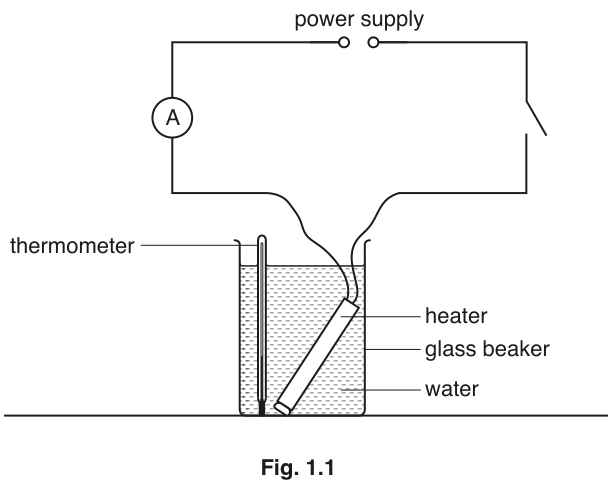
He sets up the apparatus as shown in Fig. 1.1.
- He pours a mass of water into a beaker, where .
- He places a heater into the water in the beaker.
- He connects a voltmeter to measure the potential difference across the heater.
Draw a voltmeter symbol on the circuit diagram of Fig. 1.1 to show the voltmeter measuring the potential difference across the heater.
The student measures the initial temperature of the water and records it at time in Table 1.1.
Table 1.1
| time | temperature |
|---|---|
| 0 | 21.5 |
| 60 | 27.0 |
| 120 | 32.0 |
| 180 | 37.0 |
| 240 | |
| 300 | 45.5 |
| 360 | 48.5 |
- He closes the switch, starts a stopwatch and records the temperature of the water every for 6 minutes.
- He records the current in the heater and the potential difference across the heater.
His measurements are:
- He opens the switch.
The reading of the thermometer at time is shown in Fig. 1.2.
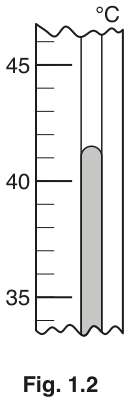
Read the thermometer and record the temperature in Table 1.1.
State why it is important to:
ensure that the heating coil is completely immersed in the water
______
stir the water before recording each temperature.
______
On the grid in Fig. 1.3, plot the graph of (-axis) against (-axis).
Start the temperature axis at .
Draw the smooth curve of best fit.

Use your graph to calculate the temperature rise of the water in the first of heating.
= ______
Calculate the thermal energy supplied by the heater in the first and give the unit.
Use the equation shown:
= ______
Calculate a value for the specific heat capacity of water. Use the mass given at the start of this question, your answers to (c)(ii) and (d)(i), and the equation:
= ______
The specific heat capacity of water is .
Examine the apparatus set-up shown in Fig. 1.1.
Suggest one practical reason why your calculated value of is inaccurate.
State one improvement to the apparatus that produces a more accurate result.
Another student repeats the experiment and forgets to switch off the heater at the end of the experiment. The temperature of the water continues to rise until it reaches and then remains constant at this value.
Suggest one reason why the temperature of the water stops increasing when it reaches .
The rest of this paper
3 more questions- Q2Experimental Contexts · Use of Techniques, Apparatus and Materials4M
- Q3Experimental Contexts · Use of Techniques, Apparatus and Materials · Analysis, Conclusions and Evaluation6M
- Q4Experimental Contexts4M