Physics 5054/32 — May/June 2019
Cambridge O-Level · Practical Test · worked solutions for every part, with the mark scheme
Topics Experimental Contexts · Observations and Measurements · Analysis, Conclusions and Evaluation · Use of Techniques, Apparatus and Materials
In this experiment, you will investigate the oscillation of a pendulum joined to a spring.
You are provided with:
- a length of thread
- a 300 g mass
- a stopwatch
- a stand, boss and clamp
- a second boss
- a split cork
- a spring
- a metre rule
- a G-clamp or weight.
The supervisor has set up the apparatus as shown in Fig. 1.1.
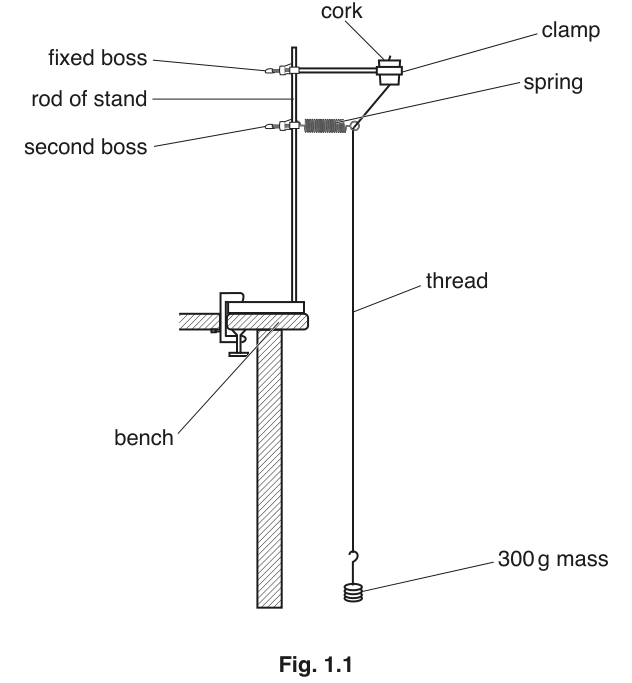
The position of the boss attached to the clamp holding the cork is fixed and must not be changed.
The position of the boss attached to the spring will be adjusted.
Ensure that the distance between the bosses is 10 cm, as shown in Fig. 1.2.
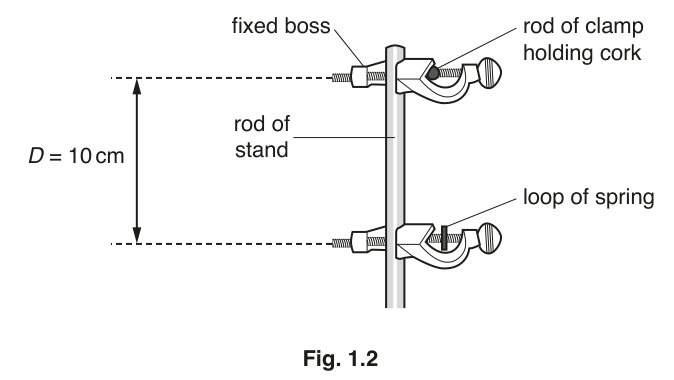
View the apparatus from the side, as shown in Fig. 1.1.
Move the right hand loop of the spring along the thread until the spring is as close to horizontal as possible.
Move the mass approximately 5 cm to the right.
Release the mass and observe it swing to the left and then return to its point of release as shown in Fig. 1.3. This is one oscillation.
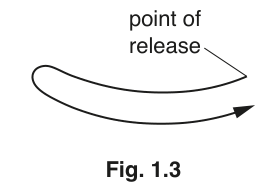
Determine the time for twenty oscillations of the pendulum.
= ______
Move the second boss down the rod of the stand until . Ensure that the spring is horizontal again.
Determine the time for twenty oscillations of the pendulum.
= ______
Move the second boss down the rod of the stand until . Ensure that the spring is horizontal.
Determine the time for twenty oscillations of the pendulum.
= ______
Describe the trend shown in the results of the experiment.
Another method to determine the time for 20 oscillations is to start and stop the stopwatch as the mass passes through the centre of the oscillation as shown in Fig. 1.4.
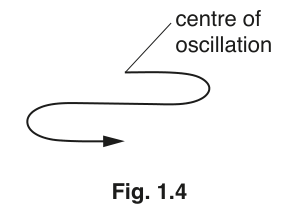
By considering the speed of the mass, suggest why this method is more accurate.
The rest of this paper
3 more questions- Q2Observations and Measurements · Experimental Contexts · Analysis, Conclusions and Evaluation5M
- Q3Observations and Measurements · Experimental Contexts · Analysis, Conclusions and Evaluation · Use of Techniques, Apparatus and Materials5M
- Q4Observations and Measurements · Experimental Contexts · Analysis, Conclusions and Evaluation15M