Physics 5054/42 — October/November 2018
Cambridge O-Level · Alternative to Practical · worked solutions for every part, with the mark scheme
Topics Use of Techniques, Apparatus and Materials · Observations and Measurements · Experimental Contexts · Analysis, Conclusions and Evaluation · Planning Experiments and Investigations
A student investigates how the current in a thermistor depends upon temperature.
She sets up the circuit shown in Fig. 1.1.
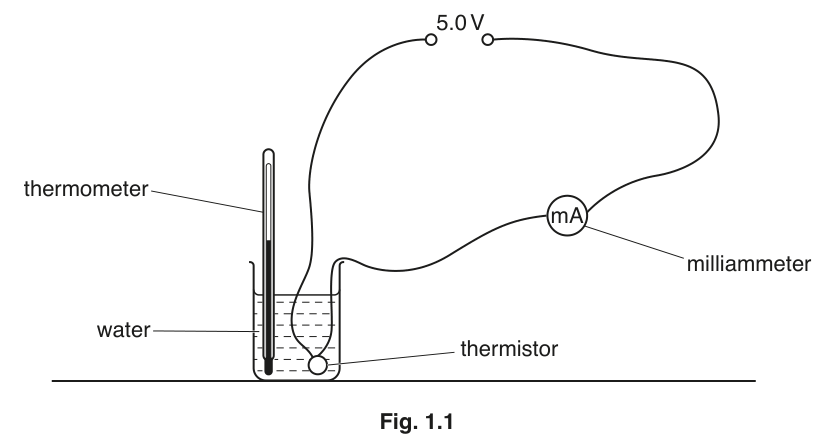
- She pours hot water into the beaker.
- She stirs the water, measures its temperature and reads the ammeter.
- She records the values of temperature and current in the table of Fig. 1.2.
- She repeats these readings at intervals, as the water cools, until the water reaches room temperature.
- She records all her readings in the table, as shown in Fig. 1.2.
Fig. 1.2
| temperature | current |
|---|---|
| 80 | 2.90 |
| 70 | 2.30 |
| 60 | 1.75 |
| 50 | 1.20 |
| 40 | |
| 30 | 0.60 |
| 20 | 0.45 |
Fig. 1.3 shows the ammeter reading when the temperature of the water is .
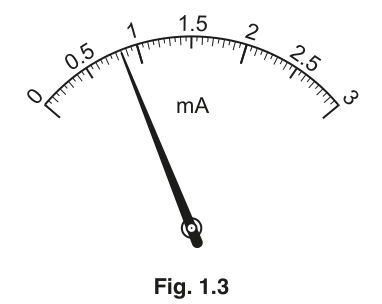
Read the ammeter and record the missing value of current in the table of Fig. 1.2.
State why the student stirs the water before taking a temperature reading.
On Fig. 1.4, plot a graph of on the y-axis against on the x-axis. Start both axes from the origin.
Draw the smooth curve of best fit.
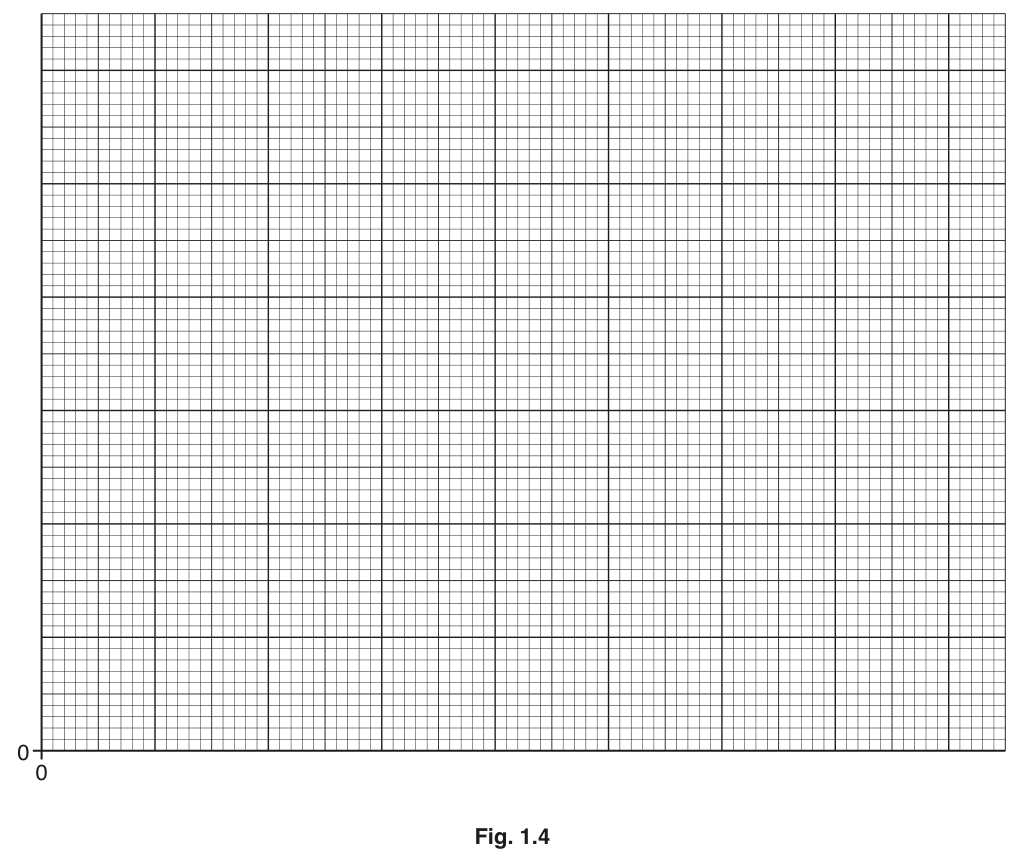
Extend your curve to predict the current for the temperature of .
current at = ______
Suggest how the student can modify her investigation to check the prediction made in (c)(i).
Use your graph to estimate the current when the temperature of the water is .
= ______
The voltage of the power supply is 5.0 V.
Use the equation
to calculate the resistance of the thermistor at .
= ______
Describe the relationship between current and temperature for the thermistor, shown by your graph.
Deduce the relationship between resistance and temperature for the thermistor.
The rest of this paper
3 more questions- Q2Observations and Measurements · Experimental Contexts · Use of Techniques, Apparatus and Materials6M
- Q3Experimental Contexts · Analysis, Conclusions and Evaluation · Observations and Measurements · Use of Techniques, Apparatus and Materials6M
- Q4Use of Techniques, Apparatus and Materials · Analysis, Conclusions and Evaluation4M