Physics 5054/32 — October/November 2018
Cambridge O-Level · Practical Test · worked solutions for every part, with the mark scheme
Topics Observations and Measurements · Experimental Contexts · Analysis, Conclusions and Evaluation
In this experiment, you will determine the power developed when sliding a wooden block across the bench.
You are provided with:
- a wooden block
- five masses
- a spring attached to the block with a piece of string
- a ruler
- a metre rule
- a stopwatch.
Set up the apparatus as shown in Fig. 1.1.
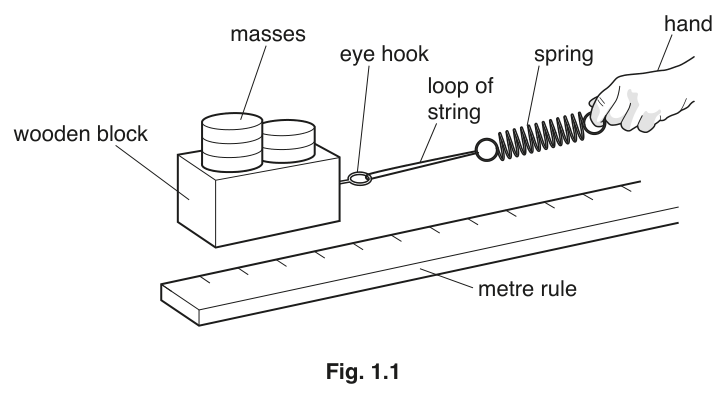
Pull the spring slowly to the right as shown in Fig. 1.1.
The spring stretches, as shown in Fig. 1.2, and the block just begins to slide. Hold the spring steady in this position.
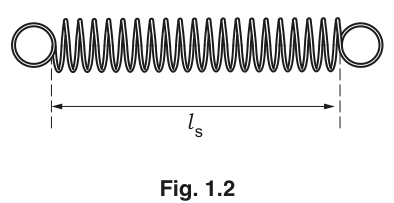
Measure the stretched length of the spring at this position.
= ______
For the spring provided, measure the unstretched length of the spring, as shown in Fig. 1.3.
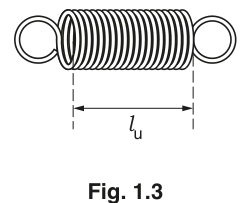
= ______
Use the equation to calculate the extension of the spring.
= ______
Use the equation to calculate the force applied by the spring, where . Give the unit of your answer.
= ______ unit ______
Pull the spring slowly to the right until the block just begins to slide on the bench.
Start the stopwatch and pull the block along the bench, keeping the extension of the spring constant.
Stop the stopwatch when the block has moved .
Repeat and find the average value for the time taken. Show your working.
= ______
Use the equation
to calculate the power developed.
= ______
The rest of this paper
3 more questions- Q2Observations and Measurements · Experimental Contexts · Analysis, Conclusions and Evaluation5M
- Q3Experimental Contexts · Observations and Measurements · Analysis, Conclusions and Evaluation5M
- Q4Observations and Measurements · Experimental Contexts · Analysis, Conclusions and Evaluation15M