Physics 5054/22 — October/November 2018
Cambridge O-Level · Theory · worked solutions for every part, with the mark scheme
Topics Kinematics · Forces · Energy, Work and Power · Transfer of Thermal Energy · Thermal Properties of Matter · Current, Voltage and Resistance · +10 more
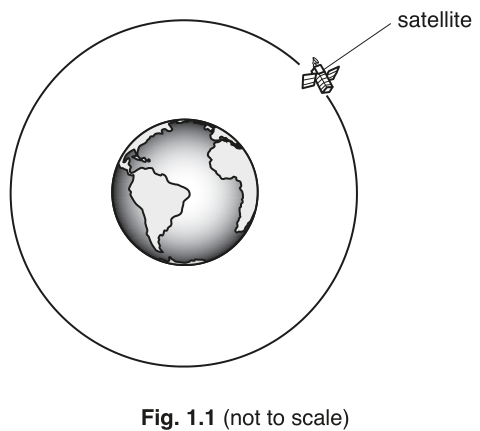
Fig. 1.1 shows a satellite travelling at a constant speed in a circular orbit around the Earth.
State how speed differs from velocity.
______
Answer
Speed is a scalar quantity (has magnitude only), whereas velocity is a vector quantity (has both magnitude and direction).
Speed does not have a direction / is a scalar quantity (while velocity has a direction / is a vector quantity)
Walkthrough
Speed is defined as the rate of change of distance. It has a magnitude (numerical value and unit) but no specified direction, which makes it a scalar quantity.
Velocity is defined as the rate of change of displacement or speed in a given direction. Because it includes both magnitude and a specific direction, it is a vector quantity.
Key Takeaways
- A scalar has magnitude only (e.g., speed, distance, mass, energy).
- A vector has both magnitude and direction (e.g., velocity, displacement, acceleration, force).
Common Mistakes
- Stating that speed and velocity are measured in different units (both are measured in ).
- Simply giving the formula without stating the fundamental difference involving direction.
Things to Be Careful About
- Ensure you clearly identify which quantity has direction (velocity) or state that speed lacks direction / is a scalar.
As it orbits the Earth, the satellite is experiencing an acceleration.
Explain, in terms of its velocity, why the satellite is accelerating.
Answer
- As the satellite moves in a circle, its direction of motion is continuously changing.
- Since velocity includes direction, the velocity is changing, and a change in velocity over time is an acceleration.
The direction of motion changes continuously, so velocity changes with time, which means there is an acceleration.
Walkthrough
- Acceleration is defined as the rate of change of velocity ().
- Velocity is a vector quantity, possessing both magnitude (speed) and direction.
- Even though the satellite's speed is constant, its direction of travel is constantly changing as it follows the circular orbit around Earth.
- Therefore, its velocity is constantly changing. Because velocity changes over time, the satellite experiences an acceleration (centripetal acceleration).
Key Takeaways
- Acceleration occurs whenever speed changes, direction changes, or both change.
- In uniform circular motion, speed is constant, but velocity changes due to continuous change in direction.
Common Mistakes
- Confusing speed with velocity and claiming there is no acceleration because speed is constant.
Things to Be Careful About
- Mention both that the direction (of velocity) is changing and that acceleration is the rate of change of velocity.
On Fig. 1.1, draw an arrow, starting on the satellite, to show the direction of the satellite's acceleration.
Answer
Draw a straight arrow starting at the satellite and pointing directly towards the centre of the Earth.
Straight arrow drawn starting on the satellite pointing towards the centre of the Earth
Walkthrough
For an object moving in a circular path at constant speed, the resultant force (gravitational force) acts towards the centre of the circle (the centre of the Earth). By Newton's second law (), the acceleration is always in the same direction as the resultant force. Therefore, the acceleration is centripetal, directed along the radius towards the centre of the Earth.
Key Takeaways
- Centripetal acceleration and centripetal force always point towards the centre of the circular path.
Common Mistakes
- Drawing the arrow tangent to the orbit in the direction of motion (which is the direction of velocity, not acceleration).
- Drawing the arrow pointing outwards away from the Earth.
Things to Be Careful About
- The arrow must start on the satellite and clearly point towards the centre of the Earth.
As the satellite orbits the Earth, it experiences a force due to gravitational attraction.
State and explain whether this force does work on the satellite and state whether the energy of the satellite is affected.
Answer
- Work done: No work is done because the gravitational force acts towards the centre of the Earth, which is perpendicular () to the satellite's direction of motion (there is no displacement in the direction of the force).
- Energy: The energy of the satellite is not affected (the kinetic energy and gravitational potential energy both remain constant).
No work is done because the force is perpendicular to the motion; energy remains constant / is unaffected.
Walkthrough
- Work done is defined as the product of the force and the distance moved in the direction of the force ().
- The gravitational force acts radially inwards towards the centre of the Earth, while the satellite's motion is along the tangent of the circular path. The angle between the force and the displacement is , meaning there is no movement in the direction of the force, so work done = .
- Because no work is done on the satellite, no energy is transferred to or from it.
- Since the satellite moves at a constant speed, its kinetic energy () is constant. Since it remains at a fixed orbital radius (distance from the Earth's centre), its gravitational potential energy is also constant. Thus, the total energy of the satellite is completely unchanged.
Key Takeaways
- When a force acts perpendicular to the direction of motion, no work is done by that force.
- In a circular orbit of constant radius and constant speed, both kinetic energy and gravitational potential energy remain constant.
Common Mistakes
- Thinking work is done because a force is acting over a large distance travelled around the orbit.
- Failing to state both parts of the question: the work done (with explanation) AND the effect on energy.
Things to Be Careful About
- Ensure you explicitly state that the force is perpendicular to the motion / there is no movement in the direction of the force, and state that energy is constant / not affected.
The rest of this paper
9 more questions- Q2Turning Effect of Forces6M
- Q3Transfer of Thermal Energy · Thermal Properties of Matter5M
- Q4Transfer of Thermal Energy · Practical Electricity · Thermal Properties of Matter8M
- Q5Static Electricity6M
- Q6Radioactivity8M
- Q7Electromagnetic Induction and Transformers · Current, Voltage and Resistance6M
- Q8Mass, Weight and Density · Energy, Work and Power · Kinematics · Forces15M
- Q9Sound · General Properties of Waves15M
- Q10Current, Voltage and Resistance · Electric Circuits15M