Physics 5054/41 — May/June 2018
Cambridge O-Level · Alternative to Practical · worked solutions for every part, with the mark scheme
Topics Use of Techniques, Apparatus and Materials · Experimental Contexts · Analysis, Conclusions and Evaluation · Observations and Measurements · Planning Experiments and Investigations
A student has two metal rods. One rod is made of copper and the other is made of iron. She carries out an experiment to see which metal is the better conductor. She lays the rods across a heat-proof mat placed on a tripod stand with the rods touching at one end, as shown in Fig. 1.1.
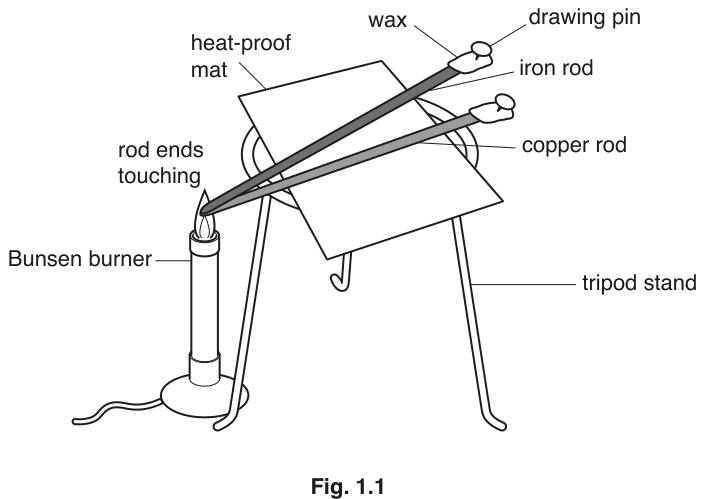
She fixes a drawing pin to the other end of each rod using a small amount of wax, which has a low melting point. She then heats the rods at the touching ends as shown.
State two features of the apparatus shown in Fig. 1.1 that ensure that the experiment is fair.
- ______
- ______
Answer
- The iron and copper rods are the same length and same thickness.
- The same amount of wax and identical drawing pins are used.
(Other acceptable answers: the rods are touching at the same position in the flame, so they are at the same temperature / same distance from the flame.)
See working
Walkthrough
To compare the thermal conductivity of two metals fairly, only the metal itself should vary. All other factors that could affect how quickly the drawing pin falls must be kept constant (control variables). These include the physical dimensions of the rods (same length and same thickness), the material and amount of wax used to hold the pins, and the size and mass of the drawing pins. The apparatus ensures the rods are heated identically by having them touch at one end directly in the flame, so they start at the same temperature and receive heat from the same position in the flame.
Key Takeaways
When comparing two materials, only the material itself should vary. All other factors affecting the outcome must be controlled. The question asks for features of the apparatus, so procedural controls (like 'heating for the same time') are not acceptable answers here.
Common Mistakes
- Saying 'same flame' is not specific enough; it must be 'same position in the flame' or 'rods touching in the flame'.
- Saying 'same heat' is not a feature of the apparatus.
- Listing procedural controls like 'start the timer at the same time' instead of apparatus features.
Things to Be Careful About
Read the question carefully: it asks for features of the apparatus shown in Fig. 1.1. The rods touching at one end is an apparatus feature that ensures they are at the same temperature. Length, thickness, wax amount, and pin size are all visible or implied apparatus features that must be identical.
Explain what happens and state how she determines which metal is the better conductor.
Answer
The wax on the copper rod melts first and the drawing pin falls off the copper rod first. This shows that copper is the better conductor of heat.
The drawing pin falls off the copper rod first
Walkthrough
Heat travels along the rods by conduction. Copper is a better thermal conductor than iron, so heat reaches the wax at the far end of the copper rod more quickly. The wax on the copper rod melts first, and the drawing pin falls off. The student determines which is the better conductor by noting which drawing pin falls off first.
Key Takeaways
A better thermal conductor transfers heat more quickly, causing the wax to melt and the pin to fall sooner.
Common Mistakes
- Saying 'the pin falls off the copper rod' without mentioning the wax melting or the pin falling first.
- Saying 'copper conducts heat faster' without linking it to the pin falling.
Things to Be Careful About
The mark scheme gives exactly one mark for this part. The answer must state that the pin falls first (or wax melts first) and identify the better conductor.
The rest of this paper
3 more questions- Q2Experimental Contexts · Use of Techniques, Apparatus and Materials · Analysis, Conclusions and Evaluation11M
- Q3Use of Techniques, Apparatus and Materials · Observations and Measurements · Experimental Contexts · Analysis, Conclusions and Evaluation8M
- Q4Experimental Contexts · Use of Techniques, Apparatus and Materials · Planning Experiments and Investigations8M