Physics 5054/22 — May/June 2018
Cambridge O-Level · Theory · worked solutions for every part, with the mark scheme
Topics Kinematics · Forces · Energy, Work and Power · Thermal Properties of Matter · Electromagnetic Induction and Transformers · Practical Electricity · +9 more
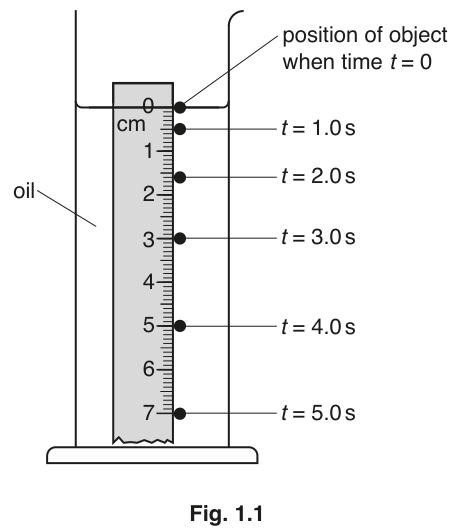
A student drops a small metal object into a cylinder of oil. The object falls alongside a vertical ruler and a camera records its position at intervals, as shown in Fig. 1.1.
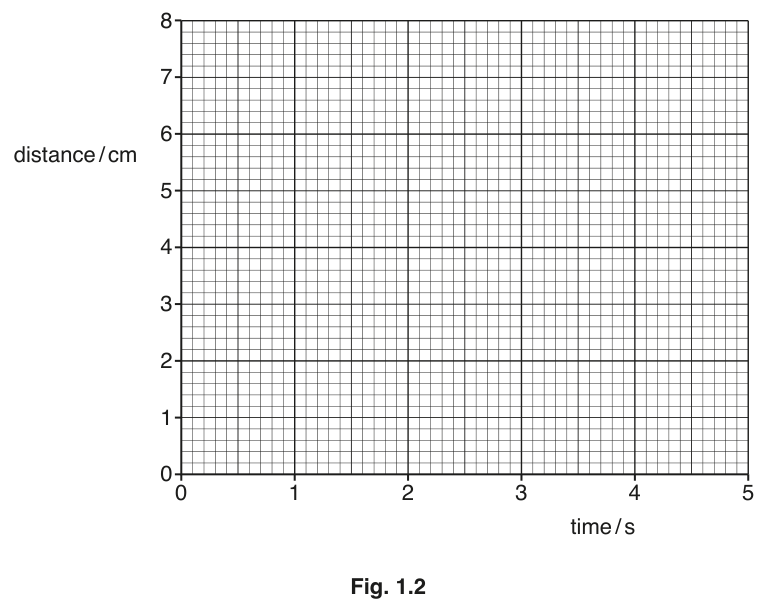
On the grid in Fig. 1.2, plot a distance-time graph for the object.
Answer
Points plotted at: (1.0, 0.5), (2.0, 1.6), (3.0, 3.0), (4.0, 5.0), (5.0, 7.0).
A smooth curve starting from the origin (0,0) passing through these points, curving upwards and then becoming a straight line.
Graph with points at (1, 0.5), (2, 1.6), (3, 3), (4, 5), (5, 7) and a smooth curve from the origin
Walkthrough
The question asks to plot a distance-time graph based on the positions shown in Fig. 1.1. We extract the coordinates (time, distance) from the marking scheme (which corrects the image description values to ensure consistency with the final answer):
- At s, distance = 0 cm.
- At s, distance = 0.5 cm.
- At s, distance = 1.6 cm.
- At s, distance = 3.0 cm.
- At s, distance = 5.0 cm.
- At s, distance = 7.0 cm.
We plot these points on the grid in Fig. 1.2. The horizontal axis is time (0 to 5 s) and the vertical axis is distance (0 to 8 cm). After plotting, we draw a smooth curve connecting the origin to the points. The curve starts steep (high speed) and becomes less steep, eventually becoming a straight line (constant speed).
Key Takeaways
- Reading data from a diagram: identify the axis labels and read the values at specific time intervals.
- Plotting a graph: ensure points are plotted to within half a small square.
- Curve of best fit: for motion with changing speed, draw a smooth curve, not a straight line joining points.
Common Mistakes
- Plotting points incorrectly (e.g., swapping time and distance axes).
- Drawing straight lines between points instead of a smooth curve.
- Forgetting to start the curve at the origin (0,0).
Things to Be Careful About
- Read the graph axes carefully: vertical is distance (cm), horizontal is time (s).
- The marking scheme specifies specific coordinates (1, 0.5), (2, 1.6), etc. Use these values even if the image description text varies slightly; the marking scheme is the authority for the expected answer.
- Plotting precision: points should be plotted to within half a small square on the grid.
The object has a constant speed for some of the time.
State and explain how a distance-time graph shows that speed is constant.
Answer
The graph is a straight line (or the gradient/slope is constant).
This means the object travels equal distances in equal intervals of time (or the gradient equals speed, which is constant).
Straight line (constant gradient); travels equal distances in same time
Walkthrough
The question asks how a distance-time graph shows constant speed. Speed is the rate of change of distance, which is the gradient of the distance-time graph (). If the speed is constant, the gradient must be constant. A constant gradient on a graph is represented by a straight line. Alternatively, one can say that for every equal time interval (e.g., every 1 second), the object covers the same distance.
Key Takeaways
- Gradient of distance-time graph = speed.
- Constant speed = straight line on distance-time graph.
- Equal distances in equal time intervals implies constant speed.
Common Mistakes
- Saying 'the line is straight' without explaining what that means for the motion.
- Confusing distance-time with speed-time graphs (on a speed-time graph, constant speed is a horizontal line; on distance-time, it's a straight sloping line).
Things to Be Careful About
- The question asks to 'State and explain'. State the feature (straight line/constant gradient) and explain the consequence (equal distances in same time/constant speed).
Explain, in terms of the forces acting on the object, how it is able to fall at a constant speed.
Answer
The forces acting are the weight (downwards) and the force from the oil/liquid (upwards) (drag or upthrust).
These forces are balanced (equal and opposite), so there is no resultant force (or resultant force is zero).
Weight and upward force from oil are balanced (resultant force is zero)
Walkthrough
The object is falling through oil. The forces acting on it are:
- Weight acting downwards (due to gravity).
- Upward force from the oil. This is a combination of upthrust (buoyancy) and drag (viscous friction). At 5054 level, referring to it as 'force from oil/liquid upwards' or 'drag' is sufficient.
As the object falls, it accelerates initially because weight > upward force. However, as speed increases, the upward drag force increases. Eventually, the upward force equals the weight. At this point, the resultant force is zero. According to Newton's First Law, if the resultant force is zero, the object continues at a constant speed (terminal velocity). The graph in part (a) shows this as the straight-line section where the gradient (speed) is constant.
Key Takeaways
- Forces on a falling object in a fluid: Weight (down) and Drag/Upthrust (up).
- Constant speed (terminal velocity) occurs when resultant force is zero.
- Balanced forces mean no acceleration.
Common Mistakes
- Saying 'gravity and air resistance' (it's oil, not air; though air resistance is a type of drag, 'force from oil' is more precise).
- Saying 'no forces act' (forces act, they are just balanced).
- Confusing mass and weight.
Things to Be Careful About
- The question asks 'in terms of the forces acting'. Must name the forces (weight and upward force) and state they are balanced/equal/opposite.
- 'Resultant force' is a key phrase. 'Forces cancel' is also acceptable.
The rest of this paper
10 more questions- Q2Forces · Energy, Work and Power6M
- Q3Thermal Properties of Matter · Mass, Weight and Density6M
- Q4Thermal Properties of Matter · Transfer of Thermal Energy5M
- Q5Kinematics · General Properties of Waves · Electromagnetic Spectrum5M
- Q6Lenses and Dispersion6M
- Q7Simple Magnetism and Magnetic Fields · Electromagnetic Induction and Transformers6M
- Q8Practical Electricity · Electric Circuits5M
- Q9Energy, Work and Power · Electromagnetic Induction and Transformers15M
- Q10Current, Voltage and Resistance · Electric Circuits · Practical Electricity15M
- Q11Radioactivity15M