Physics 5054/41 — October/November 2017
Cambridge O-Level · Alternative to Practical · worked solutions for every part, with the mark scheme
Topics Experimental Contexts · Use of Techniques, Apparatus and Materials · Observations and Measurements · Analysis, Conclusions and Evaluation
A student finds the mass of a table-tennis ball using a top-pan balance, as shown in Fig. 1.1. The top-pan balance reads to the nearest gram.
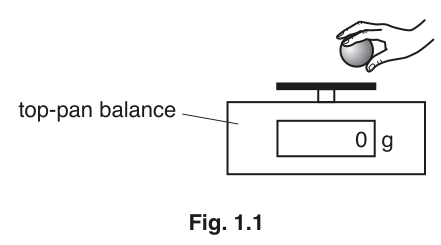
The mass of the ball is about 2.5 g.
Suggest a reason why placing the ball on the top-pan balance does not give an accurate value for the mass of the ball.
Answer
The top-pan balance only measures to the nearest 1 g, so the ball's mass of about 2.5 g is too small to be measured accurately. (Alternatively: the ball may roll about on the pan, causing a zero error or unstable reading.)
The top-pan balance only measures to the nearest 1 g, so the ball's mass is too small to be measured accurately.
Walkthrough
The question states the top-pan balance reads to the nearest gram (1 g). The mass of a single table-tennis ball is about 2.5 g. When measured on a balance with 1 g resolution, the reading will be rounded to either 2 g or 3 g. This gives a large percentage error (up to 20% or more) and the measurement is not accurate. Additionally, a small, light, spherical ball is likely to roll around on the flat pan of the balance, making it difficult to get a stable reading or causing a zero error if it rolls off-centre.
Key Takeaways
When measuring a very small mass, the resolution of the balance may be too coarse, leading to a large percentage error. Small, round objects can also roll, making readings unstable.
Common Mistakes
- Stating 'the balance is not accurate' without explaining why (e.g., resolution is too coarse).
- Saying 'the ball is too light' without linking it to the balance's precision or percentage error.
- Not mentioning that the ball rolling is a valid practical issue.
Things to Be Careful About
The mark scheme accepts any one of several valid points: the resolution of the balance (1 g), the small mass causing a large percentage error, the ball rolling about, or a zero error. Any one of these scores the full mark. Be sure to write a complete sentence explaining the reason.
The student uses ten identical balls and a glass beaker to hold them, as shown in Fig. 1.2.
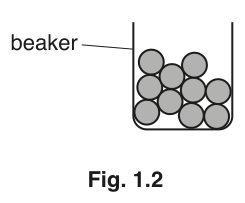
Explain in detail how the student can obtain a more accurate value for the mass of one ball.
Answer
Method 1 (using tare):
- Place the empty glass beaker on the top-pan balance and tare (zero) the balance.
- Add all 10 table-tennis balls to the beaker and read the total mass.
- Divide the total mass by 10 to find the mass of one ball.
Method 2 (without tare):
- Find the mass of the empty glass beaker.
- Find the total mass of the beaker and the 10 balls.
- Subtract the mass of the empty beaker from the total mass.
- Divide the result by 10 to find the mass of one ball.
Tare the balance with the empty beaker on it, add 10 balls, read the total mass, and divide by 10.
Walkthrough
Measuring a single 2.5 g ball on a 1 g balance gives a large percentage error. By measuring 10 balls at once, the total mass is about 25 g. The same 1 g balance now gives a much smaller percentage error (4% instead of 20%). To find the mass of one ball, the total mass must be divided by 10. The beaker is used to hold the balls so they do not roll away. You must either tare (zero) the balance with the beaker on it, or measure the beaker's mass separately and subtract it from the total mass before dividing by 10.
Key Takeaways
The method of averages (measuring multiple small objects together) reduces the percentage error caused by the limited resolution of an instrument. Always remember to account for the mass of the container holding the objects.
Common Mistakes
- Forgetting to divide the total mass by 10 at the end.
- Forgetting to subtract the mass of the beaker (if not using the tare function).
- Saying 'measure 10 balls and divide by 10' without mentioning how to hold them or account for the container.
Things to Be Careful About
The mark scheme provides two equivalent routes: using the tare (zero) function, or finding the mass of the empty beaker and subtracting it. Both routes must include the final division by 10. Any step missing from the three-step procedure will lose a mark.
The rest of this paper
3 more questions- Q2Experimental Contexts · Use of Techniques, Apparatus and Materials · Observations and Measurements · Analysis, Conclusions and Evaluation13M
- Q3Use of Techniques, Apparatus and Materials · Experimental Contexts · Observations and Measurements · Analysis, Conclusions and Evaluation6M
- Q4Experimental Contexts · Observations and Measurements · Use of Techniques, Apparatus and Materials · Analysis, Conclusions and Evaluation7M