Physics 5054/31 — October/November 2017
Cambridge O-Level · Practical Test · worked solutions for every part, with the mark scheme
Topics Experimental Contexts · Observations and Measurements · Analysis, Conclusions and Evaluation · Use of Techniques, Apparatus and Materials
In this experiment, you will investigate the oscillations of a mass connected to springs.
You are provided with
- an arrangement of two springs that are connected in series,
- a single spring,
- a mass labelled M,
- a stand, boss and clamp from which to suspend the springs,
- a stopwatch,
- a second clamp and boss.
Set up the apparatus as shown in Fig. 1.1, using the arrangement of the two springs that are connected in series.
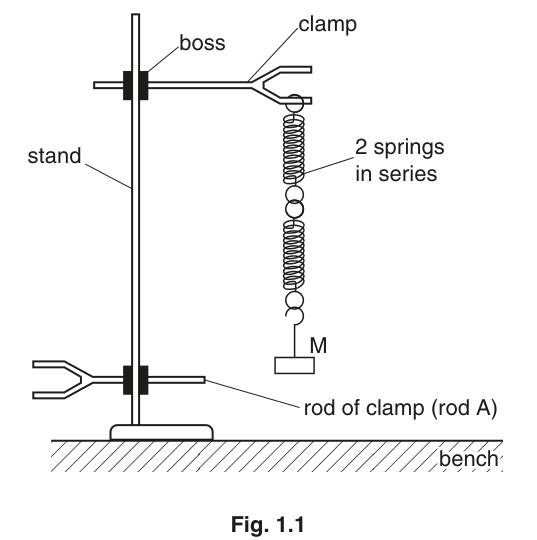
Answer
Apparatus set up as shown in Fig. 1.1: two springs connected in series and clamped vertically from the retort stand, with mass M hung from the bottom of the lower spring, and the clamped rod of a second boss (rod A) positioned horizontally near the mass.
Apparatus set up as shown in Fig. 1.1, with two springs in series supporting mass M
Walkthrough
This step is not separately marked — it is the physical assembly the candidate performs before taking any readings in part (b).
- Clamp the top of the first spring to the upper boss on the retort stand.
- Connect the second spring to the bottom of the first, so the two springs hang in series (one below the other).
- Hang mass M from the hook at the bottom of the lower spring.
- Position the lower boss and clamp so rod A sits horizontally near the mass, as shown in Fig. 1.1.
Key Takeaways
- Connecting the springs in series (rather than side by side) means the same tension acts through both, and their extensions add together.
Common Mistakes
- Connecting the springs in parallel instead of in series.
- Leaving the springs slack or tangled where they join.
Things to Be Careful About
- Make sure the springs hang freely and vertically, not touching the stand or leaning against anything.
Pull the mass M down a short distance vertically and release it.
One oscillation of the mass occurs when the mass moves from its lowest position to its highest position and then back down to its lowest position.
Adjust the height of rod A to help you when counting the number of oscillations.
Describe how you use rod A to ensure that you count complete oscillations made by the mass. You may draw a diagram if you wish.
Answer
Align rod A with the bottom (or centre / equilibrium position) of mass M. Count one complete oscillation each time the mass returns to and passes rod A moving in the same direction (e.g. moving from the level of rod A to the top, back down to the bottom, and returning to rod A).
Place rod A level with a fixed point on the mass (e.g. the lowest point) and count one oscillation every time the mass returns to this level moving in the same direction.
Walkthrough
In vertical oscillations, judging by eye when an oscillating mass reaches an extreme position or passes through equilibrium can lead to counting errors. Using a horizontal reference rod (rod A) as a fiducial marker provides a clear visual reference line.
To count complete oscillations accurately:
- Position rod A horizontally so that it is level with a defined point on the mass (for example, the bottom edge at its lowest position or at its rest position).
- When the mass is released and reaches this reference level moving in a chosen direction, start timing (or count 'zero').
- Each time the mass completes a full cycle—travelling up to its maximum height and back down to align with rod A in the same direction—count one full oscillation.
Key Takeaways
- A fiducial marker (rod A) acts as a fixed visual reference point to ensure complete cycles are timed accurately.
- One complete oscillation requires returning to the exact starting position while moving in the same direction.
Common Mistakes
- Counting every time the mass passes the rod without requiring it to move in the same direction (which counts half-oscillations instead of whole oscillations).
- Starting the count at 'one' instead of 'zero' when starting the stopwatch.
Things to Be Careful About
- Clearly state the reference point and specify that a full oscillation involves returning to that level moving in the same direction.
The time for 10 oscillations is . Take measurements to determine an accurate value of .
= ______
Working
First timing for 10 oscillations:
Repeat timing for 10 oscillations:
Answer
12.5 s (value in the range 9.0 s to 16.0 s with repeat and average shown)
Walkthrough
This is a practical measurement where the candidate measures the time taken for 10 complete oscillations of the mass suspended from two springs connected in series.
To earn full credit:
- Measure the time for 10 oscillations using the stopwatch ().
- Repeat the measurement () to ensure reliability.
- Calculate the mean value:
- The obtained value should fall in the expected experimental range of to and must be recorded with its unit (). A representative scoring value is .
Key Takeaways
- Timing multiple oscillations (here, 10) significantly reduces the percentage uncertainty caused by human reaction time.
- Repeating the measurement and taking an average minimises random timing errors.
Common Mistakes
- Omitting the unit () or writing incorrect abbreviations (e.g. or for minutes).
- Recording only a single measurement without showing a repeat and average calculation.
Things to Be Careful About
- Ensure the stopwatch reading is recorded to or and consistent with the range of the apparatus.
Calculate the time for one oscillation. Give your answer to an appropriate number of significant figures.
= ______
Working
Answer
1.25 s
Walkthrough
The period is the time taken for one single oscillation.
- Divide the average time for 10 oscillations () by 10:
- Using the representative value :
- The result should be stated to 2 or 3 significant figures and must include the unit of time (). The mark scheme allows the unit to appear either in (b)(ii) or (b)(iii).
Key Takeaways
- Period , where is the number of oscillations.
- Significant figures should be maintained consistently with the measured time (2 or 3 s.f.).
Common Mistakes
- Multiplying by 10 instead of dividing by 10.
- Rounding excessively to 1 significant figure (e.g. writing instead of or ).
Things to Be Careful About
- Ensure the unit () is present if it was not clearly stated in (b)(ii).
Replace the double spring arrangement by the single spring. Suspend the mass M from the single spring.
Repeat (b)(ii) and (b)(iii) so that new values are obtained for the time for 10 oscillations and the time for one oscillation.
= ______
= ______
Working
First timing for 10 oscillations:
Repeat timing for 10 oscillations:
(Note: )
Answer
t_2 = 8.9 s, T_2 = 0.89 s (with T_2 < T_1)
Walkthrough
- The single spring is stiffer (has a larger effective spring constant ) than the two springs connected in series ().
- Because the period of a mass-spring system depends inversely on the stiffness (), a single spring oscillates faster, meaning its period is shorter than ().
- The candidate repeats the timing method of (b)(ii) and (b)(iii) with the single spring, finding (e.g. ) and calculating .
- The mark is awarded for obtaining a valid value of that is strictly less than .
Key Takeaways
- Springs in series are more compliant (lower overall spring constant), leading to a longer period of oscillation.
- A single spring has higher stiffness than two identical springs in series, resulting in a shorter oscillation period ().
Common Mistakes
- Obtaining due to incorrect counting or timing errors.
- Forgetting to divide by 10 to obtain .
Things to Be Careful About
- Ensure units are stated for and , and check that the value is physically sensible ().
Calculate .
Working
Answer
0.71
Walkthrough
- Calculate the ratio of the periods:
- The theoretically expected value for identical ideal springs is:
- The mark scheme accepts calculated ratios in the range to .
- Because this is a ratio of two quantities with identical units (), the final value must be dimensionless (no units).
Key Takeaways
- The ratio of two physical quantities with the same unit is dimensionless and should be written without a unit.
- In spring systems, the period ratio .
Common Mistakes
- Attaching a unit (such as ) to a dimensionless ratio.
- Calculating the inverse ratio instead of .
Things to Be Careful About
- Quote the final answer to 2 or 3 significant figures without any trailing unit.
The rest of this paper
3 more questions- Q2Experimental Contexts · Observations and Measurements · Analysis, Conclusions and Evaluation5M
- Q3Use of Techniques, Apparatus and Materials · Observations and Measurements · Experimental Contexts · Analysis, Conclusions and Evaluation5M
- Q4Observations and Measurements · Experimental Contexts · Use of Techniques, Apparatus and Materials · Analysis, Conclusions and Evaluation15M