Physics 5054/42 — May/June 2017
Cambridge O-Level · Alternative to Practical · worked solutions for every part, with the mark scheme
Topics Experimental Contexts · Analysis, Conclusions and Evaluation · Observations and Measurements · Planning Experiments and Investigations · Use of Techniques, Apparatus and Materials
A student measures the acceleration of free-fall . He drops a metal ball from a height of onto the floor, and measures the time it takes to hit the floor.
Fig. 1.1 shows the ball and a metre rule, held vertically in a clamp.
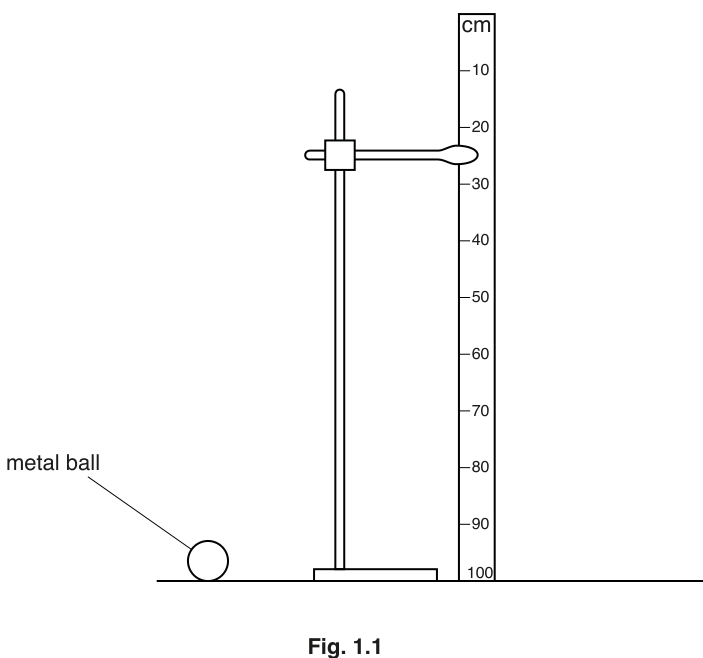
On Fig. 1.1, draw the position of the ball at its point of release.
He repeats the experiment and obtains the following five values of , measured in seconds.
Calculate , the average value for . Give your answer to two decimal places.
= ______
Suggest why the value for is not given to more than two decimal places.
The acceleration due to free-fall is given by the equation
where .
Calculate a value for .
= ______
Another student suggests that, to obtain a better value for , the ball should be dropped from a height greater than .
Explain why this student is correct.
The rest of this paper
3 more questions- Q2Experimental Contexts · Observations and Measurements · Analysis, Conclusions and Evaluation5M
- Q3Planning Experiments and Investigations · Experimental Contexts · Observations and Measurements · Analysis, Conclusions and Evaluation5M
- Q4Experimental Contexts · Observations and Measurements · Analysis, Conclusions and Evaluation · Planning Experiments and Investigations13M