Physics 5054/22 — May/June 2017
Cambridge O-Level · Theory · worked solutions for every part, with the mark scheme
Topics Energy, Work and Power · Kinematics · Forces · Physical Quantities and Measurement · Mass, Weight and Density · Turning Effect of Forces · +15 more
A car accelerates from rest in a straight line. During the first , the acceleration is uniform and the car reaches a speed of .
Calculate the acceleration of the car.
acceleration = ______
Working
Answer
1.8 m/s^2
1.8 m/s^2
Walkthrough
The car starts from rest, so the initial speed . It reaches a final speed in time . With uniform acceleration, we use the kinematic equation . Substituting the values gives , which rounds to to two significant figures.
Key Takeaways
- The equation applies to uniform acceleration.
- Always remember that 'from rest' means .
- Round the answer to 2 or 3 significant figures as appropriate for the data given.
Common Mistakes
- Forgetting that 'from rest' means and accidentally using or .
- Swapping the numerator and denominator in the formula.
- Forgetting to include the unit in the final answer.
Things to Be Careful About
- The mark scheme accepts as the substitution step, so showing the formula with substituted is sufficient.
- Ensure the unit is written as and not to match 5054 conventions.
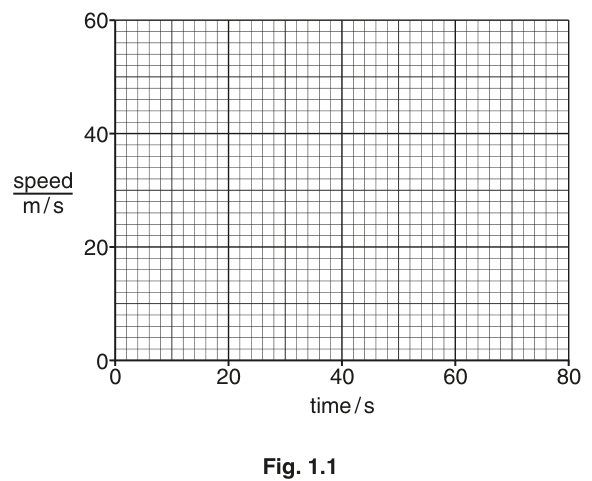
After the first , the speed of the car continues to increase but the acceleration decreases. From to after the start, the car moves at a constant speed of .
On Fig. 1.1, draw a possible speed-time graph for the car.
Answer
Speed-time graph: straight line from (0,0) to (14,25), curve with decreasing gradient to (70,55), then horizontal line to (80,55)
Walkthrough
The graph must show three distinct phases of motion:
- 0 to 14 s: Uniform acceleration from rest to . On a speed-time graph, uniform acceleration is a straight line with a positive gradient. Draw a straight line from to .
- 14 s to 70 s: Speed continues to increase, but acceleration decreases. Decreasing acceleration means the gradient of the speed-time graph is decreasing. Draw a smooth curve from up to that is concave down (gradient gets flatter).
- 70 s to 80 s: Constant speed of . Constant speed means zero acceleration, so the gradient is zero. Draw a horizontal straight line from to .
Key Takeaways
- Gradient of a speed-time graph = acceleration.
- Straight line = uniform acceleration; curve with decreasing gradient = decreasing acceleration; horizontal line = constant speed (zero acceleration).
Common Mistakes
- Drawing a straight line for the second section instead of a curve with a decreasing gradient.
- Starting the constant speed section at the wrong time or wrong speed (must be and ).
- Not reaching exactly at for the first section.
Things to Be Careful About
- Read the graph axes carefully: time is in steps of , speed is in steps of .
- Ensure the curve is smooth and clearly shows a decreasing gradient; do not draw a jagged or straight line between and .
At a later time, the driver applies the brakes to stop. He is wearing a seat belt and slows down in his seat. A bag on the seat next to him slides forwards, across the seat towards the front of the car.
Using ideas about the forces acting, explain why the driver slows down but the bag slides forwards.
Answer
- The brakes apply a backward force on the car, and the seat belt (and friction with the seat) applies a backward force on the driver, causing the driver to slow down.
- The bag experiences no (or very small) backward force.
- Due to its inertia, the bag resists the change in its state of motion and continues to move forward at the original constant velocity.
The driver is acted on by a backward force (from the seat belt/friction), causing deceleration. The bag has no backward force, so its inertia causes it to continue moving forward at constant velocity.
Walkthrough
When the brakes are applied, the car slows down. The driver is also wearing a seat belt and is sitting on the seat. The seat belt and the friction between the driver and the seat exert a backward force on the driver, which causes the driver to decelerate along with the car.
The bag, however, is not secured. There is no significant backward force (like a seat belt) acting on it. According to Newton's first law, an object will continue in its state of motion unless acted on by a resultant force. The bag has inertia (resistance to change in motion), so with no backward force to slow it down, it continues to move forward at the car's original speed. Relative to the slowing car, the bag appears to slide forwards.
Key Takeaways
- Newton's first law (inertia) explains why objects continue moving when no resultant force acts on them.
- A seat belt provides the necessary force to decelerate the driver.
- Relative motion: if the car slows down and the bag doesn't, the bag moves forward relative to the car.
Common Mistakes
- Saying 'the bag has no force acting on it' (gravity and normal reaction still act vertically; the key is there is no horizontal backward force).
- Using the word 'heat' or 'friction' incorrectly to explain the forward motion (friction between the bag and seat is actually what would slow it down, but it's too small to matter).
- Forgetting to mention 'inertia' or 'resists change in motion'.
Things to Be Careful About
- The question asks to use 'ideas about the forces acting', so explicitly naming the backward force on the driver and the lack of one on the bag is crucial for the marks.
- Do not say 'the bag is pushed forward'; there is no forward force. It simply keeps moving forward due to inertia.
The rest of this paper
10 more questions- Q2Physical Quantities and Measurement · Energy, Work and Power · Mass, Weight and Density6M
- Q3Turning Effect of Forces · Pressure6M
- Q4Thermal Properties of Matter · Transfer of Thermal Energy4M
- Q5Kinetic Particle Model of Matter6M
- Q6General Properties of Waves · Sound5M
- Q7Magnetic Effect of a Current and the d.c. Motor · Practical Electricity · Energy, Work and Power6M
- Q8Static Electricity5M
- Q9Reflection and Refraction of Light · Electromagnetic Spectrum15M
- Q10Current, Voltage and Resistance · Electric Circuits15M
- Q11Radioactivity · The Nuclear Atom15M