Physics 5054/21 — May/June 2017
Cambridge O-Level · Theory · worked solutions for every part, with the mark scheme
Topics Mass, Weight and Density · Electric Circuits · Electromagnetic Induction and Transformers · Forces · Kinematics · Pressure · +14 more
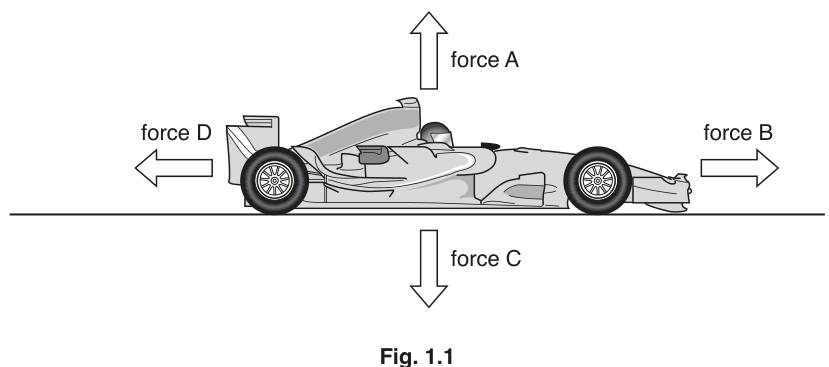
Fig. 1.1 shows the directions of four forces acting on a racing car as it travels in a horizontal straight line.
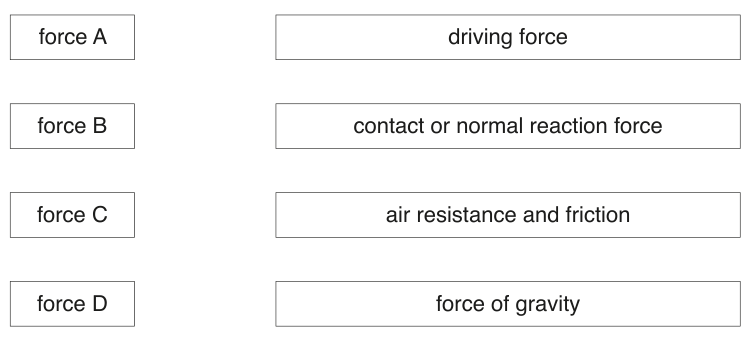
Draw a line from each box on the left to the correct description of each force.
Answer
- force A: contact or normal reaction force
- force B: driving force
- force C: force of gravity
- force D: air resistance and friction
A–contact or normal reaction force, B–driving force, C–force of gravity, D–air resistance and friction
Walkthrough
The diagram shows a racing car moving horizontally. We identify each force by its direction and physical cause:
- Force A points vertically upwards. This is the force from the ground pushing up on the car, known as the contact force or normal reaction force.
- Force B points horizontally forward (to the right). This is the force propelling the car forward, generated by the wheels pushing against the road. This is the driving force.
- Force C points vertically downwards. This is the pull of the Earth on the car, which is the force of gravity (or weight).
- Force D points horizontally backward (to the left). This opposes the motion and is caused by the air pushing against the car and friction in the moving parts. This is air resistance and friction.
Key Takeaways
- A free-body diagram shows all forces acting on an object.
- Vertical forces on a horizontal surface are typically weight (down) and normal reaction (up).
- Horizontal forces are typically driving force (forward) and resistive forces like air resistance/friction (backward).
Common Mistakes
- Confusing the driving force with air resistance (getting the direction wrong).
- Calling the upward force 'lift' (unless specified, it is the normal reaction/contact force).
- Using 'weight' for force A (weight always acts downwards).
Things to Be Careful About
- Ensure the matching is exact to the wording in the boxes: 'contact or normal reaction force', 'driving force', 'force of gravity', 'air resistance and friction'.
The table shows the sizes of the forces acting on the car at one time.
| force A / | force B / | force C / | force D / |
|---|---|---|---|
| 8000 | 1000 | 8000 | 600 |
The gravitational field strength is .
Calculate
the mass of the car,
mass = ______
Working
Force C is the weight of the car (force of gravity).
Answer
mass = 800 kg
800 kg
Walkthrough
- Identify the weight: Force C acts downwards and is labelled 'force of gravity' in part (a). Its magnitude is given as 8000 N.
- Use the relationship between weight, mass, and gravitational field strength: .
- Rearrange to solve for mass: .
- Substitute the values: kg.
Key Takeaways
- Weight is a force ().
- Gravitational field strength is approximately on Earth (or as given in the question).
- Mass is measured in kg, weight in N.
Common Mistakes
- Forgetting to divide by .
- Using the wrong force value (e.g., using the driving force 1000 N).
Things to Be Careful About
- The question gives , use this value, not .
the resultant force on the car,
resultant force = ______
Working
Vertical forces: Force A ( up) and Force C ( down) are equal and opposite, so they cancel.
Horizontal forces: Force B ( right) and Force D ( left).
Answer
resultant force = 400 N
400 N
Walkthrough
- Check vertical forces: Force A (up) is 8000 N, Force C (down) is 8000 N. Resultant vertical force is 0.
- Calculate horizontal resultant: Force B (forward) is 1000 N, Force D (backward) is 600 N.
- Resultant force = Forward force - Backward force = N.
- The direction is forward (to the right), but the question asks for the size (magnitude).
Key Takeaways
- Resultant force is the vector sum of all forces.
- Forces in opposite directions are subtracted.
- Balanced vertical forces mean no vertical acceleration.
Common Mistakes
- Adding the horizontal forces () instead of subtracting.
- Including the vertical forces in the calculation (they cancel out).
Things to Be Careful About
- Resultant force is a vector, but here only the magnitude is asked for (size).
the acceleration of the car.
acceleration = ______
Working
Using (from part ii) and (from part i):
Answer
acceleration = 0.50 m/s
0.50 m/s
Walkthrough
- Use Newton's second law: , where is the resultant force and is the mass.
- Rearrange for acceleration: .
- Substitute values: N, kg.
- Calculate: m/s.
Key Takeaways
- links force, mass, and acceleration.
- Acceleration is in the direction of the resultant force.
Common Mistakes
- Using the wrong force value (e.g., using 1000 N instead of the resultant 400 N).
- Arithmetic errors in division.
Things to Be Careful About
- Significant figures: 0.5 or 0.50 are both acceptable, but 0.50 m/s is precise.
At another time, the car is travelling at speed . It then accelerates for with an acceleration of , and reaches a speed of .
Calculate the value of .
= ______
Working
Given:
- Acceleration
- Time
- Final speed
- Initial speed =
Change in speed = acceleration time:
Answer
= 12 m/s
12 m/s
Walkthrough
- Identify the knowns: , , . Unknown is .
- Use the equation for acceleration: , or rearrange as change in velocity .
- Calculate the change in velocity: .
- Since the car is accelerating, the final speed is higher than the initial speed: .
- Solve for : .
Key Takeaways
- Acceleration is the rate of change of velocity: .
- Change in velocity = .
Common Mistakes
- Adding 8.0 to 20 instead of subtracting (finding final speed instead of initial).
- Using the wrong formula (e.g., when time and speeds are given).
Things to Be Careful About
- Ensure units are consistent (m/s, m/s, s).
- The question asks for , the initial speed.
The rest of this paper
10 more questions- Q2Pressure · Turning Effect of Forces4M
- Q3Transfer of Thermal Energy6M
- Q4Lenses and Dispersion5M
- Q5Electric Circuits5M
- Q6Practical Electricity7M
- Q7Magnetic Effect of a Current and the d.c. Motor · Simple Magnetism and Magnetic Fields · Electromagnetic Induction and Transformers6M
- Q8Radioactivity5M
- Q9Energy, Work and Power · Mass, Weight and Density · Thermal Properties of Matter · Electromagnetic Induction and Transformers15M
- Q10Reflection and Refraction of Light · General Properties of Waves · Sound15M
- Q11Electric Circuits · Current, Voltage and Resistance · [Legacy] Temperature and Thermometry15M