Physics 5054/31 — October/November 2016
Cambridge O-Level · Practical Test · worked solutions for every part, with the mark scheme
Topics Observations and Measurements · Experimental Contexts · Analysis, Conclusions and Evaluation · Use of Techniques, Apparatus and Materials
In this experiment, you will determine a value for the density of a piece of modelling clay.
You are provided with
- a 30 cm ruler,
- a spring,
- a stand, boss and clamp to support the spring,
- a piece of modelling clay attached to a length of string with a loop at the top of the string,
- an S-hook,
- a glass beaker,
- a supply of water,
- paper towels or cloths to mop up spillages.
Set up the apparatus as shown in Fig. 1.1.
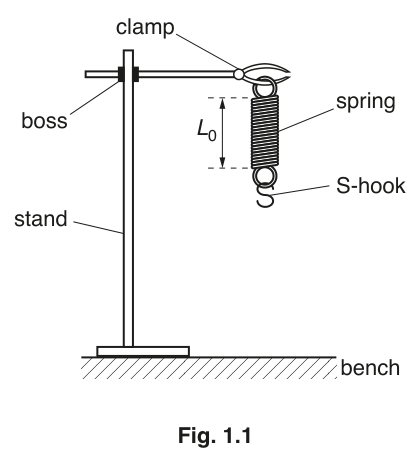
Suspend the S-hook from the lower end of the spring.
Measure the length of the coiled part of the spring.
= ______
Working
Measure the unstretched coiled length to the nearest (or ), ensuring the reading is within the typical range of to .
Answer
2.4 cm (typical value in range 1.5 cm to 3.0 cm)
Walkthrough
The student is required to measure the initial unstretched length of the coiled part of the spring (excluding the supporting loop and hook).
A standard laboratory ruler has millimeter divisions, so measurements must be recorded to the nearest millimeter (e.g. or ). A valid unit ( or ) must be explicitly stated.
Key Takeaways
- Always include units with experimental measurements.
- Ruler measurements should be recorded to at least the nearest ().
Common Mistakes
- Omitting the unit.
- Measuring the total length including the loops at both ends rather than only the coiled section shown in Fig. 1.1.
Things to Be Careful About
- Ensure the line of sight is perpendicular to the ruler to avoid parallax error.
(ii) Suspend the modelling clay from the hook using the loop. The modelling clay should not touch the bench. Measure the new length of the coiled part of the spring.
= ______
(iii) Calculate the extension of the spring using .
= ______
Working
Measure the new length to the nearest (e.g., ).
Calculate the extension :
Answer
L_1 = 7.2 cm, e_1 = 4.8 cm
Walkthrough
- When the modelling clay hangs in air, its weight stretches the spring. Measure the new length of the coiled section to the nearest millimeter.
- Calculate the extension in air, , using the formula:
- Ensure consistent units ( or ) are used for both and .
Key Takeaways
- The extension of a spring is the difference between its stretched length and its original unstretched length ().
Common Mistakes
- Forgetting to subtract and quoting as the extension.
- Mixing units (e.g. measuring in and subtracting in ).
Place the empty beaker below the suspended modelling clay.
Lower the clamp until the modelling clay is in the beaker and the string becomes completely slack (no tension).
Pour water into the beaker until the modelling clay is fully immersed and is covered by about 1 cm of water. If the clay starts to float, then lower the clamp further.
Raise the clamp slowly until the modelling clay rises from the bottom of the beaker but is still fully immersed.
Ensure that the modelling clay does not touch the sides of the beaker.
(i) Measure the new length of the coiled part of the spring.
= ______
(ii) Calculate the new extension using .
= ______
Working
Measure the new stretched length when the clay is fully submerged in water (e.g., ).
Calculate the extension :
Since upthrust acts upward on the submerged clay, the tension in the spring is less than in air, so .
Answer
L_2 = 5.3 cm, e_2 = 2.9 cm (such that e_2 < e_1)
Walkthrough
- When the modelling clay is submerged in water, water exerts an upward buoyant force (upthrust) on it.
- The net downward force supported by the spring is , where is the weight of the clay and is the upthrust.
- Because the net downward force is smaller than the weight in air, the spring extends less: , and therefore .
- Measure to the nearest and subtract to find .
Key Takeaways
- Upthrust reduces the apparent weight of a submerged object, resulting in a smaller spring extension ().
Common Mistakes
- Allowing the clay to rest on the bottom or touch the sides of the beaker, which would lead to an incorrect length measurement.
Things to Be Careful About
- Ensure the clay is completely submerged beneath the surface of the water but not resting on the bottom.
Calculate the density of the modelling clay using
= ______
Working
Using the given equation:
Substituting values and :
(For representative values yielding between and , e.g. with and :
)
Answer
1.6 g/cm3 (value in range 1.0 g/cm3 to 2.0 g/cm3)
Walkthrough
- By Archimedes' principle, the upthrust is proportional to , while the weight (and mass ) is proportional to . The volume of the object equals the volume of displaced water, so the density of the object is given by:
where .
2. Substitute the measured extensions and .
3. Calculate the numerical value to 2 or 3 significant figures and include the unit .
4. A realistic density for modelling clay lies within the mark scheme range of to .
Key Takeaways
- Densities calculated from experimental data must be quoted with correct units and to 2 or 3 significant figures.
Common Mistakes
- Inverting the denominator to , giving a negative density.
- Forgetting to write the unit or writing an incorrect unit such as .
- Quoting the answer to excessive significant figures (e.g. 5 or 6 decimal places).
The rest of this paper
3 more questions- Q2Use of Techniques, Apparatus and Materials · Experimental Contexts · Observations and Measurements · Analysis, Conclusions and Evaluation5M
- Q3Observations and Measurements · Experimental Contexts · Analysis, Conclusions and Evaluation5M
- Q4Experimental Contexts · Use of Techniques, Apparatus and Materials · Observations and Measurements · Analysis, Conclusions and Evaluation15M