Physics 5054/22 — October/November 2016
Cambridge O-Level · Theory · worked solutions for every part, with the mark scheme
Topics Forces · Transfer of Thermal Energy · Current, Voltage and Resistance · Kinematics · Energy, Work and Power · Mass, Weight and Density · +14 more
A skier sets off from rest and accelerates uniformly at in a straight line for .
Calculate the speed of the skier after .
speed = ______
Working
Answer
17 m/s
17 m/s
Walkthrough
The skier starts from rest, so the initial speed . The acceleration is constant at and the time elapsed is . We use the constant acceleration equation to find the final speed . Substituting the values gives .
Key Takeaways
- The equation applies only when acceleration is uniform.
- Always state the initial speed clearly; 'from rest' means .
Common Mistakes
- Forgetting that 'from rest' means and using an incorrect initial speed.
- Omitting the unit in the final answer; the mark scheme requires 'm/s'.
Things to Be Careful About
- Ensure units are consistent: acceleration is in and time is in , so the result is directly in .
- Give the answer to 2 significant figures as the data ( and ) are given to 2 significant figures.
At , the skier stops accelerating and travels on for a further at a constant speed.
State the size of the resultant force acting on the skier during these .
Answer
0 N (or zero)
0 N
Walkthrough
During the final , the skier travels at a constant speed. According to Newton's first law, an object moving at a constant velocity (constant speed in a straight line) has no acceleration. By Newton's second law, , if acceleration , the resultant force must also be zero. The driving force (or component of gravity) is exactly balanced by friction and drag.
Key Takeaways
- Constant speed in a straight line implies zero acceleration and therefore a resultant force of zero.
- 'Resultant force' is the vector sum of all forces; it is not the same as 'no forces acting'.
Common Mistakes
- Answering 'no forces' instead of 'zero resultant force'. Forces are still acting (gravity, normal reaction, friction, drag), but they cancel out.
- Confusing 'resultant force' with 'driving force'.
Things to Be Careful About
- The question asks for the 'size' of the resultant force, so a numerical value of '0' or '0 N' is required.
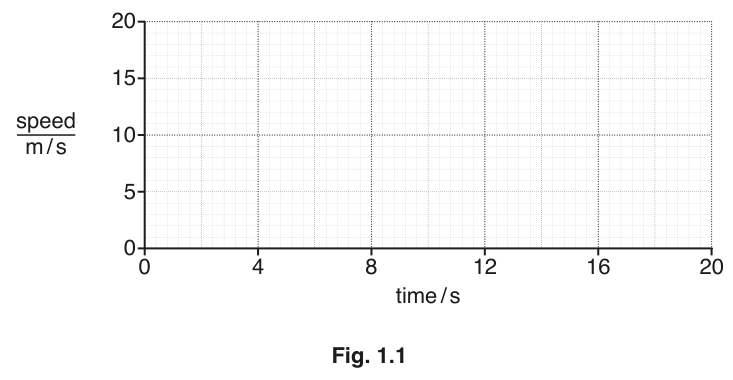
On Fig. 1.1, sketch a speed-time graph for the skier during the whole .
Answer
Speed-time graph: straight line from (0, 0) to (5.0, 17), then horizontal line from (5.0, 17) to (15.0, 17).
Speed-time graph: straight line from (0, 0) to (5.0, 17), then horizontal line from (5.0, 17) to (15.0, 17)
Walkthrough
The motion has two distinct phases:
- 0 to 5.0 s: Uniform acceleration from rest. The speed increases linearly from at to at . On a speed-time graph, this is a straight line with a positive gradient passing through the origin and the point .
- 5.0 s to 15.0 s: Constant speed of . The speed does not change, so the graph is a horizontal line at from to (and beyond, up to at least ).
Key Takeaways
- A straight line with a positive gradient on a speed-time graph represents uniform acceleration.
- A horizontal line on a speed-time graph represents constant speed (zero acceleration).
- The gradient of a speed-time graph is acceleration; the area under it is distance.
Common Mistakes
- Drawing a curve for the first phase instead of a straight line (acceleration is uniform, so the graph must be straight).
- Extending the horizontal line only to ; the question asks for the whole , so the line must reach at least .
- Starting the line at a non-zero speed or not passing through the origin.
Things to Be Careful About
- Read the coordinates accurately: the point is , not or similar.
- Ensure the graph is drawn with a sharp corner at , not a smooth curve, as the acceleration changes abruptly from to .
State how the distance travelled by the skier can be determined using the speed-time graph.
Answer
By calculating the area under the speed-time graph (or the area of the trapezium).
By calculating the area under the speed-time graph
Walkthrough
The area under a speed-time graph represents the distance travelled by the object. For this specific graph, the area is a trapezium (or a triangle plus a rectangle), and calculating this area gives the total distance covered during the .
Key Takeaways
- The area under a speed-time graph is always equal to the distance travelled.
- This is a fundamental property of integration in kinematics, applicable at O Level as a geometric area calculation.
Common Mistakes
- Saying 'the gradient' gives the distance (the gradient gives acceleration).
- Saying 'the area gives speed' (the value on the y-axis gives speed).
Things to Be Careful About
- The question asks 'how the distance can be determined', so a method is required, not a numerical value. 'Area under the graph' or 'area of the trapezium' are the accepted phrases.
The rest of this paper
9 more questions- Q2Energy, Work and Power · Forces6M
- Q3Mass, Weight and Density · Turning Effect of Forces5M
- Q4Thermal Properties of Matter · Transfer of Thermal Energy9M
- Q5Kinetic Particle Model of Matter5M
- Q6[Legacy] Introductory Electronics · Current, Voltage and Resistance6M
- Q7The Nuclear Atom · Radioactivity7M
- Q8Forces · Pressure · Physical Quantities and Measurement15M
- Q9Current, Voltage and Resistance · Practical Electricity · Simple Magnetism and Magnetic Fields15M
- Q10Electromagnetic Spectrum · General Properties of Waves · Reflection and Refraction of Light · Lenses and Dispersion · Transfer of Thermal Energy15M