Physics 5054/31 — May/June 2016
Cambridge O-Level · Practical Test · worked solutions for every part, with the mark scheme
Topics Experimental Contexts · Analysis, Conclusions and Evaluation · Observations and Measurements · Use of Techniques, Apparatus and Materials
In this experiment, you will determine an accurate value for the mass of a 30 cm plastic ruler.
You have been provided with
- a 30 cm plastic ruler with a mm scale,
- a 10 g mass,
- a pivot (knife-edge).
Fig. 1.1 shows a 30 cm ruler of total length .
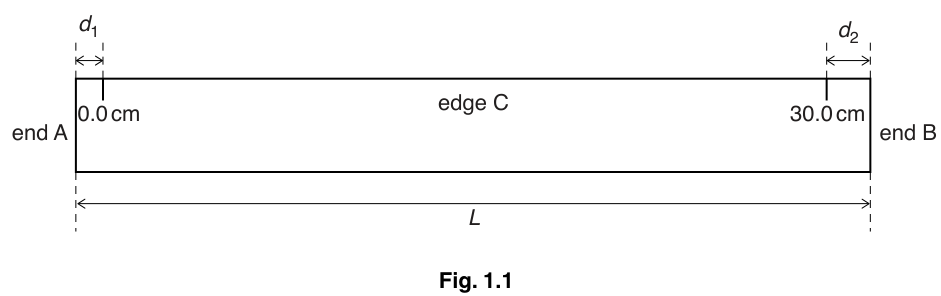
At one end of the ruler there is a 'dead space' of length before the 0.0 cm mark and at the other end there is a 'dead space' of length after the 30.0 cm mark.
(i) Place the ruler provided on Fig. 1.2.
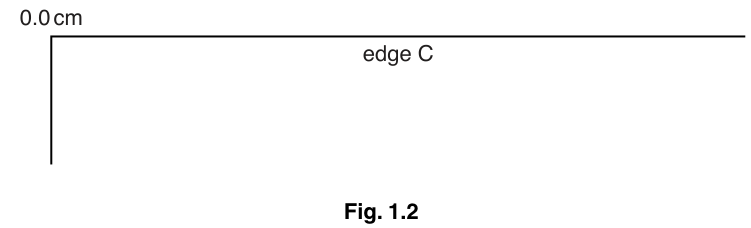
Align the 0.0 cm mark and edge C of the ruler with the lines in the diagram. Draw a line on Fig. 1.2 to mark the position of end A of the ruler. Using Fig. 1.2, measure .
= ______
(ii) Using Fig. 1.3, repeat (a)(i) with end B and measure .
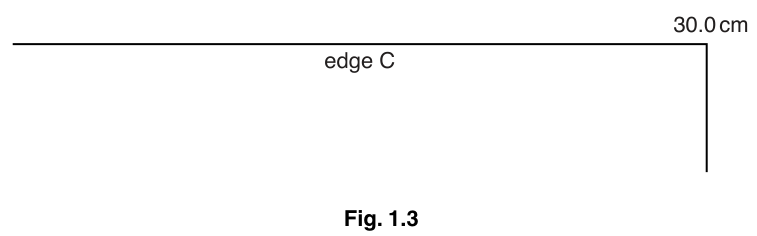
= ______
(iii) Calculate the total length of the ruler.
= ______
Answer
(i)
(ii)
(iii)
d_1 = 3.0 mm, d_2 = 4.0 mm, L = 30.7 cm
Walkthrough
(i) Place the ruler on the alignment diagram (Fig. 1.2) so that the 0.0 cm mark lines up with the vertical line and edge C lines up with the horizontal line. Read the distance from the 0.0 cm mark to end A of the ruler. This is the dead space . Read to the nearest millimetre. Example reading: .
(ii) Repeat the process using Fig. 1.3, aligning the 30.0 cm mark with the vertical line. Read the distance from the 30.0 cm mark to end B. This is . Example reading: .
(iii) The total length is the sum of the scale length (30.0 cm) and the two dead spaces. Convert the dead spaces to cm: , . Add them together: .
Key Takeaways
- Dead spaces on a ruler must be included when finding the true physical length.
- Readings from a mm scale must be given to the nearest mm, including a trailing zero if the reading falls exactly on a mark (e.g., 3.0 mm, not 3 mm).
- Units must be stated clearly for all measured and calculated quantities.
Common Mistakes
- Forgetting to convert mm to cm before adding to 30.0 cm.
- Not including a unit in the final answer for .
- Reading the scale incorrectly or not using the correct alignment lines.
Things to Be Careful About
- The marking scheme requires readings to the nearest mm. If your reading is outside the sensible range (2–8 mm), it may be penalised unless a substitute value (SV) is used.
- Ensure the unit 'mm' or 'cm' is written explicitly. The mark scheme notes: 'the unit must appear at least once in (a)'.
(i) Place the ruler on the pivot. Move the position of the ruler until it balances horizontally. Record the scale reading shown on the ruler at the position of the pivot.
= ______
(ii) Place the 10 g mass so that its outer edge is at the 30.0 cm mark on the ruler. Record the scale reading shown on the ruler at the position of the centre of the 10 g mass.
= ______
(iii) With the 10 g mass position in (b)(ii), place the ruler on the pivot and move the position of the ruler until it balances horizontally. The arrangement is shown in Fig. 1.4.
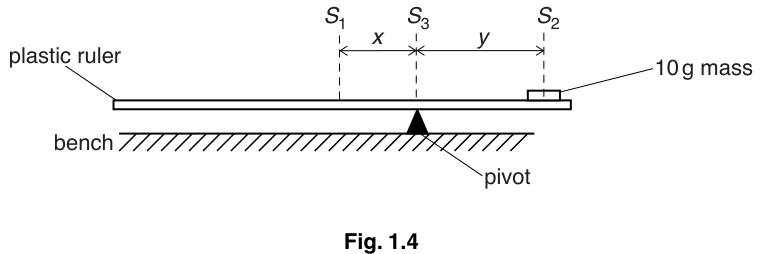
Record the scale reading shown on the ruler at the pivot.
= ______
(iv) Determine the distances and shown on Fig. 1.4.
= ______
= ______
Answer
(i)
(ii)
(iii)
(iv)
S_1 = 14.5 cm, S_2 = 28.5 cm, S_3 = 19.0 cm, x = 4.5 cm, y = 9.5 cm
Walkthrough
(i) Place the ruler on the pivot (knife-edge) and slide it until it balances horizontally. The pivot is now at the centre of mass of the ruler. Read the scale marking on the ruler directly above the pivot. This is . Example reading: .
(ii) Place the 10 g mass on the ruler so its outer edge is at the 30.0 cm mark. Read the scale marking at the centre of the 10 g mass. This is . Example reading: .
(iii) Keep the 10 g mass in the same position. Place the ruler on the pivot again and slide it until it balances horizontally. Read the scale marking at the pivot. This is . Example reading: .
(iv) Calculate the distances and from the scale readings:
- is the distance from the ruler's centre of mass to the pivot: .
- is the distance from the pivot to the 10 g mass: .
Key Takeaways
- Finding the balance point of an object locates its centre of mass.
- When balancing with an additional mass, the pivot moves, and the distances from the pivot to the centre of mass and the additional mass are the moment arms.
- Distances are found by subtracting scale readings, not by measuring directly with a second ruler.
Common Mistakes
- Reading the scale at the wrong edge of the mass or pivot.
- Forgetting to include units (cm) with all readings and calculated distances.
- Calculating and incorrectly (e.g., using the wrong order of subtraction).
Things to Be Careful About
- Readings must be to the nearest mm (e.g., 14.5 cm, not 14.50 cm unless the scale supports it, but 14.5 cm is acceptable for a mm scale read to 0.1 cm).
- The mark scheme requires units to appear at least once in part (b).
- Ensure the 10 g mass is placed correctly with its outer edge at 30.0 cm so its centre is at .
Calculate the mass of the ruler using
= ______
Working
Answer
21.1 g
Walkthrough
Substitute the values of and from part (b) into the given formula:
Round to a sensible number of significant figures (e.g., 21.1 g). The mark scheme accepts any value in the region of 20 g, so 21.1 g is acceptable.
Key Takeaways
- The principle of moments states that for a balanced system, the clockwise moment equals the anticlockwise moment.
- Here, , which rearranges to .
- This is a practical method for finding the mass of an object without a balance.
Common Mistakes
- Using incorrect values for and (e.g., using and directly without finding the distances).
- Forgetting the unit 'g' in the final answer.
- Calculating the formula incorrectly (e.g., instead of ).
Things to Be Careful About
- The formula is given, so no need to derive it from the principle of moments, but understanding it helps verify the answer.
- Ensure and are in the same units (both in cm here), so they cancel out, leaving the mass in grams.
The rest of this paper
3 more questions- Q2Experimental Contexts · Analysis, Conclusions and Evaluation5M
- Q3Observations and Measurements · Experimental Contexts · Analysis, Conclusions and Evaluation5M
- Q4Observations and Measurements · Experimental Contexts · Analysis, Conclusions and Evaluation15M