Physics 5054/22 — May/June 2016
Cambridge O-Level · Theory · worked solutions for every part, with the mark scheme
Topics Forces · Energy, Work and Power · Current, Voltage and Resistance · [Legacy] Introductory Electronics · Kinematics · Mass, Weight and Density · +13 more
Fig. 1.1 shows the speed-time graph for a car travelling along a horizontal road.
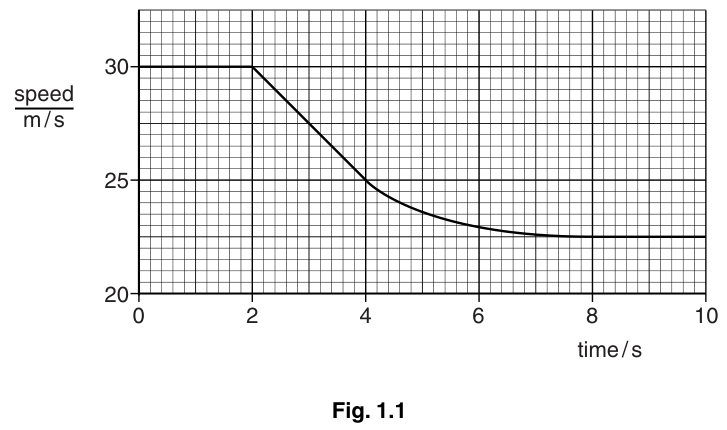
On Fig. 1.1, mark and label a point where the car has a non-uniform deceleration.
Answer
Mark a point on the curved section of the graph between s and s (for example, at s, speed m/s). This section has a changing gradient, indicating non-uniform deceleration.
Point marked on the curved deceleration section between t = 4.0 s and t = 8.0 s
Walkthrough
The gradient of a speed-time graph gives the acceleration. A straight line has a constant gradient, meaning uniform acceleration (or deceleration). A curved line has a changing gradient, meaning non-uniform acceleration. The graph shows a straight-line deceleration from s to s, followed by a curved section from s to s where the speed decreases from 25 m/s to 22.5 m/s. Any point on this curved section has non-uniform deceleration.
Key Takeaways
A straight section on a speed-time graph represents uniform acceleration; a curved section represents non-uniform acceleration.
Common Mistakes
Marking a point on the straight-line section between s and s (this is uniform deceleration) or on the horizontal sections (this is zero acceleration, not deceleration).
Things to Be Careful About
Ensure the marked point is clearly on the curve and not exactly on a corner where the straight line meets the curve, as the exact boundary can be ambiguous. Mark it clearly in the middle of the curved region, e.g., between s and s.
Calculate the deceleration of the car at .
deceleration = ______
Working
At s, the graph is a straight line from to . The deceleration is the magnitude of the gradient of this line.
Answer
2.5 m/s^2
Walkthrough
The question asks for the deceleration at s. At this time, the car is on the straight-line section of the graph between s and s. For a straight line on a speed-time graph, the acceleration is constant and equals the gradient. We read the coordinates at the ends of this straight section: and . The change in speed is m/s over a time of s. The acceleration is . Deceleration is the magnitude of this, so .
Key Takeaways
The gradient of a speed-time graph gives acceleration. For a straight line, the gradient is constant and can be found using any two points on that line.
Common Mistakes
Using coordinates from different sections of the graph (e.g., mixing the straight line and the curve) or forgetting that deceleration is a positive magnitude.
Things to Be Careful About
Read the graph to the correct precision. The grid lines are every 2 s and 5 m/s, with minor divisions every 0.2 m/s and 0.4 s. Ensure the points and are read accurately.
Explain, in terms of the horizontal forces that act on the car, why its speed is constant at .
Answer
The forward driving force and the backward resistive forces (friction and air resistance) are equal in magnitude. Therefore, the resultant horizontal force is zero, so there is no acceleration and the speed remains constant.
The forward driving force and backward resistive forces are equal, so the resultant horizontal force is zero.
Walkthrough
At s, the speed-time graph is horizontal, meaning the speed is constant at 30 m/s. Constant speed implies zero acceleration. According to Newton's first law (or with ), if the acceleration is zero, the resultant force must be zero. In the horizontal direction, the car experiences a forward driving force from the engine and backward resistive forces from friction and air resistance. For the resultant force to be zero, these two forces must be equal in magnitude and opposite in direction, so they balance each other.
Key Takeaways
Constant speed (or constant velocity) means zero acceleration, which in turn means the resultant force is zero. Forces must be balanced.
Common Mistakes
Saying 'there are no forces acting on the car' (forces are always present; they just cancel out) or saying 'the forces are zero' instead of 'the resultant force is zero'.
Things to Be Careful About
The question specifically asks to explain 'in terms of the horizontal forces'. You must name the forward and backward forces and state that they are equal or balance. Simply saying 'resultant force is zero' without mentioning the individual forces may only earn one mark.
The rest of this paper
10 more questions- Q2Energy, Work and Power6M
- Q3Forces · Mass, Weight and Density5M
- Q4Thermal Properties of Matter6M
- Q5Lenses and Dispersion6M
- Q6Electromagnetic Spectrum6M
- Q7Static Electricity6M
- Q8Electromagnetic Induction and Transformers · Simple Magnetism and Magnetic Fields · Current, Voltage and Resistance5M
- Q9Current, Voltage and Resistance · Electric Circuits · Energy, Work and Power · Practical Electricity · [Legacy] Introductory Electronics15M
- Q10[Legacy] Introductory Electronics · Uses of an Oscilloscope · General Properties of Waves15M
- Q11The Nuclear Atom · Radioactivity · Stars and the Universe15M