Physics 5054/21 — May/June 2016
Cambridge O-Level · Theory · worked solutions for every part, with the mark scheme
Topics Forces · Mass, Weight and Density · Thermal Properties of Matter · General Properties of Waves · Electric Circuits · Physical Quantities and Measurement · +11 more
A sky-diver jumps from a stationary balloon. His initial downwards acceleration is .
Fig. 1.1 shows the directions of the air resistance and the weight of the sky-diver.
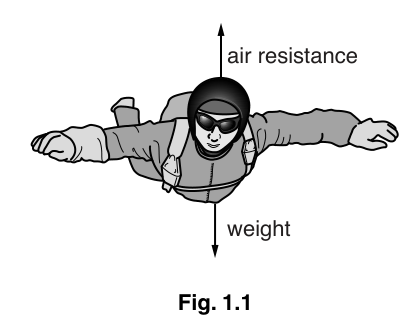
The mass of the sky-diver is and his weight is .
Explain, using ideas about the forces, why his initial downwards acceleration is .
When the parachute opens, the sky-diver experiences an upward acceleration for a short time.
Explain why.
The total force of air resistance on the sky-diver and open parachute changes with their speed, as shown in Fig. 1.2.
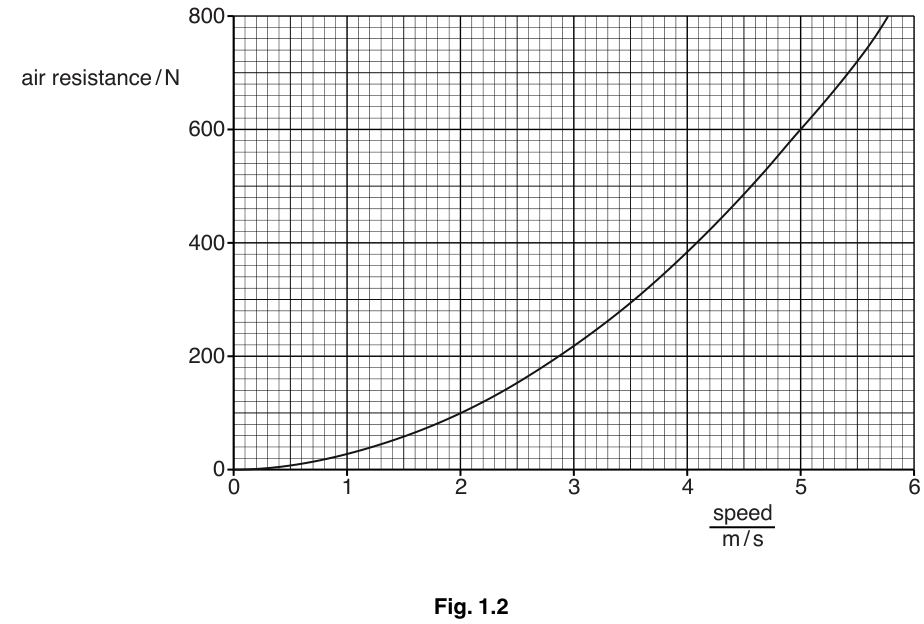
After the parachute opens, the sky-diver slows down to a terminal velocity.
The weight of the sky-diver is .
Using Fig. 1.2, determine the terminal velocity of the sky-diver.
terminal velocity = ______
Calculate the resultant force on the sky-diver when his speed is .
resultant force = ______
The rest of this paper
11 more questions- Q2Forces · Mass, Weight and Density5M
- Q3Mass, Weight and Density · Physical Quantities and Measurement6M
- Q4Thermal Properties of Matter · [Legacy] Temperature and Thermometry4M
- Q5General Properties of Waves4M
- Q6Reflection and Refraction of Light7M
- Q7Magnetic Effect of a Current and the d.c. Motor · General Properties of Waves6M
- Q8Electric Circuits4M
- Q9Uses of an Oscilloscope · Current, Voltage and Resistance · Electric Circuits8M
- Q10Thermal Properties of Matter · Transfer of Thermal Energy15M
- Q11Electromagnetic Induction and Transformers · Practical Electricity15M
- Q12Energy, Work and Power · Kinematics · Forces · Pressure15M