Physics 5054/11 — May/June 2016
Cambridge O-Level · Multiple Choice · answer key with instant marking and worked solutions
Topics Current, Voltage and Resistance · Physical Quantities and Measurement · Forces · Energy, Work and Power · Electric Circuits · Turning Effect of Forces · +17 more
Tap an option under each question to check it — your score builds as you go.
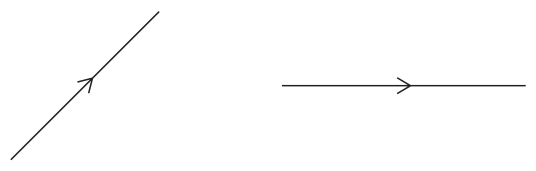
The diagram shows arrows representing two vector quantities.
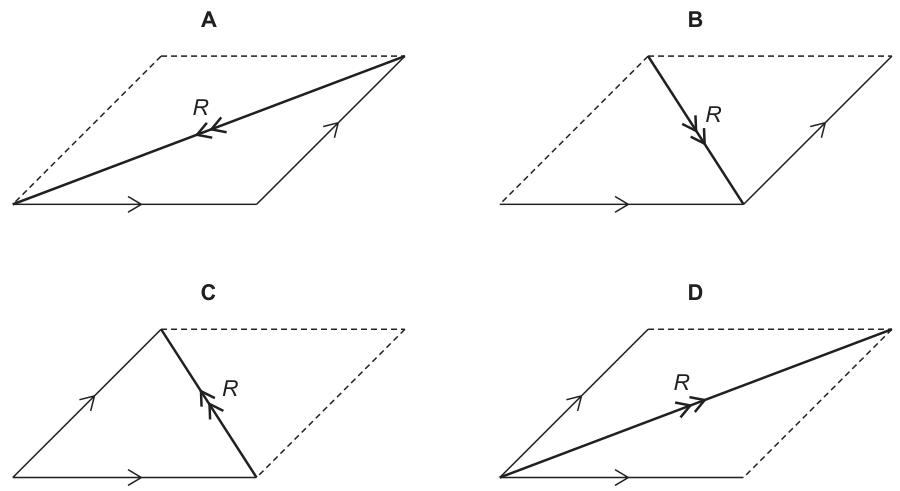
Which diagram shows the resultant of these two vectors?
Options
Answer
D
D
Walkthrough
The question asks for the resultant of two vectors shown in Fig. 1. The parallelogram law states that if two vectors are drawn from a common point (tail-to-tail) as adjacent sides of a parallelogram, the resultant is the diagonal drawn from that common point to the opposite corner.
In Fig. 1, the two vectors are:
- A horizontal vector pointing to the right.
- A diagonal vector pointing upwards and to the right.
Placing them tail-to-tail at the bottom-left, the parallelogram is completed with dashed lines. The resultant must start at the bottom-left (the common origin) and point to the top-right corner.
Looking at the options:
- A: points from top-right to bottom-left (wrong direction).
- B: points downwards (incorrect construction).
- C: points from bottom-right to top-left (this represents the difference between the vectors, not the sum).
- D: points from bottom-left to top-right, correctly representing the sum of the two vectors.
Therefore, D is the correct diagram.
Key Takeaways
- The resultant of two vectors can be found using the parallelogram law.
- The resultant vector is drawn from the common origin (tail) of the two vectors to the opposite corner of the parallelogram.
- The direction of the resultant is crucial; pointing it backwards gives the negative of the resultant.
Common Mistakes
- Choosing a diagram where points in the wrong direction (e.g., from the opposite corner back to the origin, as in A).
- Confusing vector addition (parallelogram/triangle method for sum) with vector subtraction (where would be the third side of the triangle pointing from the tip of one vector to the tip of the other, as in C).
- Not placing the vectors tail-to-tail before drawing the parallelogram.
Things to Be Careful About
- Vectors are quantities with both magnitude and direction. The direction of the resultant arrow must be correct.
- In the triangle method (tip-to-tail), the resultant is drawn from the tail of the first vector to the tip of the second vector. In the parallelogram method (tail-to-tail), it is drawn from the common tail to the opposite corner. Both give the same resultant.
- Ensure the dashed lines are drawn parallel to the original vectors to complete the parallelogram correctly.
The rest of this paper
39 more questions- Q2Physical Quantities and Measurement1M
- Q3Physical Quantities and Measurement1M
- Q4Kinematics1M
- Q5Forces1M
- Q6Forces1M
- Q7Mass, Weight and Density1M
- Q8Forces1M
- Q9Turning Effect of Forces1M
- Q10Turning Effect of Forces1M
- Q11Energy, Work and Power1M
- Q12Energy, Work and Power1M
- Q13Stars and the Universe1M
- Q14Energy, Work and Power1M
- Q15Pressure1M
- Q16Kinetic Particle Model of Matter1M
- Q17Kinetic Particle Model of Matter1M
- Q18Transfer of Thermal Energy1M
- Q19General Properties of Waves1M
- Q20General Properties of Waves1M
- Q21Reflection and Refraction of Light1M
- Q22Lenses and Dispersion1M
- Q23Reflection and Refraction of Light1M
- Q24Electromagnetic Spectrum1M
- Q25Electromagnetic Spectrum1M
- Q26Sound1M
- Q27Simple Magnetism and Magnetic Fields1M
- Q28Static Electricity1M
- Q29Current, Voltage and Resistance1M
- Q30Current, Voltage and Resistance1M
- Q31Electric Circuits1M
- Q32Current, Voltage and Resistance1M
- Q33Practical Electricity1M
- Q34Current, Voltage and Resistance1M
- Q35Magnetic Effect of a Current and the d.c. Motor1M
- Q36Electric Circuits1M
- Q37Electric Circuits1M
- Q38Radioactivity1M
- Q39Radioactivity1M
- Q40The Nuclear Atom1M