Physics 5054/21 — October/November 2015
Cambridge O-Level · Theory · worked solutions for every part, with the mark scheme
Topics Forces · Kinetic Particle Model of Matter · Energy, Work and Power · Kinematics · Transfer of Thermal Energy · Turning Effect of Forces · +12 more
Fig. 1.1 shows an archer firing an arrow at a target during a competition.
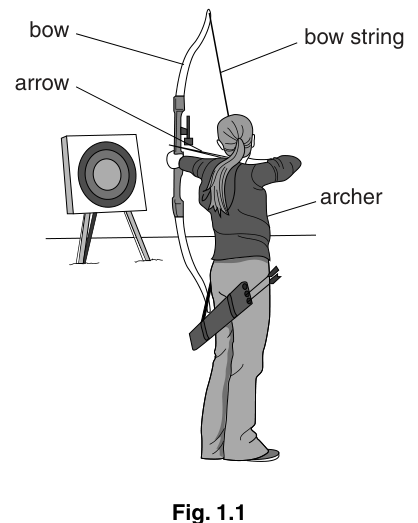
The arrow has a mass of and is initially at rest. The arrow leaves the bow after the bow string is released. When it leaves the bow, the velocity of the arrow is .
Calculate
the average acceleration of the arrow during the ,
average acceleration = ______
Working
Answer
Walkthrough
The question asks for the average acceleration of the arrow. Acceleration is defined as the change in velocity divided by the time taken for that change. The arrow starts from rest, so the initial velocity and the final velocity . The time interval is . Substituting these values into the formula gives . Rounding to two significant figures (matching the precision of the given values like 95 and 0.011), we get .
Key Takeaways
Average acceleration is calculated using . Always ensure the change in velocity is final minus initial, and units are consistent.
Common Mistakes
- Forgetting that the arrow starts from rest and using an incorrect initial velocity.
- Not converting units (though here all are already in standard SI units: m/s and s).
- Rounding too early in the calculation, which can lead to a slightly different force in part (ii).
Things to Be Careful About
- The mark scheme accepts or . Using scientific notation is safer for large numbers.
- Keep the unrounded value () in your calculator for use in part (ii) to avoid rounding errors.
the average force exerted on the arrow during the .
average force = ______
Working
Answer
155 N
155 N
Walkthrough
Newton's second law states that the resultant force acting on an object is equal to its mass multiplied by its acceleration (). The mass of the arrow is given as . Using the average acceleration calculated in part (i), (using the unrounded value for accuracy), we calculate the average force:
Rounding to appropriate significant figures, the average force is . The mark scheme also accepts values between 150 N and 160 N, reflecting the acceptance of slightly rounded acceleration values from part (i).
Key Takeaways
Newton's second law () links force, mass, and acceleration directly. When using a calculated value from a previous part, it is best practice to use the unrounded value to minimise compounding errors.
Common Mistakes
- Using the rounded acceleration value () instead of the more precise value (), leading to a force of , which is still acceptable but shows the importance of keeping extra digits.
- Forgetting to include the unit Newtons (N) in the final answer.
- Confusing mass and weight; here, mass is given directly in kg, so no multiplication by is needed.
Things to Be Careful About
- The mass is given in kg (), which is the correct SI unit, so no conversion is needed.
- The mark scheme explicitly allows a range (150 to 160 N) because students might carry forward different levels of rounding from part (i). Always state your working clearly so the examiner can follow your error carried forward (ecf) if applicable.
In practice, the force exerted on the arrow gradually decreases to zero during firing.
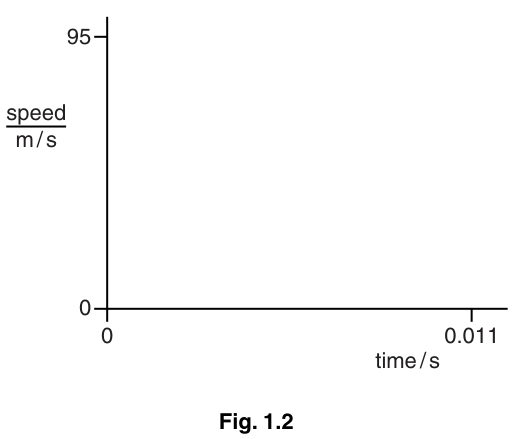
On Fig. 1.2, sketch a possible speed-time graph for the arrow as it is being fired.
Answer
The graph starts at the origin (0, 0). It rises to the point (0.011, 95) with a continuously decreasing gradient (the curve is concave down). At , the speed reaches and the graph becomes a horizontal line.
Speed-time graph: curve from origin to (0.011, 95) with decreasing gradient, then horizontal at 95 m/s
Walkthrough
The question states that the force exerted on the arrow gradually decreases to zero during firing. According to Newton's second law (), if the force decreases, the acceleration must also decrease. On a speed-time graph, the gradient represents acceleration. Therefore, the graph must have a decreasing gradient (it should curve downwards, becoming less steep) as time progresses from to .
At , the arrow leaves the bow. At this instant, the speed is . After leaving the bow, the force from the bow string is zero. Ignoring air resistance for the immediate moment (or assuming the question only asks for the graph as it is being fired and immediately after), the speed remains constant at . Thus, from onwards, the graph is a horizontal line at speed = .
Key Takeaways
- The gradient of a speed-time graph is acceleration.
- A decreasing force means decreasing acceleration, which corresponds to a decreasing gradient on a speed-time graph.
- Once the accelerating force is removed, the object moves at constant speed (horizontal line on the graph), assuming no other forces like drag act immediately to change it.
Common Mistakes
- Drawing a straight line from (0, 0) to (0.011, 95). This represents constant acceleration, which would mean a constant force, contradicting the question.
- Drawing a curve that continues to rise after . The arrow leaves the bow at , so the speed cannot increase beyond due to the bow.
- Forgetting to make the graph horizontal after .
Things to Be Careful About
- Ensure the curve is smooth and clearly shows a decreasing gradient (concave down). Do not draw a straight line with a kink.
- The graph must start exactly at (0, 0) and end the curved section exactly at (0.011, 95).
- The horizontal section should extend to the right edge of the axes to show the constant speed after firing.
The rest of this paper
10 more questions- Q2Transfer of Thermal Energy · Kinetic Particle Model of Matter6M
- Q3Energy, Work and Power6M
- Q4Turning Effect of Forces · Mass, Weight and Density · Forces5M
- Q5Thermal Properties of Matter · Kinetic Particle Model of Matter5M
- Q6Lenses and Dispersion6M
- Q7Sound · General Properties of Waves5M
- Q8Electric Circuits6M
- Q9Physical Quantities and Measurement · Energy, Work and Power · Forces15M
- Q10Simple Magnetism and Magnetic Fields · Electromagnetic Induction and Transformers · Practical Electricity15M
- Q11The Nuclear Atom · Radioactivity15M