Physics 5054/11 — October/November 2015
Cambridge O-Level · Multiple Choice · answer key with instant marking and worked solutions
Topics Electric Circuits · Forces · Current, Voltage and Resistance · Magnetic Effect of a Current and the d.c. Motor · Mass, Weight and Density · Pressure · +18 more
Tap an option under each question to check it — your score builds as you go.
During an experiment to find the density of a stone, the stone is lowered into a measuring cylinder partly filled with water.
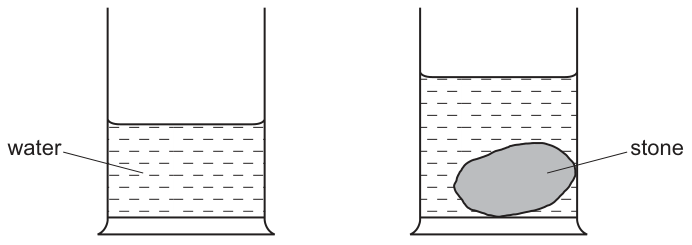
Which statement is correct?
Options
A The difference between the readings gives the density of the stone.
B The difference between the readings gives the volume of the stone.
C The final reading gives the density of the stone.
D The final reading gives the volume of the stone.
Answer
The experiment demonstrates the displacement method for finding the volume of an irregular solid.
- The left cylinder shows the initial volume of water, .
- The right cylinder shows the final volume after the stone is submerged, . This is the volume of the water plus the volume of the stone.
- The stone displaces a volume of water equal to its own volume. Therefore, the volume of the stone is the difference between the final and initial readings: .
- Density is defined as mass divided by volume (). To find the density, the mass of the stone must also be measured (e.g., using a balance). The difference in cylinder readings alone only gives the volume, not the density.
Therefore, the difference between the readings gives the volume of the stone.
Correct Option: B
B
Walkthrough
The question asks to identify what the readings from a measuring cylinder experiment tell us about a stone. The image shows two states: water alone, and water with a submerged stone.
- Initial Reading (): The left cylinder contains only water. The reading on the scale gives the volume of the water.
- Final Reading (): The right cylinder contains the water and the submerged stone. The water level has risen because the stone takes up space. The new reading represents the total volume of (water + stone).
- Calculating Volume: By Archimedes' principle of displacement, the volume of the submerged object is equal to the volume of fluid it displaces. Mathematically, . Thus, the difference between the two readings is the volume of the stone.
- Calculating Density: Density () requires two pieces of information: mass () and volume (), using the formula . The measuring cylinder only provides volume information. Without the mass of the stone (which would be measured on a balance before lowering it in), the density cannot be determined from these readings alone. Therefore, the difference is a volume, not a density.
Key Takeaways
- The displacement method (using a measuring cylinder and water) is used to find the volume of an irregular solid that does not dissolve in water.
- The volume of the object is the difference between the final water level (with object) and the initial water level (without object).
- Density is a derived quantity () and requires both mass and volume measurements; a volume measurement alone is insufficient to state the density.
Common Mistakes
- Confusing volume and density: Students may think the reading directly gives density because the experiment is "to find the density". However, the cylinder only measures volume; mass is the missing variable.
- Misinterpreting the final reading: The final reading () is the total volume of water and stone combined, not the volume of the stone alone. Option D is incorrect for this reason.
- Ignoring the initial reading: Option A suggests the difference is density. This is a common error where students forget that density is a ratio of mass to volume, not just a volume difference.
Things to Be Careful About
- Full submersion: For the displacement method to work correctly, the stone must be fully submerged and not touch the sides/bottom in a way that traps air, though the diagram implies a standard setup.
- Meniscus reading: In a real experiment, readings should be taken at the bottom of the meniscus at eye level to ensure accuracy, though this is a conceptual question.
- Units: Volume is typically in or (). Density would be in or .
The rest of this paper
39 more questions- Q2Physical Quantities and Measurement1M
- Q3Kinematics1M
- Q4Forces1M
- Q5Forces1M
- Q6Forces1M
- Q7Mass, Weight and Density1M
- Q8Turning Effect of Forces1M
- Q9Forces1M
- Q10Forces1M
- Q11Pressure1M
- Q12Pressure1M
- Q13Kinetic Particle Model of Matter1M
- Q14Energy, Work and Power1M
- Q15[Legacy] Temperature and Thermometry1M
- Q16[Legacy] Temperature and Thermometry1M
- Q17Thermal Properties of Matter1M
- Q18Thermal Properties of Matter1M
- Q19General Properties of Waves1M
- Q20Lenses and Dispersion1M
- Q21Reflection and Refraction of Light1M
- Q22Sound1M
- Q23Simple Magnetism and Magnetic Fields1M
- Q24Static Electricity1M
- Q25Static Electricity1M
- Q26Current, Voltage and Resistance1M
- Q27Current, Voltage and Resistance1M
- Q28Electric Circuits1M
- Q29Electric Circuits1M
- Q30Electric Circuits1M
- Q31Practical Electricity1M
- Q32Magnetic Effect of a Current and the d.c. Motor1M
- Q33Magnetic Effect of a Current and the d.c. Motor1M
- Q34Electric Circuits · Current, Voltage and Resistance1M
- Q35Electromagnetic Induction and Transformers1M
- Q36Electric Circuits1M
- Q37[Legacy] Introductory Electronics1M
- Q38Electric Circuits · Magnetic Effect of a Current and the d.c. Motor1M
- Q39Radioactivity1M
- Q40Radioactivity · Stars and the Universe1M