Physics 5054/21 — October/November 2014
Cambridge O-Level · Theory · worked solutions for every part, with the mark scheme
Topics Kinematics · Current, Voltage and Resistance · Electromagnetic Induction and Transformers · Forces · Turning Effect of Forces · Mass, Weight and Density · +11 more
Fig. 1.1 shows a motorcycle during a race.
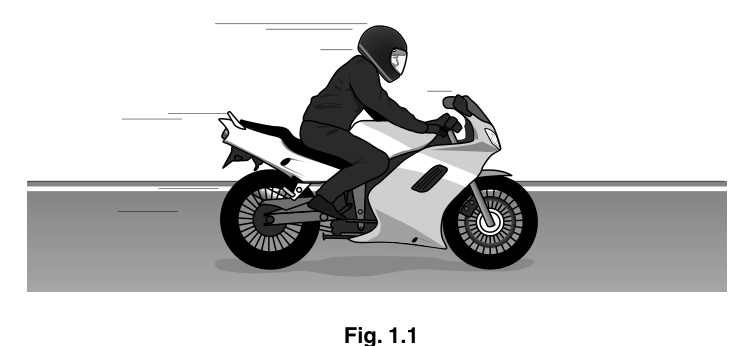
The motorcycle accelerates along a straight section of the track from a speed of to maximum speed.
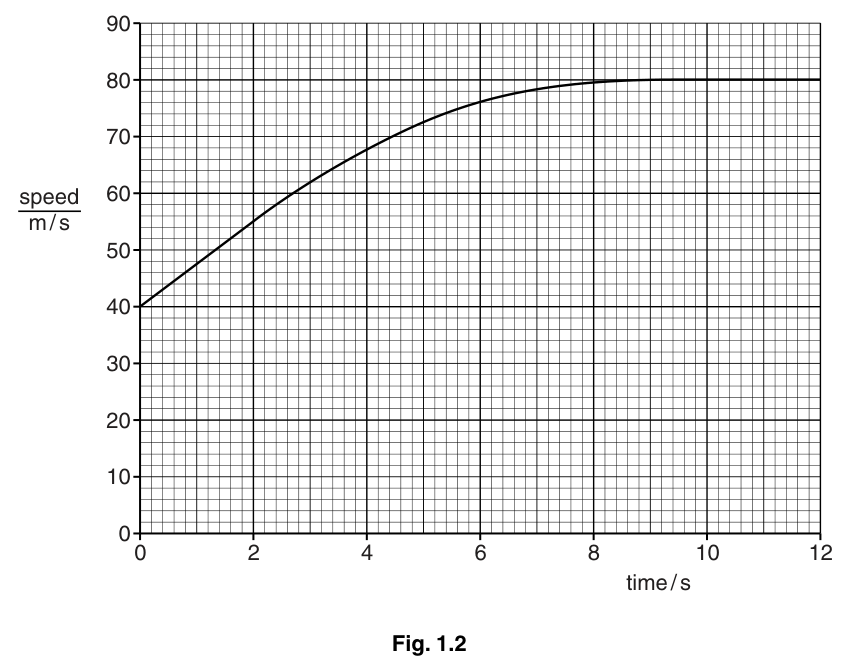
Fig. 1.2 is the speed-time graph for the motorcycle along the straight section of the track.
The mass of the motorcycle is .
For the time 0 to , determine
the acceleration of the motorcycle,
acceleration = ______
Working
From Fig. 1.2, the initial speed at s is . At s, the speed is .
Answer
7.5 m/s^2
Walkthrough
The question asks for the average acceleration over the first seconds. Acceleration is the rate of change of velocity, given by the formula . We read the initial speed from the graph at s, which is . We then read the speed at s, which is . Substituting these values gives .
Key Takeaways
Acceleration is the gradient of a speed-time graph. For a straight section on the graph, it is simply the change in speed divided by the time taken.
Common Mistakes
Reading the wrong value from the graph at s. Forgetting to include the unit in the final answer.
Things to Be Careful About
Ensure you read the graph to the correct precision. The grid has major lines every and minor lines every , so is read accurately at s. Use the exact values given or read from the graph; do not round intermediate values unnecessarily.
the resultant force acting on the motorcycle.
force = ______
Working
Using Newton's second law:
Answer
1350 N
Walkthrough
Newton's second law states that the resultant force acting on an object is equal to its mass multiplied by its acceleration (). The mass of the motorcycle is given as and the acceleration calculated in part (a)(i) is . Multiplying these gives .
Key Takeaways
links the resultant force, mass, and acceleration. The resultant force is what causes the acceleration; it is not the driving force itself.
Common Mistakes
Using the wrong mass, or forgetting to convert units (though here all units are already in SI). Writing the answer without the unit .
Things to Be Careful About
The mark scheme accepts a range like if a slightly different acceleration was read from the graph (e.g. to ). Using the exact value gives exactly , which is safely within the range. Always include the unit .
The driving force acting on the motorcycle remains constant throughout the spent on the straight section of track.
Using Fig. 1.2, describe how the acceleration of the motorcycle changes during this time.
Answer
The acceleration decreases (to zero).
The acceleration decreases (to zero)
Walkthrough
On a speed-time graph, the gradient at any point represents the acceleration. Looking at Fig. 1.2, the curve starts steep and gradually flattens out, becoming horizontal at s. A decreasing gradient means the acceleration is decreasing. When the graph is horizontal, the gradient is zero, so the acceleration is zero.
Key Takeaways
The gradient of a speed-time graph is the acceleration. A straight line means constant acceleration; a curve means changing acceleration; a horizontal line means zero acceleration (constant speed).
Common Mistakes
Saying the speed decreases (it is actually increasing and then staying constant). Saying the acceleration is constant (the gradient is clearly changing).
Things to Be Careful About
Be precise with wording. "Decreases" is the key word. You can also add "to zero" to be fully clear, as the graph eventually becomes horizontal.
Explain, in terms of the forces acting, why the acceleration changes in this way.
Answer
- There is air resistance (or friction / drag) acting on the motorcycle.
- As the speed increases, the air resistance (or friction / drag) increases.
- This means the resultant force (driving force minus air resistance) decreases, so the acceleration decreases. When air resistance equals the driving force, the resultant force is zero and acceleration is zero.
Air resistance increases with speed, so the resultant force decreases to zero and acceleration falls to zero.
Walkthrough
The question states the driving force is constant. However, as the motorcycle moves, it experiences air resistance (drag) and friction. Air resistance increases as the speed of the vehicle increases. The resultant force is the driving force minus the air resistance. As air resistance grows, the resultant force gets smaller. Since , a smaller resultant force means a smaller acceleration. Eventually, the air resistance becomes equal to the driving force. At this point, the resultant force is zero, so the acceleration is zero and the motorcycle travels at a constant maximum speed (terminal velocity).
Key Takeaways
When a constant driving force acts on a vehicle, drag forces increase with speed. This reduces the resultant force and therefore the acceleration, until drag equals the driving force and terminal velocity is reached.
Common Mistakes
Saying "friction increases" without specifying air resistance or drag. Saying the driving force decreases (the question states it is constant). Not linking the forces to the resultant force and then to acceleration.
Things to Be Careful About
The mark scheme specifically looks for three points: (1) mention of air resistance / drag / friction, (2) that this resistance increases with speed (or resultant force decreases), and (3) that the resultant force eventually becomes zero (or resistance equals driving force). Ensure all three links are present in your explanation.
The rest of this paper
10 more questions- Q2Turning Effect of Forces · Mass, Weight and Density5M
- Q3Kinetic Particle Model of Matter5M
- Q4General Properties of Waves8M
- Q5Sound · Kinematics4M
- Q6Static Electricity · Current, Voltage and Resistance5M
- Q7Electromagnetic Induction and Transformers4M
- Q8The Nuclear Atom · Radioactivity6M
- Q9Energy, Work and Power · Electromagnetic Induction and Transformers15M
- Q10Transfer of Thermal Energy · Practical Electricity · Thermal Properties of Matter15M
- Q11Current, Voltage and Resistance · Electric Circuits15M