Physics 5054/11 — October/November 2014
Cambridge O-Level · Multiple Choice · answer key with instant marking and worked solutions
Topics Forces · Electric Circuits · Energy, Work and Power · Magnetic Effect of a Current and the d.c. Motor · General Properties of Waves · Kinematics · +19 more
Tap an option under each question to check it — your score builds as you go.
Forces of and act on an object in the directions shown.
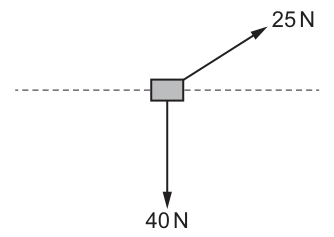
Which arrow shows the direction of the resultant force on the object?
Options
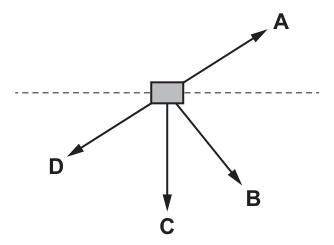
Working
The 25 N force acts at an angle upward and to the right, so it can be resolved into a horizontal component to the right and a vertical component upward. The 40 N force acts vertically downward.
- Horizontal direction: The only horizontal component is to the right, so the resultant must point to the right. This eliminates arrows C and D.
- Vertical direction: The downward force is 40 N. The upward component of the 25 N force must be less than 25 N (since it is at an angle). Therefore, the downward force is larger than the upward force, giving a net vertical component downward. This eliminates arrow A.
Combining a rightward and a downward component, the resultant force points downward and to the right.
Answer
B
B
Walkthrough
To find the direction of the resultant force, we resolve the two forces into horizontal and vertical components.
- The 25 N force points upward and to the right. This means it has a positive horizontal component (to the right) and a positive vertical component (upward).
- The 40 N force points vertically downward. This is a purely vertical component (downward).
- For the horizontal direction, there is no leftward force to cancel the rightward component of the 25 N force. Thus, the resultant must have a net component to the right.
- For the vertical direction, the downward force is 40 N. The upward component of the 25 N force is , which is strictly less than 25 N. Since , the downward force is larger, meaning the net vertical component is downward.
- A resultant with a rightward horizontal component and a downward vertical component must point downward and to the right. Looking at the options, arrow B matches this direction.
Key Takeaways
- Any force at an angle can be resolved into two perpendicular components (usually horizontal and vertical).
- The resultant force's direction is determined by combining the net horizontal and net vertical components.
- When one component is zero and the other is non-zero, the resultant aligns with the non-zero component; when both are non-zero, the resultant points into the quadrant defined by their signs.
Common Mistakes
- Forgetting to resolve the angled force into components and just guessing based on the larger force (40 N is larger, so one might incorrectly choose C, vertically downward).
- Assuming the resultant must point in the direction of the larger force without considering the horizontal component.
- Confusing the direction of the components (e.g., thinking the 25 N force has a leftward component).
Things to Be Careful About
- Always resolve angled forces into horizontal and vertical components before combining them.
- Remember that a component of a force at an angle is always less than the force itself (e.g., the upward component of 25 N is less than 25 N).
- In multiple-choice questions involving resultants, eliminate options that do not match the signs of the net horizontal and vertical components.
The rest of this paper
39 more questions- Q2Physical Quantities and Measurement1M
- Q3General Properties of Waves · Kinematics · Thermal Properties of Matter · Energy, Work and Power1M
- Q4Kinematics1M
- Q5Forces1M
- Q6Mass, Weight and Density1M
- Q7Turning Effect of Forces1M
- Q8Forces1M
- Q9Forces1M
- Q10Pressure1M
- Q11Pressure1M
- Q12Kinetic Particle Model of Matter1M
- Q13Energy, Work and Power1M
- Q14Energy, Work and Power1M
- Q15Transfer of Thermal Energy1M
- Q16[Legacy] Temperature and Thermometry1M
- Q17[Legacy] Temperature and Thermometry1M
- Q18Thermal Properties of Matter1M
- Q19General Properties of Waves1M
- Q20Reflection and Refraction of Light1M
- Q21Reflection and Refraction of Light1M
- Q22Lenses and Dispersion1M
- Q23Lenses and Dispersion1M
- Q24Electromagnetic Spectrum1M
- Q25Sound1M
- Q26Simple Magnetism and Magnetic Fields1M
- Q27Simple Magnetism and Magnetic Fields1M
- Q28Electric Circuits · Current, Voltage and Resistance1M
- Q29Current, Voltage and Resistance · Electric Circuits1M
- Q30Magnetic Effect of a Current and the d.c. Motor1M
- Q31Magnetic Effect of a Current and the d.c. Motor1M
- Q32Electromagnetic Induction and Transformers1M
- Q33[Legacy] Introductory Electronics1M
- Q34Electric Circuits1M
- Q35Electric Circuits1M
- Q36Magnetic Effect of a Current and the d.c. Motor1M
- Q37Radioactivity1M
- Q38Stars and the Universe1M
- Q39Radioactivity1M
- Q40The Nuclear Atom1M