Physics 5054/42 — May/June 2014
Cambridge O-Level · Alternative to Practical · worked solutions for every part, with the mark scheme
Topics Experimental Contexts · Observations and Measurements · Analysis, Conclusions and Evaluation · Use of Techniques, Apparatus and Materials · Planning Experiments and Investigations
A student investigates a floating wooden rod.
The wooden rod is placed in a tall beaker. A rubber band around one end of the rod makes it float vertically, as shown in Fig. 1.1.
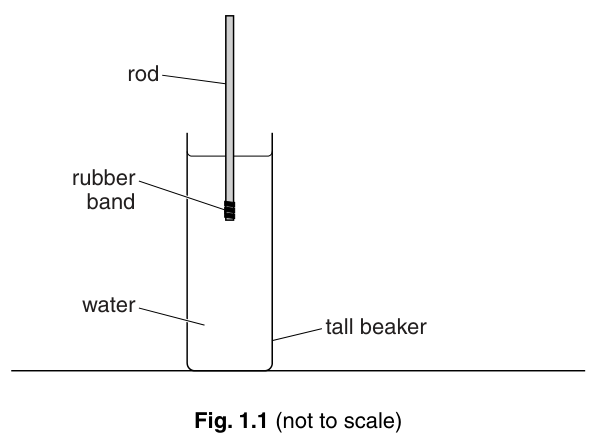
On Fig. 1.1, mark and label the length of the rod above the water.
Explain why it is difficult to measure .
Describe a method of measuring accurately.
The student increases the number of rubber bands on the bottom of the rod and measures for each value of . Fig. 1.2 shows the student's results.
Fig. 1.2
| 1 | 8.5 |
| 3 | 6.8 |
| 5 | 5.1 |
| 7 | 3.5 |
| 9 | 1.6 |
On Fig. 1.3, plot the graph of on the y-axis against on the x-axis. Start your graph from the origin. Draw the line of best fit.
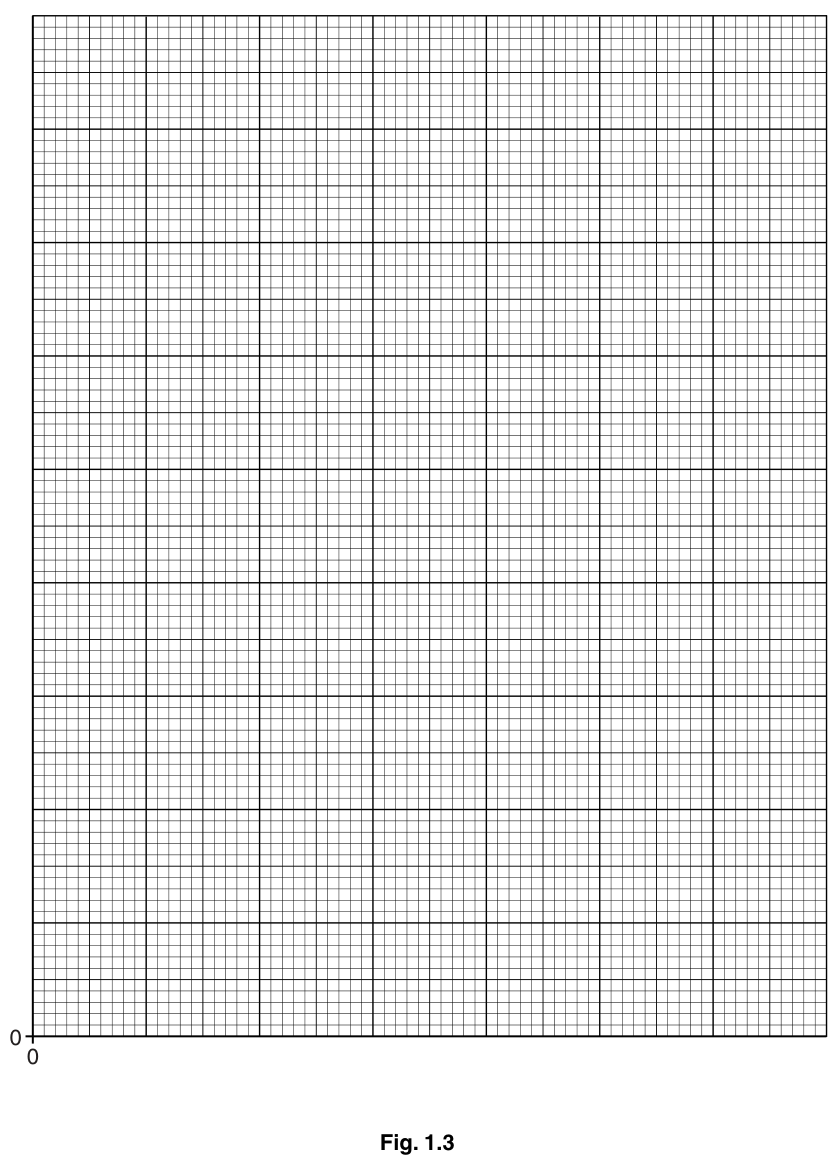
Describe the relationship between and .
Use the graph to estimate the smallest number of bands needed to sink the rod.
number of bands = ______
Explain why it is important to use identical rubber bands.
The rest of this paper
3 more questions- Q2Experimental Contexts6M
- Q3Experimental Contexts · Observations and Measurements · Analysis, Conclusions and Evaluation6M
- Q4Experimental Contexts · Observations and Measurements6M