Physics 5054/32 — May/June 2014
Cambridge O-Level · Practical Test · worked solutions for every part, with the mark scheme
Topics Experimental Contexts · Observations and Measurements · Analysis, Conclusions and Evaluation · Use of Techniques, Apparatus and Materials
In this experiment, you will determine the mass of a half-metre rule.
You are provided with
- a half-metre rule with holes near both ends,
- a length of string attached to the rule at the 49.0 cm mark,
- a pivot in the form of a thin rod or nail,
- a 50 g mass labelled P,
- a pulley supported above the bench,
- a stand and boss to support the pivot,
- a metre rule,
- a set square.
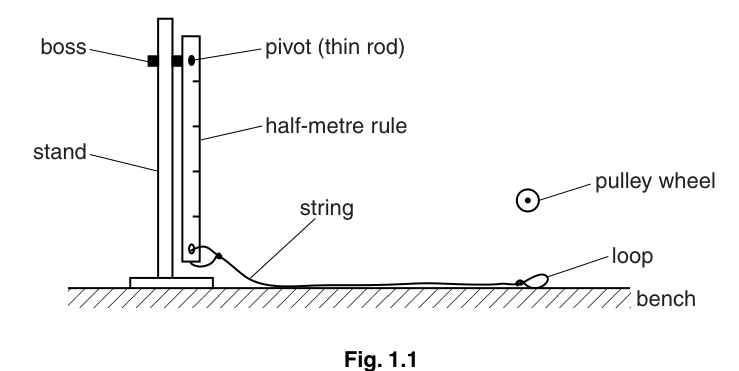
The Supervisor has set up the apparatus as shown in Fig. 1.1.
Set up the apparatus as shown in Fig. 1.2. Adjust the height of the pulley and/or the position of the stands to make the section of the string labelled AB horizontal.
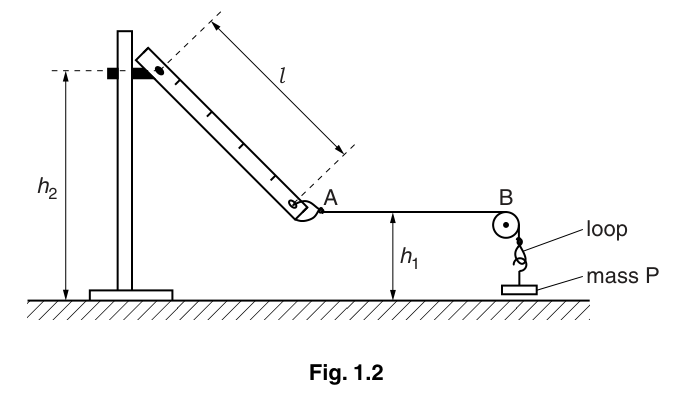
Explain how you made sure that AB was horizontal. You may draw on Fig. 1.2 if you wish.
Answer
Measured the height of the string AB above the bench at two different points using the metre rule and adjusted the height of the pulley or the position of the stands until the two heights were equal. (Alternatively, aligned the string with a known horizontal surface such as a windowsill or the edge of the bench.)
Measured the height of AB above the bench at two points and adjusted until the heights were equal
Walkthrough
The question asks how to ensure the section of string AB is horizontal. In a practical setting, the most reliable way to check horizontal alignment without a spirit level is to measure the vertical distance from a fixed reference level (the bench) to the string at two different points along its length. By adjusting the pulley or the stands until these two measured heights are identical, the candidate confirms that the string is horizontal. A secondary acceptable method is to visually align the string with a known horizontal feature in the laboratory, such as a windowsill or the edge of the bench.
Key Takeaways
When setting up apparatus to require a horizontal or vertical alignment, use direct measurement at multiple points to verify the alignment rather than relying solely on visual estimation.
Common Mistakes
- Saying 'looked at it' or 'used eyes' without specifying a measurable technique.
- Forgetting to mention that the two heights must be equal or the same.
- Not mentioning the use of the metre rule or a reference surface.
Things to Be Careful About
- The mark scheme accepts either measuring at two points or aligning with a horizontal surface. Both are valid.
- Ensure the explanation clearly states the adjustment process (changing pulley height or stand position) to achieve the equal heights.
Measure and record
(i) the height of AB above the bench,
= ______
(ii) the height of the centre of the pivot above the bench,
= ______
(iii) the distance between the centres of the two holes in the rule.
= ______
Answer
(i)
(ii)
(iii)
(Note: These are representative values. In the actual exam, the candidate records their own readings. The mark scheme requires in the range 47.8–48.2 cm, , all measurements to the nearest mm, and units recorded.)
Candidate-dependent readings: , , (to nearest mm with units)
Walkthrough
The candidate must take three measurements using the provided metre rule and the apparatus setup:
- : The vertical height of the horizontal string AB above the bench. Read off the metre rule held vertically.
- : The vertical height of the pivot (the thin rod) above the bench.
- : The distance between the centres of the two holes in the half-metre rule. This is measured along the rule itself.
The metre rule has millimetre graduations, so readings must be taken to the nearest millimetre (e.g., 40.0 cm, not 40 cm). A trailing zero is required to show the precision. The unit 'cm' must be written somewhere in the answer.
Key Takeaways
- Always read instruments to the precision of their smallest division.
- Include a trailing zero when the smallest division is 1 mm (e.g., 48.0 cm, not 48 cm).
- Always record the unit of measurement.
Common Mistakes
- Reading to the nearest cm instead of mm (e.g., writing 40 instead of 40.0).
- Omitting the unit 'cm' entirely.
- Recording , which is physically impossible for this setup (the pivot must be higher than the string).
Things to Be Careful About
- The distance is the distance between the holes, not the length of the rule. It is typically around 48.0 cm for a standard half-metre rule with holes near the ends.
- Ensure as the pivot is above the horizontal string.
Calculate
(i) the distance using ,
= ______
(ii) the distance using
= ______
(iii) the mass of the half-metre rule using
where the mass of P is 50 g.
= ______
Working
(i)
(ii)
(iii)
(Using representative values: , , . Actual answers will vary based on candidate readings, but should be in the range 30–70 g.)
Answer
(i)
(ii)
(iii)
Using representative values: , , (range 30–70 g accepted)
Walkthrough
This part requires the candidate to process their measured values using the provided formulas.
(i) Calculate :
The vertical distance between the pivot and the string is simply the difference in their heights above the bench:
Substitute the measured values (e.g., ).
(ii) Calculate :
The rule, the vertical drop , and the horizontal distance form a right-angled triangle where is the hypotenuse. By the Pythagorean theorem:
Substitute the values (e.g., ).
(iii) Calculate :
The formula given is derived from taking moments about the pivot. The mass of P (50 g) acts at a horizontal distance from the pivot's vertical line, while the rule's mass acts at its centre of gravity (25 cm from the end, but the geometry simplifies to the given formula).
Substitute , , and :
The answer must be given to 2 or 3 significant figures with the unit 'g'.
Key Takeaways
- The Pythagorean theorem is used to find the horizontal distance from the rule length and vertical drop .
- The final mass calculation is a direct substitution into a provided formula.
- Units cancel appropriately in the formula for , so and can remain in cm as long as they are consistent.
Common Mistakes
- Forgetting to square the values before subtracting in the calculation for .
- Dropping units in intermediate steps, leading to confusion.
- Giving the final mass to 1 significant figure or without a unit.
- Calculating as instead of using the Pythagorean theorem.
Things to Be Careful About
- The mark scheme accepts a wide range of final answers for (30–70 g) because the candidate's physical setup will yield different and values. The working must be consistent with the candidate's own measured values.
- Ensure the unit 'g' is included for the final mass.
- Use at least 3 significant figures for intermediate values like to avoid rounding errors in the final answer.
The rest of this paper
3 more questions- Q2Experimental Contexts · Observations and Measurements · Analysis, Conclusions and Evaluation5M
- Q3Experimental Contexts · Observations and Measurements · Use of Techniques, Apparatus and Materials · Analysis, Conclusions and Evaluation5M
- Q4Use of Techniques, Apparatus and Materials · Experimental Contexts · Observations and Measurements · Analysis, Conclusions and Evaluation15M