Physics 5054/31 — May/June 2014
Cambridge O-Level · Practical Test · worked solutions for every part, with the mark scheme
Topics Observations and Measurements · Experimental Contexts · Analysis, Conclusions and Evaluation · Use of Techniques, Apparatus and Materials
In this experiment, you will determine the mass of a half-metre rule.
You are provided with
- a half-metre rule with holes near both ends,
- a length of string attached to the rule at the 49.0 cm mark,
- a pivot in the form of a thin rod or nail,
- a 50 g mass labelled P,
- a pulley supported above the bench,
- a stand and boss to support the pivot,
- a metre rule,
- a set square.
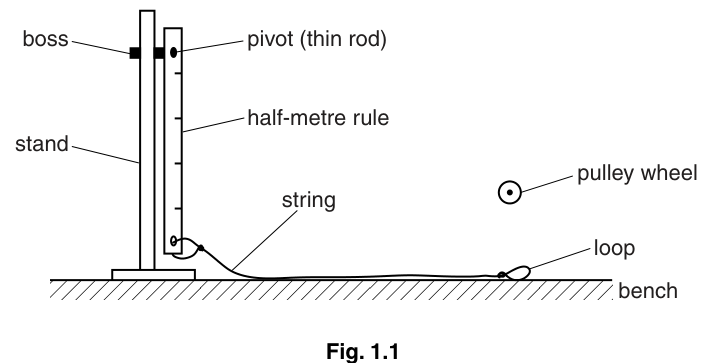
The Supervisor has set up the apparatus as shown in Fig. 1.1.
Set up the apparatus as shown in Fig. 1.2. Adjust the height of the pulley and/or the position of the stands to make the section of the string labelled AB horizontal.
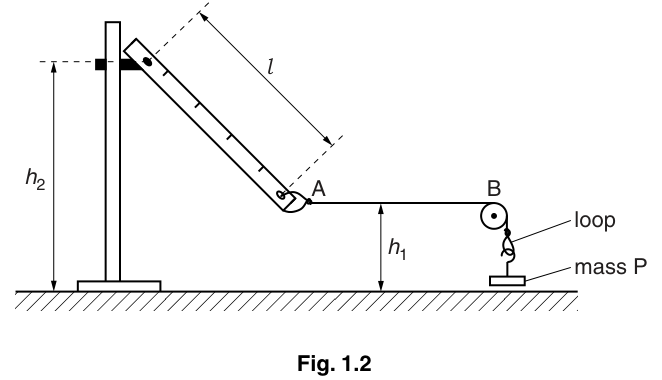
Explain how you made sure that AB was horizontal. You may draw on Fig. 1.2 if you wish.
Measure and record
(i) the height of AB above the bench,
= ______
(ii) the height of the centre of the pivot above the bench,
= ______
(iii) the distance between the centres of the two holes in the rule.
= ______
Calculate
(i) the distance using ,
= ______
(ii) the distance using
= ______
(iii) the mass of the half-metre rule using
where the mass of P is 50 g.
= ______
The rest of this paper
3 more questions- Q2Experimental Contexts · Observations and Measurements · Analysis, Conclusions and Evaluation5M
- Q3Use of Techniques, Apparatus and Materials · Observations and Measurements · Experimental Contexts · Analysis, Conclusions and Evaluation5M
- Q4Experimental Contexts · Observations and Measurements · Analysis, Conclusions and Evaluation15M