Physics 5054/32 — October/November 2013
Cambridge O-Level · Practical Test · worked solutions for every part, with the mark scheme
Topics Observations and Measurements · Experimental Contexts · Analysis, Conclusions and Evaluation · Use of Techniques, Apparatus and Materials
In this experiment, you will determine the weight of a metal stand.
You have been provided with
- a metal stand labelled A,
- a knife-edge to act as a pivot,
- a support for the knife-edge,
- a metre rule,
- a spring,
- a clamp, boss and stand labelled B to support the spring.
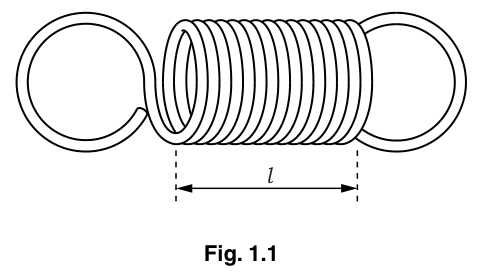
Measure the unstretched length of the coil of the spring as shown in Fig. 1.1.
= ______
Set up the apparatus as shown in Fig. 1.2.
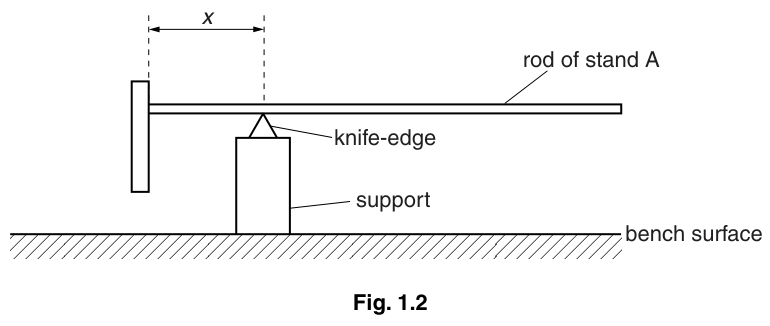
Move the rod of stand A along the knife-edge until the rod balances horizontally, as shown in Fig. 1.2. Measure the distance from the top of the base of stand A to the position of the knife-edge.
= ______
Lift stand A off the knife-edge and move the stand a few centimetres to the right. Replace stand A on the knife-edge. The right-hand end of the stand will move towards the bench.
Slide one of the loops of the spring on to the end of the rod and hold the other loop in the clamp. Adjust the height of the clamp until the rod is horizontal. The arrangement is shown in Fig. 1.3. Make the extension of the spring as large as possible by moving stand A further to the right. Adjust the height of the clamp so that the rod is horizontal and move stand B so that the spring is vertical.
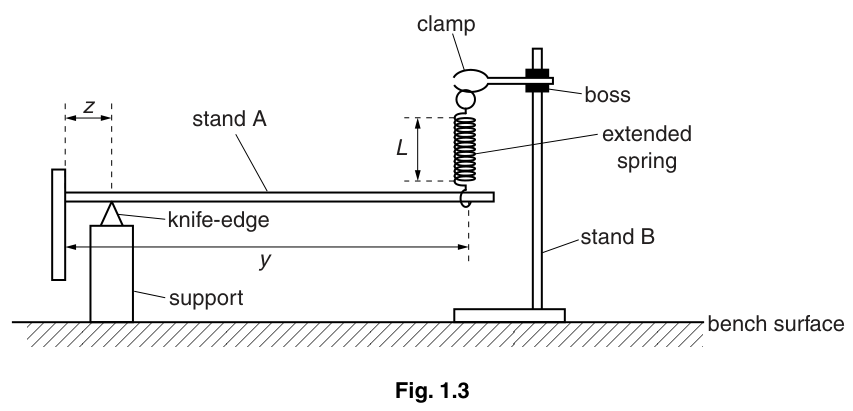
Measure
(i) the distance from the top of the base of stand A to the spring,
= ______
(ii) the distance from the top of the base of stand A to the knife-edge,
= ______
(iii) the stretched length of the coil of the spring.
= ______
Calculate the weight of stand A using the equation
where the constant is and all distances are in .
= ______
The rest of this paper
3 more questions- Q2Experimental Contexts · Observations and Measurements · Analysis, Conclusions and Evaluation5M
- Q3Observations and Measurements · Experimental Contexts · Analysis, Conclusions and Evaluation5M
- Q4Experimental Contexts · Use of Techniques, Apparatus and Materials · Observations and Measurements · Analysis, Conclusions and Evaluation15M