Physics 5054/31 — October/November 2013
Cambridge O-Level · Practical Test · worked solutions for every part, with the mark scheme
Topics Observations and Measurements · Experimental Contexts · Analysis, Conclusions and Evaluation · Use of Techniques, Apparatus and Materials
In this experiment, you will determine the density of the rubber from which a stopper (bung) is made.
You have been provided with
- a rubber stopper,
- a 30 cm ruler.
You also have access to a top-pan balance.
Fig. 1.1 shows the stopper.
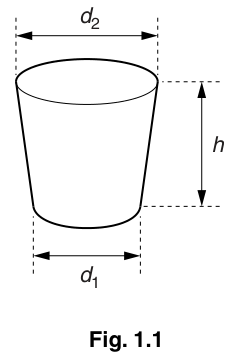
Determine, for the stopper, average values for
(i) the smallest diameter ,
= ______
(ii) the largest diameter ,
= ______
(iii) the height .
= ______
State and explain a precaution that you took to ensure that your values of and were as accurate as possible.
(i) Use the top-pan balance to measure the mass of the stopper.
= ______
(ii) Calculate , where
= ______
(iii) Calculate an approximate value of the density of the rubber using
= ______
The rest of this paper
3 more questions- Q2Experimental Contexts · Observations and Measurements · Analysis, Conclusions and Evaluation5M
- Q3Observations and Measurements · Experimental Contexts · Analysis, Conclusions and Evaluation5M
- Q4Experimental Contexts · Use of Techniques, Apparatus and Materials · Observations and Measurements · Analysis, Conclusions and Evaluation15M