Physics 5054/22 — October/November 2013
Cambridge O-Level · Theory · worked solutions for every part, with the mark scheme
Topics Forces · Energy, Work and Power · Practical Electricity · Physical Quantities and Measurement · Mass, Weight and Density · Pressure · +9 more
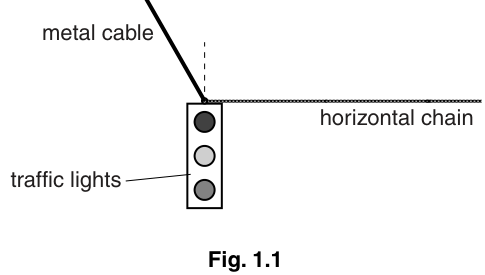
A set of traffic lights hangs from the end of a metal cable. A horizontal chain pulls the traffic lights to the right so that they are above the middle of the road. Fig. 1.1 shows the metal cable inclined to the vertical.
The weight of the traffic lights is 240 N.
Two of the forces on the traffic lights are the tension in the horizontal chain and the weight of the traffic lights.
On Fig. 1.1, mark
an arrow that represents the tension in the horizontal chain,
Answer
An arrow drawn along the horizontal chain pointing to the right, representing the tension.
Arrow on the horizontal chain pointing to the right
Walkthrough
The tension in a chain or cable always acts along the length of the chain, pulling away from the object it is attached to. Since the horizontal chain is pulling the traffic lights to the right, the tension force on the traffic lights acts horizontally to the right. We draw an arrow starting from the connection point on the traffic lights and pointing right along the chain.
Key Takeaways
Tension forces act along the direction of the string, chain or cable, pulling away from the object. Force arrows must be drawn in the correct direction and typically start from the object or the point of application.
Common Mistakes
Drawing the arrow pointing to the left (confusing the force on the chain with the force on the lights). Drawing the arrow vertically. Forgetting the arrowhead.
Things to Be Careful About
The arrow should be drawn on or along the horizontal chain. The direction must be clearly to the right. A simple arrowhead is sufficient; the length does not need to be to scale for this part.
an arrow that represents the weight of the traffic lights.
Answer
A vertical arrow pointing downwards, starting from the traffic lights.
Vertical arrow pointing downwards from the traffic lights
Walkthrough
Weight is the gravitational force exerted by the Earth on an object. It always acts vertically downwards towards the centre of the Earth. We draw an arrow starting from the traffic lights (or touching the rectangle representing them) pointing straight down.
Key Takeaways
Weight is a force that always acts vertically downwards. In free-body diagrams or force diagrams on objects, the weight arrow is drawn from the centre of mass (or the object itself) pointing straight down.
Common Mistakes
Drawing the weight arrow at an angle (following the cable instead of being vertical). Drawing the arrow pointing upwards. Not drawing the arrow touching or starting from the traffic lights.
Things to Be Careful About
The arrow must be strictly vertical. It should start at or touch the traffic lights. The direction is downwards. Do not confuse weight with the tension in the cable, which is inclined.
The tension in the horizontal chain is 140 N. Use a scale diagram to determine the size of the resultant of the weight and the tension in the chain. State the scale used for the diagram.
scale = ______
resultant force = ______
Working
Choose a convenient scale, for example: 1 cm = 20 N.
- Draw a vertical arrow pointing downwards with a length of 12 cm to represent the weight: .
- From the tip of the weight arrow, draw a horizontal arrow pointing to the right with a length of 7 cm to represent the tension: .
- Draw the resultant force as the closing side of the right-angled triangle, from the tail of the weight arrow to the tip of the tension arrow.
- Measure the length of the resultant arrow. It should be approximately 13.9 cm.
- Calculate the resultant force using the scale: .
(Alternatively, using Pythagoras' theorem to check: )
Answer
scale = 1 cm = 20 N
resultant force = 278 N
scale = 1 cm = 20 N, resultant force = 278 N
Walkthrough
The weight (240 N) acts vertically downwards and the tension in the horizontal chain (140 N) acts horizontally to the right. These two forces are perpendicular to each other. To find their resultant using a scale diagram:
- Choose a scale: The scale must have units like cm/N or N/cm. A scale of 1 cm = 20 N is convenient because 240 and 140 are both divisible by 20, giving lengths of 12 cm and 7 cm.
- Draw the vectors: Draw the weight vector as a 12 cm arrow pointing down. Draw the tension vector as a 7 cm arrow pointing right, starting from the tip of the weight vector (head-to-tail method).
- Draw the resultant: The resultant is the vector that closes the triangle, drawn from the tail of the first vector (weight) to the head of the second vector (tension). This is the hypotenuse of the right-angled triangle.
- Measure and calculate: Measure the length of the resultant arrow. Suppose it measures 13.9 cm. Multiply by the scale factor: .
The mark scheme accepts any scale with appropriate units, a correct triangle/rectangle, and a resultant value between 272 N and 283 N. Using Pythagoras' theorem gives , which falls within this range.
Key Takeaways
When two forces are perpendicular, their resultant can be found using a scale diagram (vector addition by drawing) or Pythagoras' theorem. The scale must be stated with units (e.g., 1 cm = 20 N). The resultant is the hypotenuse of the right-angled triangle formed by the two force vectors.
Common Mistakes
- Forgetting to state the scale with units (e.g., writing '1:20' instead of '1 cm = 20 N').
- Drawing the vectors tail-to-tail instead of head-to-tail, or not completing the triangle correctly to find the resultant.
- Measuring the resultant incorrectly or not converting the measured length back to Newtons using the scale.
- Using a scale that makes the diagram too large to fit on the page or too small to measure accurately.
Things to Be Careful About
- The scale must be explicitly stated and have units (cm:N or N:cm).
- The resultant value must be within the acceptable range (272-283 N) depending on the scale and measurement precision.
- When measuring with a ruler, read to the nearest millimetre and estimate one more decimal place if possible.
- Ensure the angle between the weight and tension vectors is exactly 90 degrees in the diagram.
The rest of this paper
10 more questions- Q2Mass, Weight and Density4M
- Q3Pressure · Forces · Energy, Work and Power7M
- Q4Thermal Properties of Matter6M
- Q5General Properties of Waves · Sound6M
- Q6Static Electricity6M
- Q7Practical Electricity5M
- Q8Radioactivity6M
- Q9Turning Effect of Forces · Energy, Work and Power15M
- Q10Kinematics · Forces · Energy, Work and Power15M
- Q11Current, Voltage and Resistance · Practical Electricity · [Legacy] Introductory Electronics15M