Physics 5054/41 — October/November 2012
Cambridge O-Level · Alternative to Practical · worked solutions for every part, with the mark scheme
Topics Experimental Contexts · Use of Techniques, Apparatus and Materials · Analysis, Conclusions and Evaluation · Observations and Measurements
A student investigates the behaviour of a vibrating spring.
The spring is suspended from a horizontal rod. A mass is hung from the spring.
Fig. 1.1a shows the apparatus when it is not vibrating.
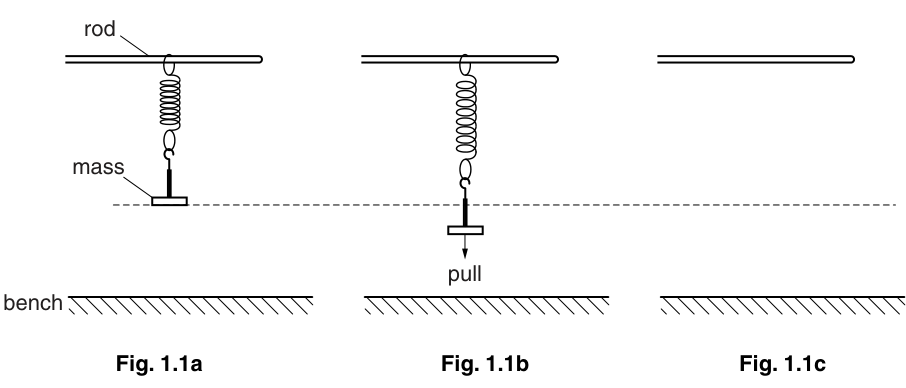
The mass is pulled down a small distance, as shown in Fig. 1.1b.
When released, the mass vibrates up and down about its original position. The student takes readings to obtain the time for one complete vibration.
On Fig. 1.1c,
draw the mass at its highest position after release,
mark the most suitable position for the student's eye when the student times the vibrations.
Explain why the mass is pulled down only a small distance before being released.
A student measures the time for the mass to complete 20 vibrations.
Suggest a reason why the student times twenty vibrations rather than one.
When the weight of the mass is 1.0 N, the student times 20 vibrations. This is repeated four times. The following results are obtained.
8.10 s 8.02 s 7.96 s 8.05 s 7.99 s
Calculate the average value of , the time for one complete vibration.
= ______
The experiment is repeated for a range of values of . The results are recorded in Fig. 1.2.
Fig. 1.2
| 1.0 | |
| 2.0 | 0.573 |
| 3.0 | 0.693 |
| 4.0 | 0.790 |
| 5.0 | 0.882 |
| 6.0 | 0.961 |
On Fig. 1.2, write your value of for . Use a suitable number of significant figures.
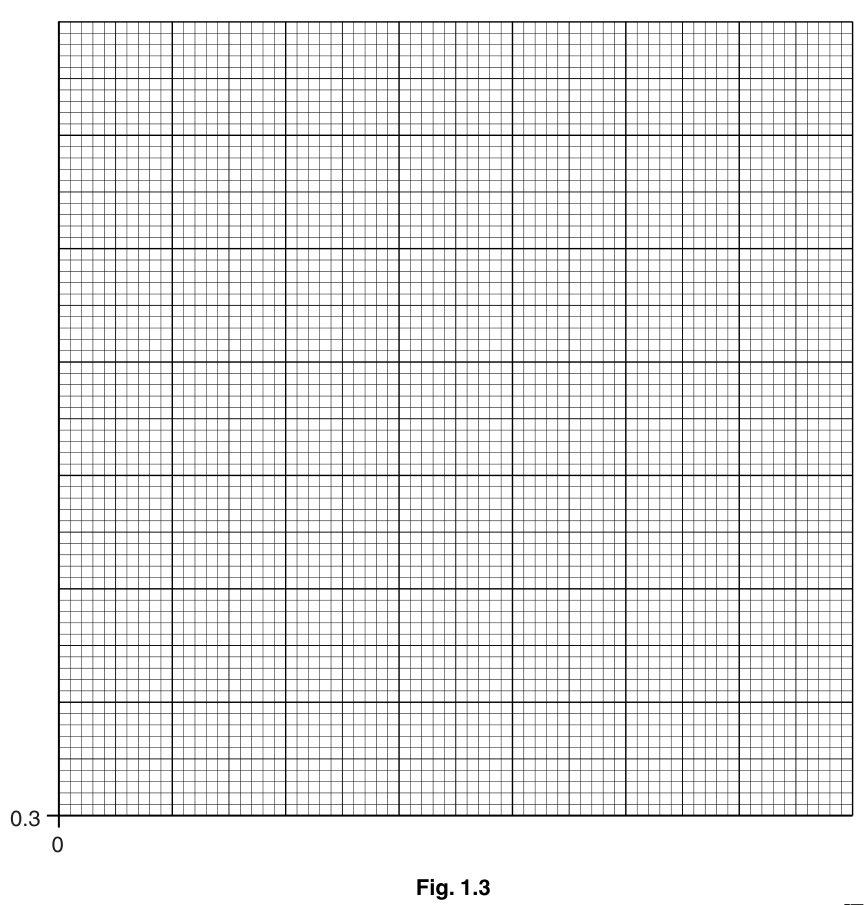
On Fig. 1.3, plot a graph of on the -axis against on the -axis.
Start your axes from and . Draw a smooth curve of best fit.
Explain whether you expect the graph to pass through the origin.
Describe the relationship between and .
The rest of this paper
3 more questions- Q2Experimental Contexts · Use of Techniques, Apparatus and Materials6M
- Q3Experimental Contexts · Use of Techniques, Apparatus and Materials · Analysis, Conclusions and Evaluation6M
- Q4Observations and Measurements · Analysis, Conclusions and Evaluation · Experimental Contexts5M