Physics 5054/32 — October/November 2012
Cambridge O-Level · Practical Test · worked solutions for every part, with the mark scheme
Topics Experimental Contexts · Use of Techniques, Apparatus and Materials · Observations and Measurements · Analysis, Conclusions and Evaluation
In this experiment, you will investigate the motion of a wooden block on a ramp.
You have been provided with
- a wooden block with a face labelled A,
- a length of wood that can be used to form a ramp,
- a stand and boss holding a rod that can be used to support the ramp,
- a metre rule,
- a mass of 200 g,
- a piece of Blu-Tack,
- a set square.
Set up the apparatus as shown in Fig. 1.1.
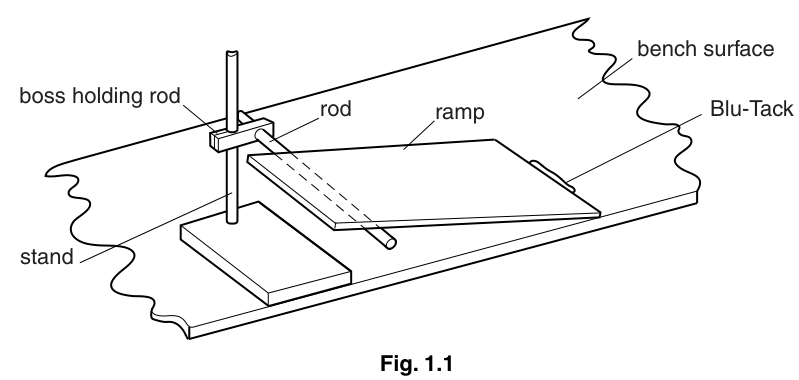
(i) Lower the boss holding the rod so that it is as low as possible on the stand. Use some of the Blu-Tack to prevent the end of the ramp sliding across the bench.
Place the wooden block at the top of the ramp with face A downwards. Raise the boss to slowly raise one end of the ramp. As you slowly raise the ramp, keep giving the wooden block small pushes until it moves down the ramp at approximately constant speed. When this happens tighten the boss to the stand so that the ramp is fixed in position. This is shown Fig. 1.2.
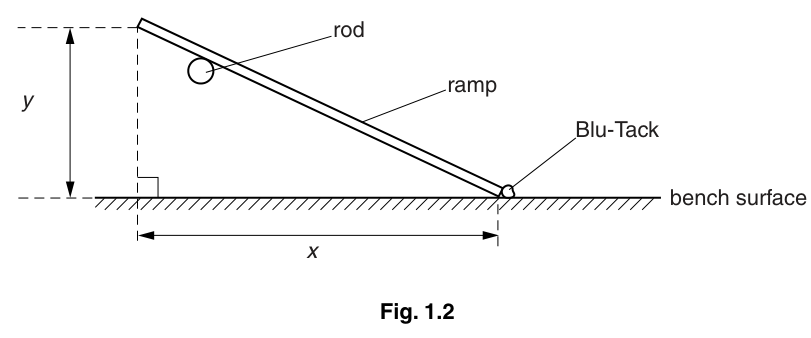
(ii) The distances and are the horizontal and vertical distances between the ends of the ramp, as shown in Fig. 1.2. Measure and .
= ______
= ______
(iii) Calculate the value of .
= ______
Repeat (b) and obtain a new set of values for , and .
= ______
= ______
= ______
Using your two values for , calculate the average value for .
average value for = ______
Use a piece of Blu-Tack to secure the 200 g mass to the wooden block. Repeat (b) and (c) to obtain a second average value for .
average value for = ______
Theory suggests that the value of does not depend on the total mass of the block. Comment on your results, taking account of this suggestion.
The rest of this paper
3 more questions- Q2Experimental Contexts · Observations and Measurements · Analysis, Conclusions and Evaluation5M
- Q3Use of Techniques, Apparatus and Materials · Experimental Contexts5M
- Q4Observations and Measurements · Experimental Contexts · Use of Techniques, Apparatus and Materials · Analysis, Conclusions and Evaluation15M