Physics 5054/32 — May/June 2012
Cambridge O-Level · Practical Test · worked solutions for every part, with the mark scheme
Topics Observations and Measurements · Experimental Contexts · Analysis, Conclusions and Evaluation · Use of Techniques, Apparatus and Materials · Planning Experiments and Investigations
In this experiment, you will determine the mass of a piece of modelling clay.
You have been provided with
- a piece of modelling clay,
- a metre rule,
- a knife-edge,
- a 50 g mass.
Balance the metre rule on the knife-edge. The knife-edge shows the position of the centre of mass of the rule. Record the position of the knife-edge.
position of knife-edge = ______
Answer
50.0 cm
(Note: This is a practical experiment. The candidate records their own reading from the balanced rule. The mark scheme accepts any value in the range 48.0 cm to 52.0 cm, measured to the nearest mm or 0.1 mm. The value 50.0 cm is used here as a representative example.)
50.0 cm (candidate's reading, expected in range 48.0 to 52.0 cm)
Walkthrough
When a uniform (or near-uniform) object like a metre rule is balanced on a knife-edge, the pivot must be directly below its centre of mass. The candidate balances the rule, reads the position on the rule's scale where the knife-edge sits, and records it. The reading must be taken to the precision the scale allows, which is typically the nearest millimetre (0.1 cm), and must include the unit.
Key Takeaways
- The centre of mass of a freely balanced object is directly above the pivot.
- Readings must be taken to the precision of the instrument and always include units.
Common Mistakes
- Forgetting to write the unit (cm).
- Reading to the wrong precision (e.g., only to the nearest cm when the scale has mm divisions).
- Not allowing for a zero error if the rule is not perfectly aligned with the scale's zero (though less likely here, it is a general technique).
Things to Be Careful About
- The mark scheme accepts any value between 48.0 cm and 52.0 cm. A perfectly balanced uniform rule would read exactly 50.0 cm, but slight variations in the rule's mass distribution or the bench surface are expected.
- Ensure the reading is to the nearest 0.1 cm (or 0.1 mm if using a finer scale, though a standard metre rule is to the nearest mm).
Place the modelling clay at one end of the metre rule and adjust the position of the 50 g mass at the other end until the rule balances. The knife-edge must remain below the centre of mass of the rule. The arrangement is shown in Fig. 1.1.
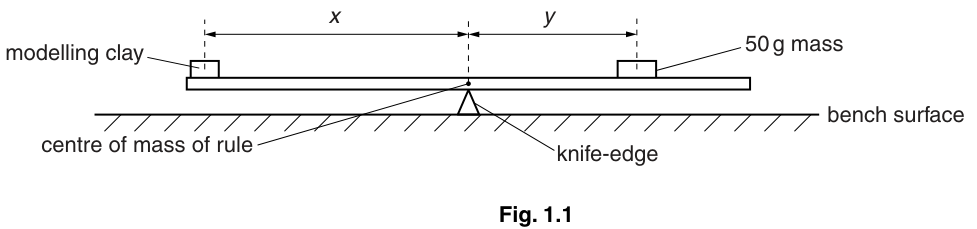
Determine the horizontal distance from the centre of the modelling clay to the knife-edge and the horizontal distance from the knife-edge to the centre of the 50 g mass.
= ______
= ______
Answer
(Note: These are example values that satisfy the constraints and . The candidate should record their own measured values from the experiment, read to the nearest mm or 0.1 mm with units.)
x = 40.0 cm, y = 32.0 cm (example values; candidate's own readings to nearest mm with units)
Walkthrough
The candidate places the clay at one end and the 50 g mass at the other, adjusting the 50 g mass until the rule balances again. The knife-edge remains below the centre of mass of the rule (so the rule's own weight produces no moment). The candidate then measures:
- : the horizontal distance from the centre of the clay to the knife-edge.
- : the horizontal distance from the knife-edge to the centre of the 50 g mass.
These distances must be measured using the metre rule to the nearest millimetre (0.1 cm). The mark scheme requires (the clay is on the left half) and (the 50 g mass must be closer to the pivot than the clay, since it is lighter).
Key Takeaways
- Moments are calculated using perpendicular distances from the pivot to the line of action of the force.
- Measurements must be precise and include units.
Common Mistakes
- Forgetting the units (cm).
- Measuring to the wrong end of the mass or clay (not the centre).
- Recording , which is physically impossible if the 50 g mass is balancing a heavier piece of clay at a greater distance.
Things to Be Careful About
- Always measure to the nearest millimetre and include a trailing zero if the scale allows (e.g., 40.0 cm, not just 40 cm).
- Ensure the distances are measured horizontally from the pivot to the centre of the objects.
Explain how you ensured that your measurement of was taken to the centre of the 50 g mass.
Answer
Take readings from both sides of the 50 g mass and calculate the average.
(Alternatively: Use the slot in the mass to locate the centre, or measure the diameter of the mass and halve it, adding this to the left-hand reading or subtracting from the right-hand reading.)
Take readings from both sides of the mass and average them (or use a slot/diameter to locate the centre).
Walkthrough
The 50 g mass has a physical width, so the distance must be measured to its centre, not its edge. To find the centre accurately:
- Read the position on the metre rule at the left edge of the mass.
- Read the position at the right edge of the mass.
- Calculate the average of these two readings to find the position of the centre.
Other acceptable techniques include using a slot in the mass (if provided) as a direct guide to the centre, or measuring the width of the mass, halving it, and adding/subtracting from an edge reading.
Key Takeaways
- When measuring distances to objects with width, always measure to their centre of mass.
- Averaging readings from both sides reduces the error in locating the centre.
Common Mistakes
- Measuring only to one edge of the mass.
- Saying "estimate the centre" without specifying a method.
Things to Be Careful About
- The mark scheme accepts any valid method to locate the centre: averaging edge readings, using a slot, or using the diameter/width. Ensure the explanation is clear and physically sound.
Calculate the mass of the modelling clay using the relationship
= ______
Working
(Note: Using the example values and . The candidate must substitute their own measured values for and .)
40.0 g (example calculation; candidate's own value based on their measurements of x and y)
Walkthrough
The principle of moments states that for a balanced object, the sum of clockwise moments equals the sum of anticlockwise moments about the pivot. Since the rule is balanced at its centre of mass, its own weight produces no moment. The moments are:
- Anticlockwise moment: (weight of clay distance )
- Clockwise moment: (weight of 50 g mass distance )
Equating them:
Substitute the measured values of and (in cm, since the units cancel) into the formula. The result is the mass in grams.
Using the example values and :
Key Takeaways
- The principle of moments can be used to find an unknown mass when distances and a known mass are measured.
- Units of distance cancel out in the ratio , so the mass is directly in grams if the 50 g mass is used.
Common Mistakes
- Forgetting the unit (g) in the final answer.
- Using incorrect values for and (e.g., swapping them).
- Not giving the answer to 2 or 3 significant figures.
Things to Be Careful About
- The mark scheme accepts values around 40.0 g (specifically ) depending on the candidate's measurements.
- Ensure the final answer is given to 2 or 3 significant figures with the correct unit (g).
- The formula is already provided, so no derivation is needed; just substitute and calculate.
The rest of this paper
3 more questions- Q2Experimental Contexts · Observations and Measurements · Analysis, Conclusions and Evaluation5M
- Q3Observations and Measurements · Experimental Contexts · Analysis, Conclusions and Evaluation5M
- Q4Observations and Measurements · Experimental Contexts · Analysis, Conclusions and Evaluation · Planning Experiments and Investigations15M