Physics 5054/22 — May/June 2012
Cambridge O-Level · Theory · worked solutions for every part, with the mark scheme
Topics Forces · Energy, Work and Power · Current, Voltage and Resistance · Mass, Weight and Density · Transfer of Thermal Energy · Thermal Properties of Matter · +9 more
Fig. 1.1 shows apparatus used to obtain the readings for a graph of force against extension for a spring.
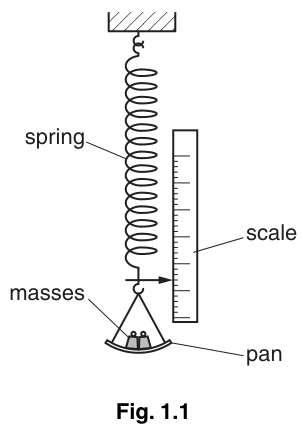
The masses added to the pan produce a force that stretches the spring.
State what is meant by the mass of a body.
Answer
The amount of matter (or substance / material) in a body.
amount of matter
Walkthrough
Mass is defined as the amount of matter or substance contained in an object. It is a scalar quantity measured in kilograms () or grams ().
Key Takeaways
- Mass measures the quantity of matter in an object and is also a property that resists change in motion (inertia).
- Mass remains the same regardless of gravitational field strength, unlike weight.
Common Mistakes
- Confusing mass with weight (the gravitational force acting on an object, ).
- Defining mass as 'how heavy an object is'.
Things to Be Careful About
- Ensure the definition refers to 'matter', 'substance', or 'material'.
Describe how the scale is used to find the extension of the spring.
Answer
Read the position of the pointer on the scale with no load (or the pan only), then read the new position on the scale after adding masses, and calculate the difference between the two readings.
Subtract the initial scale reading (unstretched) from the new scale reading (stretched)
Walkthrough
Extension is the increase in the length of the spring when a load is applied:
To find this with a scale, the candidate must record the initial pointer reading on the scale before masses are added (or with the empty pan), record the new pointer reading after adding masses, and subtract the initial reading from the new reading.
Key Takeaways
- Extension is an increase in length (a difference between two scale readings), not simply the total length of the spring.
Common Mistakes
- Stating that the pointer reading itself is the extension, rather than finding the difference between two readings.
Things to Be Careful About
- Make sure to explicitly mention subtracting or taking the difference between readings.
Fig. 1.2 shows the force-extension graphs for two different springs.
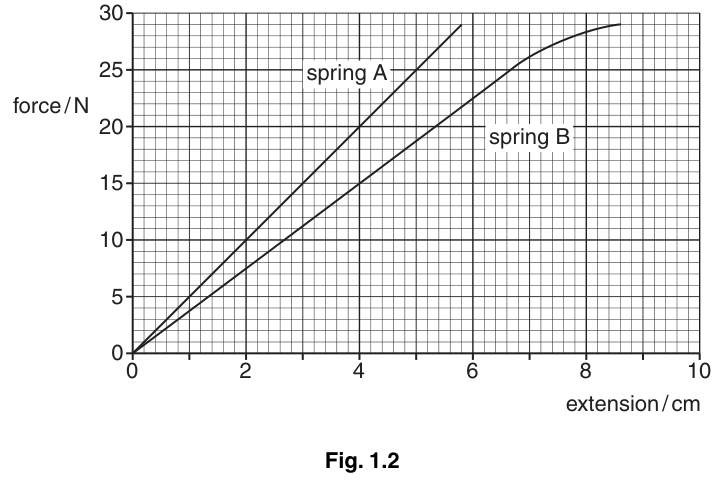
A student states that spring B is easier to stretch than spring A.
Use values from Fig. 1.2 to explain what the student means.
Answer
For a given force (e.g. ), spring B has a larger extension () than spring A ().
(Alternatively: to produce an extension of , spring B requires a smaller force of whereas spring A requires .)
For the same force, spring B extends more than spring A (e.g. at 15 N, extension of B = 4.0 cm and extension of A = 3.0 cm)
Walkthrough
'Easier to stretch' means that a spring requires less force to produce the same extension, or that a given force produces a greater extension.
To use values from Fig. 1.2:
- Choose a fixed force on the y-axis, for example :
- Spring A extension
- Spring B extension
- Since spring B stretches further for the same force, it is easier to stretch.
- Alternatively, choose a fixed extension on the x-axis, for example :
- Force on spring A
- Force on spring B
- Since spring B requires less force for the same extension, it is easier to stretch.
Key Takeaways
- On a force-extension graph ( vs ), a line with a smaller gradient represents a spring with a smaller spring constant , meaning it is easier to stretch.
Common Mistakes
- Giving a qualitative explanation without quoting numerical values from the graph.
Things to Be Careful About
- Include units with the read-off values ( and ).
When a force of 25 N is applied, spring B reaches its limit of proportionality but spring A does not. Explain how Fig. 1.2 shows this.
Answer
At , the graph for spring A is a straight line through the origin (force is directly proportional to extension), whereas the graph for spring B is curved / no longer straight.
Graph for spring A is still a straight line, but graph for spring B is curved
Walkthrough
Hooke's Law states that force is directly proportional to extension (), which appears as a straight line passing through the origin on a force-extension graph.
The limit of proportionality is the point beyond which force is no longer proportional to extension, meaning the graph ceases to be a straight line and begins to curve.
- At , the line for spring A remains completely straight, showing it has not exceeded its limit of proportionality.
- For spring B, the line starts curving around , so at it is clearly curved, showing it has passed its limit of proportionality.
Key Takeaways
- A straight line through the origin on a force-extension graph indicates that Hooke's Law is obeyed.
- Curvature in a force-extension graph indicates that the limit of proportionality has been passed.
Common Mistakes
- Confusing the limit of proportionality with the elastic limit (though they often occur at similar points, proportionality is specifically shown by the line no longer being straight).
Things to Be Careful About
- Refer clearly to both springs: A is straight / linear, and B is curved / non-linear.
The same force is applied to each spring.
Using Fig. 1.2, determine the force that produces an extension of spring B that is 1.0 cm greater than the extension of spring A.
force = ______
Working
We look for a horizontal line (same force ) where the extension of spring B minus the extension of spring A equals :
- At :
Answer
15 N
Walkthrough
The question specifies that the same force is applied to each spring. On the graph, 'the same force' corresponds to a horizontal line across at some value of on the vertical axis.
We need to find the force value where the horizontal distance between the two lines is exactly :
- At : , (difference )
- At : , (difference )
- At : , (difference )
Thus, the force is .
Key Takeaways
- Comparing two curves at the same y-value means checking the horizontal distance between them at that value.
Common Mistakes
- Reading vertical separation (difference in force at the same extension) instead of horizontal separation (difference in extension at the same force).
Things to Be Careful About
- Ensure the unit () is stated with the answer.
The rest of this paper
9 more questions- Q2Forces · Energy, Work and Power10M
- Q3Transfer of Thermal Energy · Energy, Work and Power7M
- Q4Thermal Properties of Matter · Kinetic Particle Model of Matter7M
- Q5Reflection and Refraction of Light6M
- Q6General Properties of Waves6M
- Q7Static Electricity · Current, Voltage and Resistance4M
- Q8Electric Circuits · Current, Voltage and Resistance15M
- Q9Magnetic Effect of a Current and the d.c. Motor · Electromagnetic Induction and Transformers · Practical Electricity15M
- Q10Radioactivity15M