Physics 5054/42 — October/November 2011
Cambridge O-Level · Alternative to Practical · worked solutions for every part, with the mark scheme
Topics Experimental Contexts · Use of Techniques, Apparatus and Materials · Analysis, Conclusions and Evaluation
A student measures the focal length of a converging lens.
The student sets up the apparatus as shown in Fig. 1.1.
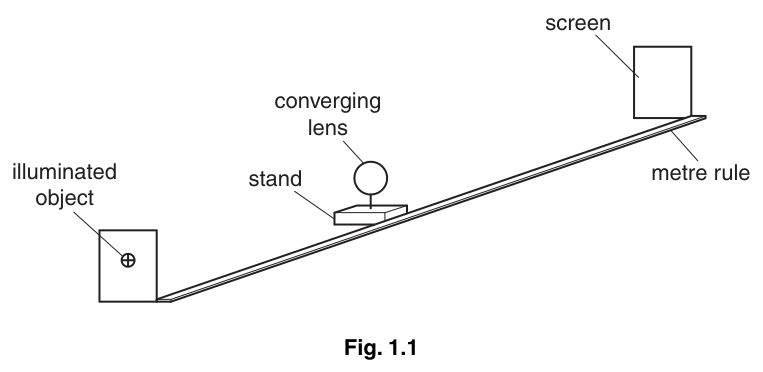
The distance between the illuminated object and the screen is fixed initially at .
The image on the screen is blurred. Describe the adjustment that the student makes to obtain a sharply focused image, without changing .
______
The focused image is at the top of the screen. Describe one adjustment that the student makes to move the focused image to the centre of the screen.
______
The lens is in a holder on a stand. The position of the centre of the lens is to be marked accurately on the stand. Describe how the student does this.
______
The student finds that, for the same value of , there are two positions of the lens that produce a focused image on the screen. These positions are at distances and from the illuminated object, as shown in Fig. 1.2.
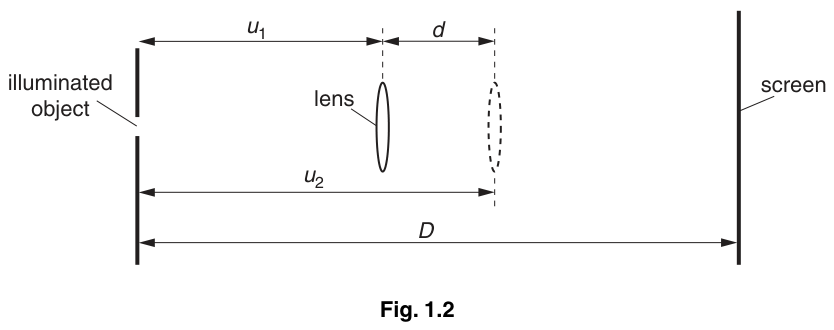
The two distances and are measured for .
The values obtained are and .
Calculate the distance between the two lens positions.
= ______
Theory shows that the focal length of the lens is given by the relationship
Calculate .
= ______
The student repeats the experiment for different values of and calculates values of each time.
Fig. 1.3 shows the student's results.
Fig. 1.3
| 1.10 | 1.08 |
| 1.20 | 1.18 |
| 1.30 | 1.29 |
| 1.40 | 1.38 |
| 1.50 | 1.47 |
On Fig. 1.4, plot the graph of on the y-axis against on the x-axis.
Start your graph from and .
Draw the straight line of best fit.
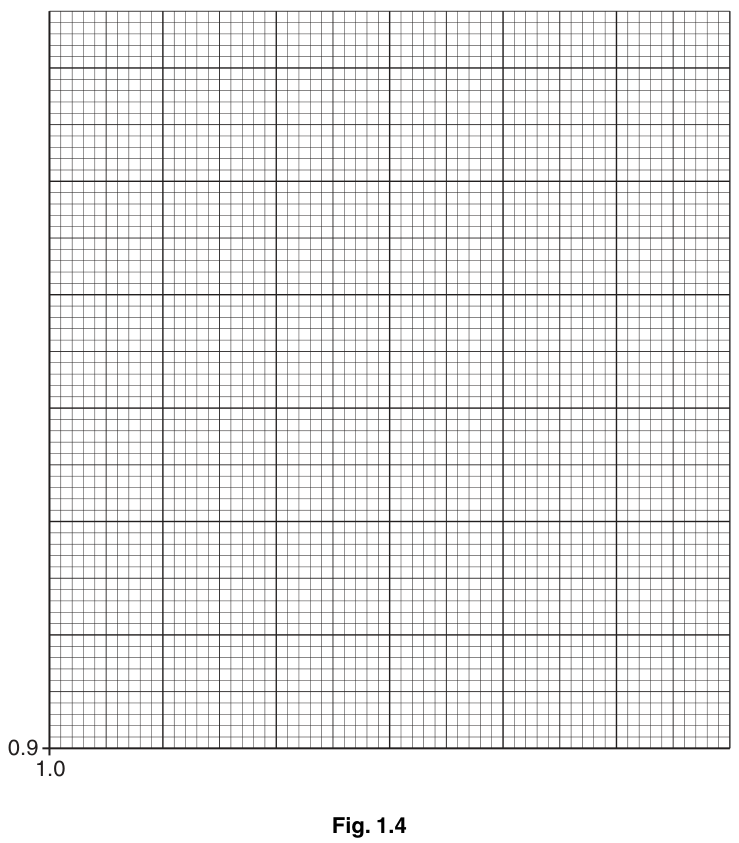
Determine the gradient of the line of best fit. Show your working clearly.
gradient = ______
Calculate using the relationship
= ______
Explain why it is better to determine using the method in (c) rather than the method in (b).
______
The rest of this paper
3 more questions- Q2Use of Techniques, Apparatus and Materials · Experimental Contexts6M
- Q3Experimental Contexts6M
- Q4Use of Techniques, Apparatus and Materials · Analysis, Conclusions and Evaluation · Experimental Contexts5M